
Putting Children First: A Parent's Guide to Human-Centred AI in Canadian ECE
The true irony of "putting children first" in ECE isn't protecting children from AI, but ensuring they aren't passive data points. This involves designing AI tools that prioritize a child's holistic development, well-being, and safety in the unique Canadian context.

What Does 'Putting Children First' Truly Mean in the Age of AI?
What Does 'Putting Children First' Truly Mean in the Age of AI?
The true irony of “putting children first” in early childhood education (ECE) in the age of AI isn't about protecting them *from* technology, but rather ensuring they aren't merely passive data points *for* it. This means intentionally designing and implementing AI tools that prioritize a child's holistic development, well-being, and safety above all else, especially within the unique Canadian context where provincial ECE regulations vary significantly, as seen between Ontario's "How Does Learning Happen?" and British Columbia's "Early Learning Framework."
For parents, this translates to clear communication from ECE providers about how AI tools are used. Imagine a daycare in Saskatoon using an AI-assisted observation tool like YochienAI. “Putting children first” here means that tool helps educators spend less time on paperwork and more time engaging directly with toddlers, observing their unique play patterns, and sharing those insights transparently with parents. It's about augmenting, not replacing, the vital human connection.
This approach directly counters the fear that AI will diminish the role of educators. Instead, it ensures technology is developmentally appropriate for ages 0-6, aligning with Canadian Paediatric Society guidelines on screen time. It safeguards children's privacy and agency, ensuring they are active participants in their learning journey, not subjects of automated monitoring. This commitment resonates with the Canadian government's responsible AI development frameworks, ensuring ethical considerations are paramount in every ECE application.
Understanding Human-Centred AI: More Than Just Technology
Understanding Human-Centred AI: More Than Just Technology
The term "human-centred AI" (HCAI) often sounds like jargon, but its core idea for early childhood education is surprisingly straightforward: it means AI tools are built to serve the unique needs of young children, their families, and educators, rather than forcing humans to adapt to technology. This is not about robots replacing teachers, but about thoughtful design. For example, a tool like YochienAI, developed in Ontario, uses AI to assist educators with observations, freeing them to spend more direct time interacting with children, rather than on administrative tasks. It's about enhancing human connection, not diminishing it.
Unlike purely data-driven AI systems that might prioritize efficiency above all else, HCAI in Canadian ECE places ethical considerations, transparency, and accountability at its forefront. This ensures that sensitive information about a three-year-old in a Vancouver daycare is handled with the utmost care, adhering to provincial privacy regulations. It means parents can ask specific questions about how their child's data is used and expect clear answers. The Canadian government's Statement of Principles on AI (2018) provides a foundational commitment to responsible AI development, influencing how these tools are designed for our youngest learners.
A truly human-centred approach actively involves educators and parents in the co-design and evaluation process. Imagine a focus group in Montreal where early childhood educators provide direct feedback on an AI-powered language learning app, ensuring it aligns with developmental stages and pedagogical principles. This collaborative model addresses the historical gap where technology is often developed in isolation from its end-users. This commitment to collaboration is key for schools and parents who want to ensure any new technology genuinely supports their child's growth.
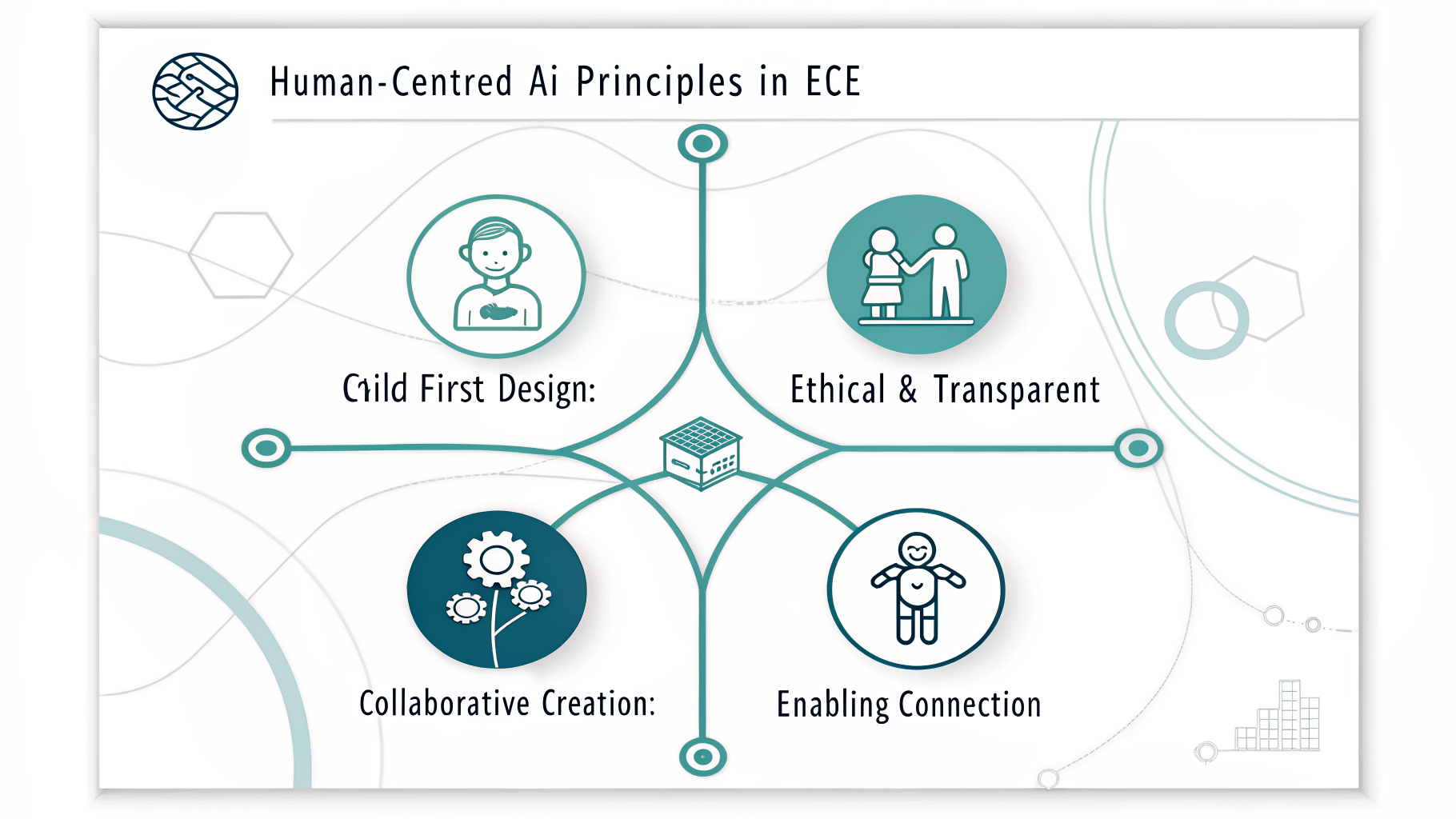
Ultimately, human-centred AI aims to personalize learning experiences and support inclusive practices.
Why a Human-Centred Approach is Essential for Canadian ECE
Despite the widespread enthusiasm for artificial intelligence, the true challenge in early childhood education isn't merely adopting AI, but ensuring it enhances, rather than diminishes, the human elements vital for child development. A human-centred approach in Canadian ECE recognizes that technology must serve the child's holistic growth, prioritizing social, emotional, and creative development above all else.
Why HCAI is a Must for ECE
- Safeguards Development: Human-centred AI (HCAI) explicitly designs tools to foster social skills, creativity, and critical thinking, directly addressing parental worries about screen time or reduced interaction. For instance, an AI-powered story generator for a pre-kindergarten class in Manitoba might suggest diverse narrative elements, prompting children to collaborate and imagine new endings, rather than passively consuming content.
- Embraces Diversity: Given Canada’s rich cultural tapestry, HCAI ensures AI solutions are inclusive and culturally responsive. A language learning app for a daycare in Montreal, built with HCAI principles, would offer content in both English and French, incorporating Indigenous stories and diverse cultural celebrations, avoiding a generic global approach.
- Supports Educators: Instead of replacing teachers, HCAI provides tools that reduce administrative burdens. An AI assistant used by a kindergarten teacher in Calgary could automate daily observation notes, freeing up 20-30 minutes per day for direct, personalized interactions with children during free play or small group activities.
- Builds Trust: By focusing on genuine benefits and transparent operation, HCAI helps address skepticism about AI's role in early learning. When a parent understands that an AI tool like YochienAI is designed in Ontario with strict privacy protocols and focuses on supporting educators' insights, their confidence in its use increases significantly.
Risks of Non-Human-Centred AI
- Developmental Backlash: AI designed without HCAI principles could inadvertently promote passive consumption or reduce critical face-to-face interaction, potentially hindering a child's social-emotional development, as highlighted by Canadian Paediatric Society guidelines on screen time.
- Cultural Irrelevance: Generic AI solutions from the global EdTech market often fail to resonate with Canada's unique cultural and linguistic diversity, potentially alienating children from non-dominant backgrounds and undermining efforts towards equitable education.
- Educator Overload: Poorly designed AI might add complexity, forcing educators to spend more time troubleshooting technology than engaging with children, directly contradicting the goal of reducing administrative burden.
Key Principles of Human-Centred AI for Young Learners

Key Principles of Human-Centred AI for Young Learners
The true power of AI in early childhood education doesn't come from its complexity, but from its intentional simplicity and alignment with foundational pedagogical principles. While many fear AI will complicate ECE, a human-centred approach actually streamlines processes by grounding technology in the needs of children, educators, and parents. This means every AI tool, from a developmental observation assistant to a communication platform, must first meet strict criteria for safety, benefit, and developmental suitability. For parents, understanding these principles is crucial for evaluating any AI tool used in a daycare or preschool. It means asking questions beyond just "what does it do?" to "how does it protect my child?" and "how does it help their educator?". For instance, an AI tool used in a pre-kindergarten program in British Columbia to identify early literacy patterns must adhere to the Canadian Paediatric Society's guidelines on screen time, ensuring any digital interaction is brief, purposeful, and interactive. It's not about replacing story time, but perhaps suggesting new books based on a child's demonstrated interests. These principles are the bedrock for "Putting Children First: Why Human-Centred AI is Key for Canadian Early Childhood Education." They ensure that as technology evolves, the focus remains firmly on fostering healthy development, protecting privacy, and strengthening the human connections vital to early learning. Understanding these foundations helps parents advocate for responsible AI integration and ensures that their child's early learning journey benefits from innovation without compromise.How Human-Centred AI Can Enhance (Not Replace) Human Connection
Enhancing Human Connection, Not Replacing It
The deepest fear parents often voice about artificial intelligence in early childhood education (ECE) is that screens and algorithms will supplant the irreplaceable human touch of a caring educator. However, human-centred AI, particularly in the Canadian context, operates with an inverse purpose: it aims to amplify and deepen human connection, not diminish it. It functions as a sophisticated assistant, freeing up educators to focus more intensely on individual children and family relationships.
Consider AI-assisted observation tools, like YochienAI, developed right here in Ontario. This specific AI program helps educators "see" every child more clearly. Instead of an educator manually tracking every developmental milestone for 15 preschoolers, the AI identifies patterns and provides objective insights into a child's engagement, interactions, or areas where they might need more support. This insight doesn't replace the educator's judgment; it augments it, giving them back precious minutes to engage in meaningful one-on-one play, read a story, or offer comfort.
Automating routine administrative tasks is another powerful benefit. Educators in mid-sized urban daycares in British Columbia spend considerable time on record-keeping, attendance logs, and progress tracking. AI streamlines these processes, allowing staff to dedicate more energy to direct engagement, creative lesson planning, and building genuine relationships with children and their families. This efficiency directly translates into more present, less stressed educators.
Furthermore, human-centred AI facilitates better communication between educators and parents. Tools can securely share insights into a child's day, highlight developmental milestones, or suggest at-home activities aligned with classroom learning. This strengthens the home-school partnership, ensuring parents in provinces like Quebec feel more informed and involved in their child's early learning journey, fostering a cohesive support system. Ethical AI in Canadian ECE acts as a powerful assistant, enhancing the quality and depth of human connection and care, reinforcing the core principle of Putting Children First: Why Human-Centred AI is Key for Canadian Early Childhood Education.
Addressing Parent and Educator Concerns: Safety, Privacy, and Development

Addressing Parent and Educator Concerns: Safety, Privacy, and Development
Many parents and educators initially worry that AI in early childhood education means more screen time, less human interaction, or compromised data. The surprising truth is that human-centred AI (HCAI) directly counters these fears by embedding safeguards for safety, privacy, and healthy development from its core design. It shifts the focus from technology for technology's sake to tools that amplify the educator's role and protect the child's well-being.
| Concern | Traditional AI Approaches | Human-Centred AI (HCAI) in ECE |
|---|---|---|
| Screen Time & Development | Often involves passive consumption; risks exceeding Canadian Paediatric Society guidelines for children under five. | Designed for brief, interactive, purposeful use (e.g., a 5-minute activity). Focuses on active engagement that enhances, not replaces, hands-on play. |
| Data Privacy & Security | Generic data collection; potential for insecure storage or misuse of sensitive child information. | Implements 'Privacy by Design' from the outset, adhering to Canadian regulations like PIPEDA. Data is anonymized where possible, encrypted, and access is strictly controlled. Read more about our privacy policy. |
| Social Skills & Creativity | Risk of isolated interaction with devices; may reduce opportunities for peer play and imaginative exploration. | Prioritizes tools that foster collaboration, problem-solving, and imaginative group activities, such as AI-assisted observation that frees educators to engage more deeply with children. |
| Educator Role & Judgment | Can feel like a replacement for human insight; requires significant training to operate. | Helps educators by automating administrative tasks (like record-keeping) to free up time for direct child interaction and professional development. Tools like YochienAI provide insights, not directives. |
This commitment means parents can confidently ask their child's ECE provider critical questions: "How does this AI tool protect my child's data?" or "How does it support, not replace, human interaction and hands-on learning?" These questions help ensure that the technology truly embodies the spirit of "Putting Children First: Why Human-Centred AI is Key for Canadian Early Childhood Education."
Navigating the Canadian Context: Regulations and Best Practices
Navigating the Canadian Context: Regulations and Best Practices
While AI offers exciting possibilities, its integration into Canadian early childhood education isn't a free-for-all; it's anchored by a complex patchwork of provincial regulations and national ethical guidelines. This unique regulatory landscape means a tool deemed appropriate in Quebec, with its distinct ECE model, might face different compliance hurdles in Alberta, where childcare licensing and curriculum frameworks vary significantly. For parents, understanding this ensures that any AI tool used with their child aligns with established Canadian standards for safety, privacy, and developmental appropriateness.
The Canadian government has laid a foundation for responsible AI development, outlined in documents like the 2018 Statement of Principles on Artificial Intelligence and the 2019 Directive on Automated Decision-Making. These frameworks emphasize transparency, accountability, and the protection of individual rights. For an early learning setting in, say, British Columbia, this translates into a demand for AI tools that clearly explain how they process data, who has access to it, and how decisions (like recommending activities) are made. It reinforces the core idea of Putting Children First: Why Human-Centred AI is Key for Canadian Early Childhood Education, by demanding that technology serves, rather than dictates, the child's best interests.
Best practices for human-centred AI in Canadian ECE settings demand rigorous vetting. This includes assessing an AI tool for its developmental appropriateness for preschoolers, ensuring cultural sensitivity across Canada's diverse populations, and strict adherence to Canadian data residency and privacy laws, such as PIPEDA. For instance, a language learning app might be considered for a junior kindergarten program in Manitoba, but only after confirming it supports both English and French instruction, aligns with the Manitoba Early Learning and Child Care Curriculum, and stores all child data on Canadian servers.
Understanding how different provinces approach technology integration and data privacy in early learning is crucial. This table provides a simplified overview of key considerations when evaluating AI tools in various Canadian contexts.
The Future of Early Learning: Co-creating a Child-First AI Ecosystem
The Future of Early Learning: Co-creating a Child-First AI Ecosystem
While the global EdTech market, including AI, projects significant growth, Canada's path forward in early childhood education (ECE) demands a more nuanced approach than simply adopting off-the-shelf solutions. The real future isn't about AI replacing human connection; it's about parents, educators, and developers collaborating to build tools that genuinely enhance it. This co-creative model addresses a critical gap: the insufficient involvement of the very people most impacted by ECE technology decisions.
This collaborative ecosystem lets early-childhood educators provide direct input on how an AI-powered observation tool should function in their classrooms, ensuring it aligns with the British Columbia Early Learning Framework. YochienAI — which offers AI-assisted observation and developmental insight — is used to support their child's learning journey, rather than just being passive recipients. This active participation fosters solutions that reflect the diverse needs and pedagogical principles across Canadian provinces.
The discussion must also include the practical challenges. Implementing human-centred AI in a remote daycare in rural Manitoba, for instance, requires addressing internet access and educator training, not just software features. It means openly discussing potential trade-offs, like balancing the efficiency of automated reporting with the need for rich, qualitative educator observations. By embracing human-centred principles for "Putting Children First: Why Human-Centred AI is Key for Canadian Early Childhood EducationCanada can lead in developing an ethical, equitable, and effective AI ecosystem that truly supports every child's potential, making AI an extension of care.
Frequently Asked Questions About Human-Centred AI in Canadian ECE
Parents and educators often have valid questions about integrating new technologies into early childhood education. Understanding how human-centred AI operates within Canadian ECE settings helps clarify its role and benefits.
Quick Reference: Human-Centred AI in ECE
This approach designs AI tools with a child's developmental stage, well-being, and safety as the core focus. It ensures technology enhances learning and social experiences without detracting from them. For example, an AI tool like YochienAI assists educators in observing children's play patterns, providing insights that lead to more targeted, human-led interactions, rather than replacing direct engagement.
Absolutely not. Human-centred AI augments and supports educators. It automates administrative tasks, such as progress tracking or generating communication for parents, freeing up a senior kindergarten teacher in Halifax to spend more time directly engaging with children in play-based learning, strengthening vital human connections.
Reputable human-centred AI tools adhere to strict Canadian data privacy laws, like PIPEDA, and implement 'Privacy by Design' principles. This means data protection is built in from the ground up, not added as an afterthought. Providers often link directly to their privacy and security policies (e.g., YochienAI's Privacy Policy) detailing robust security measures.
Benefits include personalized learning insights, enhanced educator efficiency, and improved parent-educator communication. For instance, an AI tool might flag a subtle change in a preschooler's social interaction patterns, prompting an educator to offer targeted support, aligning with the Canadian Paediatric Society's emphasis on responsive care.
Look for transparency in data use, clear alignment with Canadian Paediatric Society guidelines on screen time (e.g., no screen time for children under 2), and active involvement of early childhood educators in the tool's design. Ethical tools prioritize human oversight and bias mitigation, ensuring fair and equitable application across diverse populations, from Vancouver to St. John's.
Frequently Asked Questions
What does 'child-first AI' mean for early learning in Canada?
How can human-centred AI support Canadian early childhood educators?
Why should Canadian early learning prioritize ethical AI for young children?
Is AI safe and private for young children in Canadian daycare settings?
Can AI improve learning and development for preschoolers without replacing human interaction?
Keep reading
All articles →
Human-Centred AI in Daycare: One Day, Rules, Sample Policy
Human-centred AI in an early learning centre is a working rule: software can assist, but a named educator decides every choice about a child. This guide shows how that plays out day to day, from reviewing automated reports to writing a short family-friendly policy.
A Practical Checklist for Canadian ECEs Evaluating AI Tools
Most AI guidance treats every tool the same way, which is why evaluations stall. This checklist sorts each tool into a lane first, so Canadian ECEs can decide what to ask vendors and when AI belongs in the classroom.

Beyond the Hype: 7 Essential Questions for Canadian ECEs Adopting AI Tools
AI tools promise big shifts in ECE, but Canadian educators face a challenge: discerning which truly support child development versus being digital distractions. The market is overwhelming, making it hard to find solutions aligning with Canadian values and privacy laws.