

Before You Integrate: A Canadian ECE's AI Evaluation Checklist
The true challenge for Canadian ECEs isn't just adopting AI, but discerning tools that genuinely enhance learning without compromising child safety or pedagogical principles. This article provides a critical checklist to empower practitioners.

Introduction
Beyond the Hype: A Practitioner's Guide to AI in Early Learning
While the global market for AI in education is projected to reach tens of billions by 2030, the true challenge for Canadian early childhood educators (ECEs) isn't adopting AI, but discerning which tools genuinely enhance learning without compromising foundational pedagogical principles or child safety. Data privacy for children, for instance, often takes a backseat to flashy features in vendor pitches. This article provides Before You Integrate: A Canadian ECE's Checklist for Evaluating New AI Tools, designed to empower practitioners with a critical lens.
Many ECEs in provinces like Ontario and British Columbia feel unprepared to evaluate the rapidly evolving landscape of artificial intelligence (AI) tools—algorithms and systems that perform tasks typically requiring human intelligence, such as recognizing patterns, making predictions, or generating content. This uncertainty often leads to analysis paralysis, despite the potential for AI to streamline administrative tasks or offer personalized learning insights for a junior kindergarten teacher in Calgary.
This guide cuts through the marketing noise, offering a practical, actionable framework. It moves beyond generic advice to focus on Canadian-specific regulatory compliance, developmentally appropriate practices, and robust data stewardship, ensuring that any AI integration truly serves the child and the educator, rather than merely adding another screen to the classroom.
Why a Canadian ECE Needs a Dedicated AI Evaluation Checklist
Why a Canadian ECE Needs a Dedicated AI Evaluation Checklist
The push for AI integration in early childhood education often overlooks a critical prerequisite: a clear, practical framework for ECEs to actually *evaluate* these tools. While the global AI in education market is projected to reach tens of billions by 2030, suggesting its inevitability, many Canadian educators report feeling unprepared. They lack specific guidance to vet new technologies effectively. This uncertainty can lead to "analysis paralysis," delaying adoption even when beneficial tools are available. A structured checklist empowers ECEs to move past this confusion. It provides a concrete starting point for assessing artificial intelligence (AI) tools, which are algorithms designed to perform tasks that typically require human intelligence, like pattern recognition or natural language processing. For instance, an AI tool might analyze child observations or generate activity ideas. Without a systematic approach, a senior kindergarten teacher in Halifax might simply rely on vendor marketing, rather than scrutinizing how a new AI-powered learning game aligns with Nova Scotia's specific early learning curriculum or handles student data."I need to know, without a doubt, that any new tech protects my kids' privacy and actually helps them learn, not just distracts them. A checklist cuts through the noise." — kindergarten administrator, TorontoBefore You Integrate: A Canadian ECE's Checklist for Evaluating New AI Tools directly addresses these pain points. It ensures that decisions prioritize child safety, data privacy, and developmentally appropriate practices from the outset, moving beyond general concerns to specific, actionable questions. The next section will delve into Canada’s unique data privacy landscape, providing the essential context for these evaluations.
Understanding Canada's AI & Data Privacy Landscape for ECE

Parents are often more concerned about their child's data privacy in early learning settings than educators might realize, creating an imperative for Canadian ECEs to thoroughly vet AI tools through a privacy lens. Before integrating any new AI solution, understanding Canada's robust data protection framework is non-negotiable.
Canadian AI Privacy Quick Reference
Familiarize yourself with PIPEDA (federal) and provincial equivalents like Alberta’s PIPA or Quebec’s Act respecting the protection of personal information in the private sector. These laws impose strict rules on organizations handling personal information, especially for minors.
Verify how the AI tool obtains and manages consent for collecting children’s data. Canadian standards require clear, informed consent, often from a parent or guardian, before any personal data collection.
Investigate where the vendor stores data. Data stored within Canada is subject to Canadian laws; data stored internationally may fall under foreign jurisdictions, which could complicate privacy and access requests.
Review the AI provider's privacy policy and security pages thoroughly. Look for explicit details on data use, retention, sharing, and security measures like encryption and access controls. For an example of transparency, see YochienAI's privacy and security pages.
Confirm the vendor’s security certifications and practices. A senior kindergarten teacher in Halifax, for instance, would want to know if a tool uses multi-factor authentication and regular security audits to protect student profiles.
"I just want to be
The Pedagogical Imperative: Is the AI Developmentally Appropriate?
Evaluating an AI tool's pedagogical fit isn't about checking off features; it's about ensuring the technology genuinely supports the foundational principles of early childhood development. Often, the most hyped AI tools offer impressive automation but fail to enhance the active, play-based learning environments central to Canadian ECE.
Prioritize Active, Play-Based Learning
Does the AI tool, such as an interactive storytelling app, encourage children to predict, question, and create, or does it merely deliver passive content? For instance, a tool that prompts a child to draw an alternative ending after hearing a story is more valuable than one that just plays a video. Screen time should be purposeful and interactive, not a digital babysitter.
Align with Provincial Curricula
Examine how the AI tool integrates with specific provincial frameworks. For an ECE in Ontario, this means assessing alignment with the four foundations of “How Does Learning Happen?”: Belonging, Well-Being, Engagement, and Expression. Does an observation tool like YochienAI help educators document these foundations, or does it push a separate, unaligned agenda?
Assess Developmental Appropriateness
Consider the age range for which the tool is designed. The interface and content for a three-year-old in a Nova Scotia pre-primary program will differ significantly from a six-year-old in a Quebec kindergarten. Overly complex navigation or abstract concepts can frustrate young learners and hinder, rather than help, their cognitive development.
Ethical AI in Early Learning: Ensuring Fairness, Transparency, and Human-Centred Design
Ethical AI in Early Learning: Ensuring Fairness, Transparency, and Human-Centred Design
The most sophisticated AI tools are useless, even harmful, if their ethical foundations are shaky. Many ECEs intuitively grasp the potential for bias, but few know how to scrutinize an AI tool for it. Before you integrate any new AI, examine its design for fairness, transparency, and its commitment to human interaction. An AI observation tool, for instance, might inadvertently flag certain behaviours more frequently in children from specific cultural backgrounds if its training data was not diverse enough, potentially reinforcing stereotypes rather than providing objective insight. This YochienAI due diligence means looking beyond technical specs to the values embedded within the algorithms.
Demand clear answers on how the AI processes data and generates its recommendations. For example, if an AI suggests activities, does it explain why? Or does it operate as a black box? Prioritize tools designed to augment, not diminish, the educator's role and the crucial child-educator relationship. Accessibility is also key: ensure the tool serves all children, including those with diverse learning needs in, for instance, a multi-age classroom in British Columbia. The goal of Before You Integrate: A Canadian ECE's Checklist for Evaluating New AI Tools is to uphold Canadian values of equity and respect.
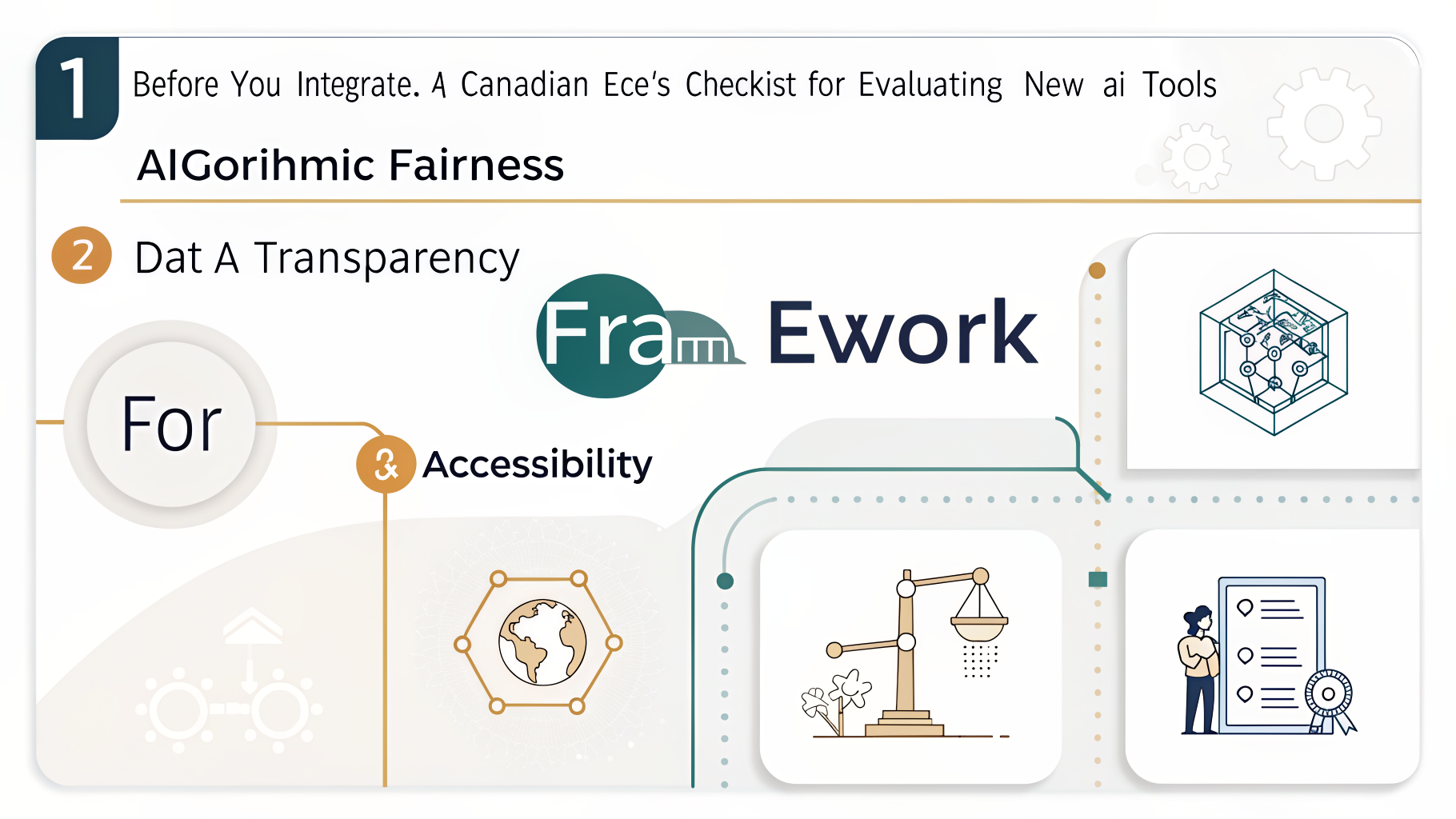
Ultimately, an ethical AI tool in early learning should feel like a supportive co-pilot, not a replacement. It should enhance your ability to connect with and understand each child, rather than creating distance or introducing unseen biases into your practice.
Beyond the Hype: Practical Criteria for Assessing AI Tool Usability & Support

Beyond the Hype: Practical Criteria for Assessing AI Tool Usability & Support
The true value of an AI tool for Canadian ECEs isn't in its marketing claims, but in its everyday utility. A tool's success hinges on its seamless integration into a busy classroom or administrative routine, not just its innovative features.What to Look For: Operational Strengths
- Intuitive Interface: The tool should be easy for a senior kindergarten teacher in Edmonton to learn in under an hour, without extensive IT support. Think drag-and-drop functionality for activity planning or clear visual cues for child observations, like those offered by YochienAI.
- Reliable Performance: Frequent crashes or slow loading times, especially during peak observation periods or parent communication, are unacceptable. Verify uptime guarantees (e.g., 99.9% availability) from the vendor.
- Robust Support & Training: Access to Canadian-based customer support, online tutorials, and professional development modules ensures educators can maximize the tool's benefits and troubleshoot issues quickly.
- Clear Cost Structure: All-inclusive pricing models, transparent subscription tiers, and no hidden fees for features like data export or additional user licenses.
Red Flags: Practical Weaknesses
- Steep Learning Curve: If the tool requires multiple hours of training or a detailed manual for basic functions, it will likely sit unused by time-strapped ECEs.
- Inconsistent Functionality: Glitches that misinterpret data, generate irrelevant suggestions, or fail during crucial tasks like attendance tracking create more work, not less.
- Limited or Offshore Support: Long wait times, generic responses, or support staff unfamiliar with Canadian ECE contexts can be a major barrier.
- Unforeseen Expenses: Needing to upgrade existing hardware (e.g., new tablets for every educator in a 40-child daycare), or pay for "premium" features that should be
Your AI Due Diligence: Key Questions to Ask Vendors and Providers
The true test of an AI tool isn't in its marketing claims, but in its vendor's ability to answer direct, probing questions about its operation and impact. Equipping yourself with a targeted list of inquiries is crucial for any Canadian ECE navigating the options for new educational technology.
Vendor Interview Questions for ECE AI Tools
Data Privacy & ComplianceHow does your AI tool comply with PIPEDA and relevant provincial privacy legislation for children's data in Canada? For example, how do you handle consent for student photos used in observation tools like YochienAI?
Pedagogical AlignmentCan you provide concrete examples of how your tool supports specific learning outcomes or developmental milestones outlined in our provincial ECE curriculum, such as Ontario's How Does Learning Happen?
Data Stewardship & DeletionWhat are your data retention and deletion policies? How can we ensure our data, particularly sensitive observations of children, is permanently removed upon request?
Bias MitigationWhat measures do you have in place to ensure fairness and prevent bias in your AI algorithms, particularly concerning diverse learners from various cultural or linguistic backgrounds?
Support & Professional DevelopmentDescribe your ongoing technical support, training, and professional development resources for Canadian ECEs, including specific examples of modules for early learning contexts.
Human-Centred DesignHow does your AI tool enhance human interaction and the educator's role, rather than replacing it? We need tools that support a kindergarten teacher in Montreal, not sideline them.
Implementing with Confidence: Piloting, Monitoring, and Continuous Evaluation
Successfully integrating AI tools into an early learning environment isn't a one-time decision; it's an ongoing commitment to observation and refinement. Even after completing the "Before You Integrate: A Canadian ECE's Checklist for Evaluating New AI Tools," the real work of ensuring sustained benefit and alignment begins with careful implementation.
1Pilot in a Controlled Setting
Begin with a small-scale pilot, perhaps in one classroom or with a specific group of educators and children, like a junior kindergarten program in Surrey, BC. This allows for initial feedback gathering and direct observation of how the AI-assisted observation tool interacts with existing routines and children's play, minimizing disruption.
2Define Success Metrics
Establish clear, measurable metrics beyond vendor marketing. Focus on specific pedagogical impacts, such as a 15% reduction in time spent on manual observation notes for a senior educator in Calgary, or improved parent communication frequency, rather than just "engagement."
3Monitor and Adapt
Implement a regular monitoring schedule—monthly check-ins for the first six months, for instance—to identify unintended consequences, developmental appropriateness issues, or shifts in data privacy practices. A 2023 NAEYC position statement emphasizes the need for continuous vigilance in technology use with young children.
4Foster Continuous Learning
Provide ongoing professional development.
Frequently Asked Questions
Why is a specific AI evaluation checklist crucial for Canadian ECE professionals?
A specific AI evaluation checklist is crucial for Canadian ECE professionals because it addresses the unique developmental needs of young children and aligns with provincial curriculum frameworks like Ontario's ELECT or BC's Early Learning Framework. Generic tech tools often overlook critical factors such as screen time limits, data privacy under PIPEDA, and the pedagogical fit for play-based learning. This tailored approach ensures tools genuinely enhance learning without compromising child well-being or regulatory compliance, offering a structured way to assess suitability before integration into programs like a licensed daycare in Quebec.
What Canadian data privacy laws apply to AI tools used in early childhood education?
Canadian data privacy laws, primarily the federal Personal Information Protection and Electronic Documents Act (PIPEDA), apply to AI tools handling personal information in ECE settings. Provinces like British Columbia and Alberta also have their own Personal Information Protection Acts (PIPA), while public institutions often fall under Freedom of Information and Protection of Privacy Acts (FIPPA). These laws mandate explicit consent for data collection, data minimization, and robust security measures to protect sensitive child data, such as learning progress or attendance records, used by an AI-powered learning app in a Toronto kindergarten.
How can I determine if an AI tool is developmentally appropriate for young children in an ECE setting?
Determining developmental appropriateness involves assessing if an AI tool aligns with the cognitive, social, and emotional stages of young children, typically 3-5 years old. It should support play-based learning, encourage interaction, and not replace human-led activities. Tools like an AI-powered story generator should offer open-ended prompts, not prescriptive tasks, and limit screen time to short, focused bursts, as recommended by the Canadian Paediatric Society. Evaluate if it fosters creativity and problem-solving, rather than passive consumption, ensuring it complements, not dictates, a child's learning experience in a preschool program.
Is it possible to ensure ethical AI use, fairness, and transparency in early learning environments?
Ensuring ethical AI use, fairness, and transparency in ECE is possible through diligent evaluation and clear policies. This involves scrutinizing vendor data usage, understanding how AI algorithms make recommendations (e.g., for personalized learning paths), and actively mitigating potential biases in content or assessment. Human oversight remains paramount; a kindergarten teacher must review AI-generated reports for fairness and accuracy. Transparency means clearly communicating the AI's role to parents and children, ensuring tools like an AI-powered language learning app don't make opaque decisions affecting a child's progress without human review.
Can Canadian ECEs effectively assess the practical usability and vendor support of new AI tools?
Canadian ECEs can effectively assess usability and vendor support by conducting pilot programs with a small group of educators and children, like in a Vancouver daycare. This tests ease of integration with existing workflows, such as an AI attendance tracking system, and evaluates the intuitiveness for both staff and children. Crucially, assess vendor responsiveness, availability of Canadian-specific training resources, and technical support channels. A strong vendor track record with clear documentation and accessible help ensures that any issues encountered during daily use can be promptly resolved, minimizing disruption to learning environments.
Frequently Asked Questions
Why is a specific AI evaluation checklist crucial for Canadian ECE professionals?
A specific AI evaluation checklist is crucial for Canadian ECE professionals because it addresses the unique developmental needs of young children and aligns with provincial curriculum frameworks like Ontario's ELECT or BC's Early Learning Framework. Generic tech tools often overlook critical factors such as screen time limits, data privacy under PIPEDA, and the pedagogical fit for play-based learning. This tailored approach ensures tools genuinely enhance learning without compromising child well-being or regulatory compliance, offering a structured way to assess suitability before integration into programs like a licensed daycare in Quebec.What Canadian data privacy laws apply to AI tools used in early childhood education?
Canadian data privacy laws, primarily the federal Personal Information Protection and Electronic Documents Act (PIPEDA), apply to AI tools handling personal information in ECE settings. Provinces like British Columbia and Alberta also have their own Personal Information Protection Acts (PIPA), while public institutions often fall under Freedom of Information and Protection of Privacy Acts (FIPPA). These laws mandate explicit consent for data collection, data minimization, and robust security measures to protect sensitive child data, such as learning progress or attendance records, used by an AI-powered learning app in a Toronto kindergarten.How can I determine if an AI tool is developmentally appropriate for young children in an ECE setting?
Determining developmental appropriateness involves assessing if an AI tool aligns with the cognitive, social, and emotional stages of young children, typically 3-5 years old. It should support play-based learning, encourage interaction, and not replace human-led activities. Tools like an AI-powered story generator should offer open-ended prompts, not prescriptive tasks, and limit screen time to short, focused bursts, as recommended by the Canadian Paediatric Society. Evaluate if it fosters creativity and problem-solving, rather than passive consumption, ensuring it complements, not dictates, a child's learning experience in a preschool program.Is it possible to ensure ethical AI use, fairness, and transparency in early learning environments?
Ensuring ethical AI use, fairness, and transparency in ECE is possible through diligent evaluation and clear policies. This involves scrutinizing vendor data usage, understanding how AI algorithms make recommendations (e.g., for personalized learning paths), and actively mitigating potential biases in content or assessment. Human oversight remains paramount; a kindergarten teacher must review AI-generated reports for fairness and accuracy. Transparency means clearly communicating the AI's role to parents and children, ensuring tools like an AI-powered language learning app don't make opaque decisions affecting a child's progress without human review.Can Canadian ECEs effectively assess the practical usability and vendor support of new AI tools?
Canadian ECEs can effectively assess usability and vendor support by conducting pilot programs with a small group of educators and children, like in a Vancouver daycare. This tests ease of integration with existing workflows, such as an AI attendance tracking system, and evaluates the intuitiveness for both staff and children. Crucially, assess vendor responsiveness, availability of Canadian-specific training resources, and technical support channels. A strong vendor track record with clear documentation and accessible help ensures that any issues encountered during daily use can be promptly resolved, minimizing disruption to learning environments.Keep reading
All articles →Smart Choices for Canadian ECE: Evaluate AI Tools Critically
Making Smart Choices for Canadian ECE: How to Evaluate AI Tools with Critical Thinking often means looking past the marketing hype to understand what AI actually does. The true value in early learning isn't just adopting new tools, but discerning their alignment with play-based learning and holistic development.
Designing for Little Hands and Big Hearts: Human-Centred AI in Canadian ECE
Human-Centred AI (HCAI) in Canadian early childhood education (ECE) isn't about complexity; it's about intentional simplicity. It aims to augment educator observation skills and deepen parent engagement, ensuring technology serves children's developmental needs.
Before You Click: 8 Essential Questions Canadian ECEs Should Ask About New AI Tools
Canadian ECEs face an overwhelming influx of new AI tools, many ill-suited for young children's unique developmental needs. This demands a structured approach to prevent pedagogical missteps and privacy breaches as the AI in education market skyrockets.


