

Beyond Hype: Essential AI Questions for Canadian ECEs
The AI in education market is booming, but Canadian ECEs must look beyond the hype. It's crucial to ask essential questions about data privacy, pedagogical alignment, and sustainability before adopting AI tools.

Introduction: Navigating AI's Promise and Peril in Canadian ECE
Navigating AI's Promise and Peril in Canadian ECE
While the global AI in education market is projected to reach USD 25.7 billion by 2032, the real challenge for Canadian Early Childhood Educators isn't merely adopting AI, but recognizing that the "hype cycle" often sidesteps critical developmental and privacy considerations unique to young children. Canadian ECEs must ask essential questions about data privacy, pedagogical alignment, and long-term sustainability before considering benefits. This risk-first approach prioritizes safeguarding children's well-being and personal information over perceived technological advantages.
The landscape for AI integration in Canadian ECE remains largely unregulated, creating confusion and anxiety for educators. Without clear, unified guidelines, an early childhood educator in Nova Scotia faces the same complex evaluation process as one in British Columbia. This lack of a standardized framework makes it difficult to discern genuinely beneficial tools from those that are overhyped or even detrimental.
This article provides a 'due diligence' playbook to help ECEs cut through the overwhelm. We aim to equip you with the confidence to assess AI tools critically, ensuring any technology adopted truly serves early learning goals and respects the unique needs of children in care. For instance, tools like YochienAI are built with these principles in mind, focusing on ethical data handling and pedagogical support.
The AI Due Diligence Framework: A Risk-First Approach for Canadian ECEs
The current lack of unified AI guidelines for Canadian early childhood educators (ECEs) means adopting a risk-first approach is not merely advised, it's essential. Without specific federal or provincial regulations beyond general privacy laws like PIPEDA, ECEs must proactively identify potential dangers before considering any benefits of AI tools.
AI Due Diligence Pillars for ECEs
Does the tool respect child autonomy and foster genuine human connection? Any AI that diminishes direct ECE-child interaction or promotes algorithmic bias is a red flag.
Verify strict adherence to Canadian privacy laws, including provincial acts like Quebec's Law 25. Ask about data anonymization, storage location (preferably Canada), and vendor data-sharing policies. A 2023 Common Sense Media survey revealed 76% of parents worry about child privacy with AI.
Evaluate if the AI genuinely enhances play-based learning and aligns with frameworks like Ontario's ELECT. Does it support observation, or does it dictate learning outcomes in a way that feels prescriptive?
Consider the learning curve for ECEs, available training, and ongoing technical support. Will it integrate smoothly into existing routines in a mid-sized daycare in Calgary, or create more workload?
Can you clearly explain the tool's function, data use, and benefits to parents and colleagues? Opaque algorithms or vague privacy policies are immediate disqualifiers.
Many Canadian early childhood educators feel overwhelmed by the sheer volume of AI tools marketed to them, often without a clear understanding of what "AI" actually entails. It's not just about generative models like ChatGPT; artificial intelligence is an umbrella term for various technologies enabling machines to perform human-like cognitive functions. This includes machine learning, where algorithms learn from data to identify patterns, and natural language processing (NLP), which allows computers to understand and generate human language. Understanding these foundational concepts is the first step in asking essential questions Canadian ECEs must ask before adopting AI tools. In early childhood settings, AI applications often fall into three practical categories: administrative automation, personalized activity suggestions, and observation analysis. For instance, an AI tool might automate daily attendance records or generate drafts for parent communication. Another common application involves recommending age-appropriate activities based on a child's observed interests, as seen in some digital learning platforms. Tools like YochienAI use AI-assisted observation to help educators analyze child interactions, providing insights into developmental milestones and engagement patterns more efficiently than manual methods alone. The core question for any ECE leader in Saskatchewan or Quebec should be: "How does this specific AI tool actually work, and what concrete problem does it solve in our ECE setting?" Distinguishing between genuinely beneficial tools and those that are merely overhyped requires looking past marketing jargon. If a tool promises "revolutionary insights" but can't explain its mechanism or offer a clear, measurable benefit to a child's development or an educator's workload, it warrants skepticism. The most profound consideration for Canadian Early Childhood Educators (ECEs) exploring AI tools isn't efficiency, but the potential impact on a child's holistic development. It's an irony often overlooked: technology designed to enhance learning could, if poorly chosen, inadvertently diminish the very human connections and spontaneous play that define quality early childhood education. Before adopting any AI solution, ECEs must deeply interrogate how it aligns with, or threatens, the foundational principles of child-centred practice in provinces like British Columbia or Ontario. A primary ethical concern involves algorithmic bias. An AI system, or AI tool, trained on limited or skewed data might inadvertently disadvantage children from certain socio-economic backgrounds or those with specific learning styles. For instance, a language assessment tool not adequately exposed to diverse Canadian accents could misinterpret a child's speech patterns, leading to inaccurate developmental insights. ECEs need to ask: How does this AI tool ensure fairness and avoid algorithmic bias that could disadvantage certain children or groups? Beyond the technical, the human element remains paramount. The unique role of an ECE lies in nurturing relationships, observing nuanced social cues, and fostering emotional intelligence through direct interaction. Will an AI-powered activity genuinely enhance a child's natural curiosity during play-based learning, or will it risk diminishing the critical, unscripted moments of exploration and discovery? A senior kindergarten teacher in Halifax, for example, prioritizes observation of spontaneous peer interaction over structured digital tasks. The question becomes: Does the tool support, rather than replace, essential human interaction and the unique role of the ECE? Navigating the data labyrinth of AI tools requires a risk-first approach, especially concerning children's sensitive information. Canadian ECEs must prioritize privacy and security, understanding that AI's utility never outweighs the imperative to protect young learners. Does the tool comply with the federal PIPEDA (Personal Information Protection and Electronic Documents Act), last updated in 2023, and relevant provincial acts like Quebec's Bill 64 (Law 25) or Alberta's PIPA? Many provinces have their own legislation, adding layers of compliance. How is children's data anonymized and encrypted, both in transit and at rest? Ask for specific protocols. A 2023 survey by Common Sense Media found that 76% of parents are concerned about their child's privacy with AI tools. What are the vendor's precise data retention policies? How long is data stored, and what is the process for permanent deletion upon request or service termination? Review the vendor's privacy policy, such as YochienAI's policy, for clarity. Is all collected data stored and processed exclusively within Canada? Ad
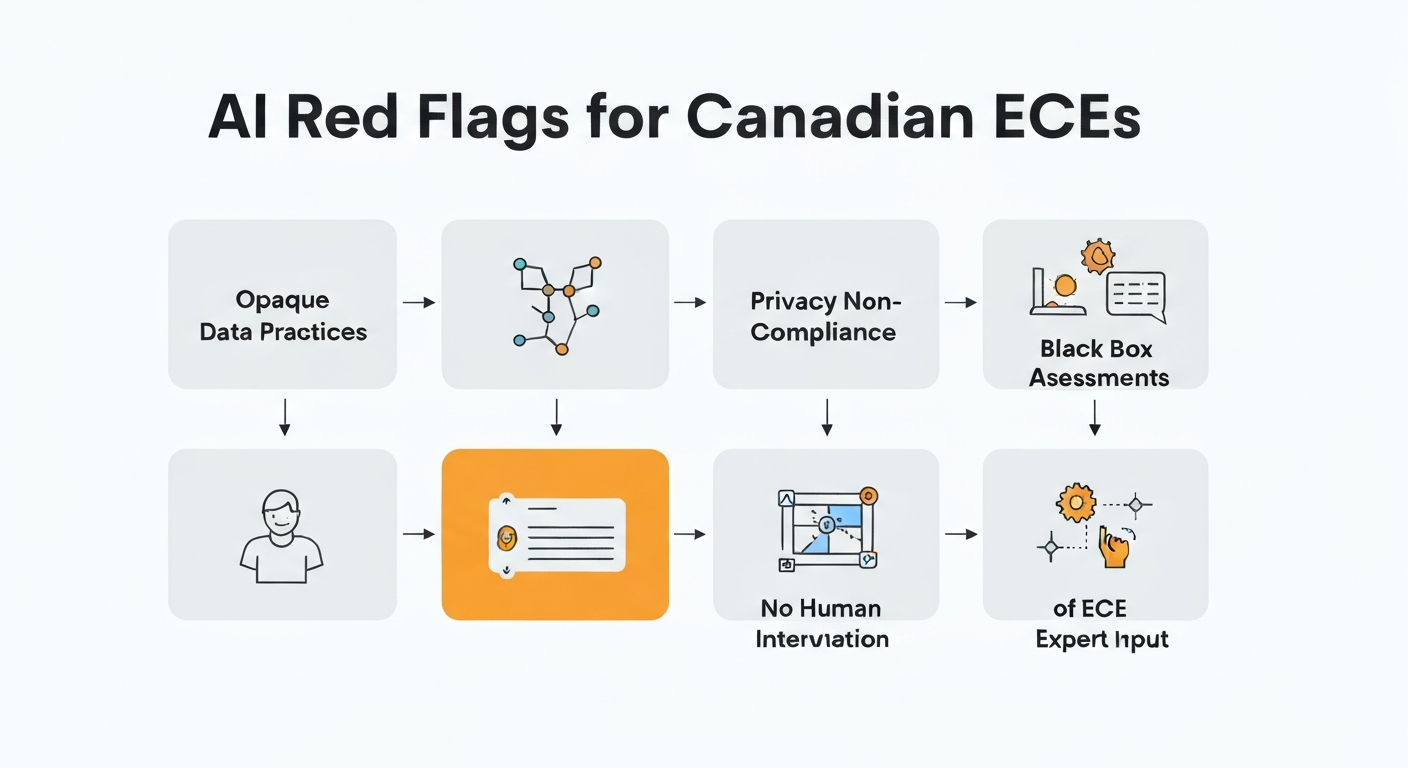
The true measure of an AI tool in early childhood education isn't its flashy features, but its seamless integration with established pedagogical practices. Many tools promise efficiency, yet few genuinely enhance the nuanced work of an Early Childhood Educator without inadvertently shifting the focus away from play-based, child-led learning. The most sophisticated AI tool offers no benefit if it compromises child safety or data integrity. Canadian ECEs, when moving beyond the hype, must first identify immediate disqualifiers. Any AI solution that lacks transparent data handling policies, for instance, should raise alarms. This includes vendors unwilling to confirm that ECEs and parents retain ownership of children's data, or those who complicate data export and deletion. A 2023 survey by Common Sense Media highlighted that 76% of parents worry about their child's privacy with AI tools, underscoring this critical concern. Another non-negotiable is non-compliance with Canadian privacy legislation. Tools must explicitly adhere not only to federal PIPEDA but also to provincial acts like Quebec's Bill 64 (Law 25). Furthermore, "black box" algorithms for child assessment, which offer recommendations without explaining their reasoning, prevent essential human oversight. ECEs need clear mechanisms to review, override, or correct any AI-generated insights. Finally, an absence of early childhood education experts in a tool's development often results in pedagogically misaligned approaches, failing to support the unique needs of young learners. Prioritizing these red flags helps ECEs make informed decisions about <
The true cost of an AI tool extends far beyond its advertised subscription fee; many Canadian ECEs overlook hidden implementation expenses and the significant investment required for staff training. While the global AI in education market is projected to reach USD 25.7 billion by 2032, according to Precedence Research (2023), most early childhood programs operate on tight budgets, making every dollar count. Before committing, ECE leaders must engage vendors about the total cost of ownership (TCO), including setup, ongoing support, and potential integration fees. Anecdotal evidence suggests many Canadian ECEs lack confidence in evaluating and implementing AI tools effectively, underscoring the critical need for robust professional development from vendors. Ask directly: What is the vendor's roadmap for updates and new features, and how does this align with our program's long-term needs? Consider vendor lock-in; inquire about data portability and export capabilities should you decide to switch tools later. This due diligence is crucial for moving Beyond the Hype: Essential Questions Canadian ECEs Must Ask Before Adopting AI Tools. Evaluating AI tools requires a clear-eyed look at the financial and operational realities for Canadian ECE programs: Even the most meticulously vetted AI tool will falter without transparent communication; ironically, the very technology designed for clarity can breed mistrust if introduced poorly. Canadian Early Childhood Educators (ECEs) must proactively address parental skepticism, which a 2023 Common Sense Media survey found affects 76% of parents concerned about their child's privacy with AI. Articulate the specific pedagogical benefits. Instead of saying, "We're using AI for observations," explain how a tool like YochienAI helps a kindergarten teacher in Calgary track developmental milestones more consistently, allowing for more individualized play-based learning plans. Focus on how AI supports, not replaces, the educator's role. Parents in provinces like Quebec, under Bill 64 (Law 25), have heightened data privacy expectations. Clearly outline how the AI tool complies with federal PIPEDA and relevant provincial legislation. Provide concrete examples: "Child data is anonymized before processing," or "No personally identifiable information leaves Canada." Before full implementation, host information sessions for parents, ECE colleagues, and administrators. Offer accessible materials—perhaps a simple FAQ sheet in English and French—and demonstrate the tool's use. This fosters a sense of shared ownership and addresses questions before anxieties
The deepest irony of AI in early childhood education (ECE) is that its greatest value lies not in replacing human effort, but in making more space for it. While AI tools promise efficiency, the core of ECE remains the irreplaceable human bond, characterized by empathy, intuition, and responsive care. An early childhood educator in British Columbia, for instance, relies on subtle cues—a child's glance, a shift in posture—to understand their needs, something no algorithm can fully replicate. The question for Canadian daycares isn't whether AI can teach, but whether it truly frees up educators to engage in more meaningful, direct interactions with children, fostering social-emotional development alongside cognitive skills. Many AI tools focus on content delivery or assessment, yet the nuanced understanding and responsive care from a human educator are paramount. We must challenge the notion that AI can ever fully replicate this; a parent in Nova Scotia expects their child to be seen and understood by a person, not a program. The priority must be tools that enhance human-to-human connection, rather than creating barriers or distractions. For example, an AI-assisted observation tool like YochienAI can streamline documentation, allowing an ECE in Calgary to spend less time typing notes and more time actively observing and interacting with a child building a block tower. Evaluating AI tools in early childhood education demands a structured approach, moving Beyond the Hype: Essential Questions Canadian ECEs Must Ask Before Adopting AI Tools. This checklist summarizes critical areas of inquiry, providing a quick reference for ECEs to vet potential solutions against Canadian standards and pedagogical principles. Canadian ECEs must prioritize developmental appropriateness, ensuring AI tools support, not replace, hands-on learning and social interaction. Data privacy is paramount; tools must protect children's sensitive information, especially under provincial regulations like Quebec's Act 25. Educators should also scrutinize AI for algorithmic bias, which could perpetuate stereotypes or limit diverse learning experiences. Transparency about how AI uses data and makes recommendations is essential for parental trust and informed consent. Screen time guidelines, like those from the Canadian Paediatric Society, must always guide implementation. Ensuring AI tools comply with Canadian privacy regulations requires due diligence. ECEs must verify that vendors adhere to federal PIPEDA and relevant provincial acts, like British Columbia's FIPPA, regarding data collection, storage, and usage. This includes understanding where data is hosted and if it's anonymized. Obtaining explicit, informed consent from parents for any data collection is non-negotiable, clearly outlining what data is gathered and its purpose. Regular audits of vendor privacy policies and data security practices are crucial to protect children's sensitive information. A risk-first approach is crucial because AI in early learning carries unique vulnerabilities. Unvetted tools could expose children's data to breaches, violating provincial privacy laws like Ontario's FIPPA. There's also the risk of developmentally inappropriate content or excessive screen time, potentially hindering social-emotional growth. For instance, an AI language app might offer limited real-world interaction compared to a teacher-led story time. Evaluating potential harms—privacy, developmental, pedagogical—before considering benefits ensures child well-being remains the absolute priority, preventing costly or detrimental implementations. AI's effectiveness in Canadian ECE hinges on its thoughtful integration as a *support* tool, not a replacement. While AI-powered speech recognition apps, for example, might offer personalized phonics practice for a child in a Montreal daycare, research consistently shows human interaction remains paramount for social-emotional and cognitive development. Over-reliance on AI can indeed diminish vital teacher-child and peer-to-peer connections. True enhancement occurs when AI frees educators from administrative tasks, allowing them more direct, quality engagement with children, rather than dictating learning experiences. A common pitfall is selecting tools not designed with early childhood development principles in mind, leading to developmentally inappropriate content or interfaces. Another is neglecting to scrutinize vendor privacy policies; many tools collect more data than necessary. ECEs should avoid solutions that promise "one-size-fits-all" learning, as young children require individualized, play-based approaches. Overlooking hidden costs, like ongoing subscriptions or integration fees, is also common. Finally, choosing tools that isolate children rather than fostering collaborative learning, common in programs like Nova Scotia's Pre-Primary, diminishes essential social development. Making Smart Choices for Canadian ECE: How to Evaluate AI Tools with Critical Thinking often means looking past the marketing hype to understand what AI actually does. The true value in early learning isn't just adopting new tools, but discerning their alignment with play-based learning and holistic development. Human-Centred AI (HCAI) in Canadian early childhood education (ECE) isn't about complexity; it's about intentional simplicity. It aims to augment educator observation skills and deepen parent engagement, ensuring technology serves children's developmental needs. Canadian ECEs face an overwhelming influx of new AI tools, many ill-suited for young children's unique developmental needs. This demands a structured approach to prevent pedagogical missteps and privacy breaches as the AI in education market skyrockets.Beyond the Buzzwords: What AI Really Means for Canadian ECEs
Beyond the Buzzwords: What AI Really Means for Canadian ECEs
"I don't need another 'innovative solution' that just adds to my screen time. I need to know exactly how this AI tool saves me time or helps a child learn better, today." — senior kindergarten teacher, Halifax
The Ethical Imperative: Prioritizing Child Well-being and Development
The Ethical Imperative: Prioritizing Child Well-being and Development
"We can't outsource empathy. An app can track progress, but it can't offer a hug when a child is sad, or truly understand the unspoken story behind a tantrum. That's our job." — Preschool Director, Calgary
Navigating the Data Labyrinth: Privacy, Security, and Canadian Regulations

Data Privacy & Security: Essential Questions
Pedagogical Fit: Does This AI Tool Truly Enhance Learning, Not Replace It?
Pedagogical Fit: Enhancing, Not Replacing, the ECE Role
Supports & Enhancements
Risks & Considerations
The 'Red Flags' Checklist: What to Avoid in AI for Early Childhood
The 'Red Flags' Checklist: What to Avoid in AI for Early Childhood
Practicalities and Pitfalls: Cost, Training, and Long-Term Sustainability

Practicalities and Pitfalls: Cost, Training, and Long-Term Sustainability
"We can't afford to invest in a flashy new tool if our team isn't confident using it, or if it becomes obsolete in a year." — kindergarten administrator, Toronto
Consideration
Typical Vendor Response
Red Flag Indicator
Initial Cost & Setup
"Monthly subscription of $X per educator."
No mention of one-time implementation fees or hardware requirements.
Ongoing Training & Support
"Access to
Building Trust: Communicating AI Decisions to Parents and Stakeholders
Explain the "Why," Not Just the "What"
Address Privacy Concerns Head-On
Involve and Educate Stakeholders Early
Maintaining the Human Heart: Ensuring AI Supports, Not Suppresses, Connection
"We're not looking for a robot teacher. We're looking for tools that give our incredible educators more time to be fully present with the children, to truly connect and respond." — Kindergarten administrator, Toronto
AI Due Diligence Checklist: A Quick Reference for Canadian ECEs
Area of Inquiry
Key Question for ECEs
Red Flag for Canadian ECEs
Ethical Imperative
Does it prioritize child well-being and avoid developmental bias?
Opaque algorithms; no input from child development experts.
Data Labyrinth
Is data secure, anonymized, and compliant with Canadian privacy laws like PIPEDA and provincial acts such as Quebec's Law 25?
Data stored outside Canada; unclear deletion or anonymization policies; vendors unable to detail security protocols.
Pedagogical Fit
Does it genuinely enhance, not replace, play-based learning and the ECE's role within frameworks like Ontario's ELECT?
Conflicts with provincial curriculum frameworks; promotes de-skilling of ECEs.
Practicalities & Support
Is it affordable, consistently supported with training, and sustainable long-term for a daycare in Calgary or a preschool in Montreal?
Hidden costs; no training provided; risk of vendor lock-in.
Communication
Can we transparently explain its function and benefits to parents and stakeholders, addressing concerns about screen time or privacy?
Lack of clear communication plan;
Beyond the Hype: Making Informed AI Choices for Canadian ECEs
Making Informed AI Choices for Canadian ECEs
The true value of artificial intelligence in early childhood education isn't in its raw processing power, but in the thoughtful, ethical framework guiding its integration. Many new tools promise efficiency, but without rigorous vetting, they risk undermining the very developmental principles Canadian ECEs uphold. A senior kindergarten teacher in Halifax, for instance, might initially see the appeal of an AI tool that auto-generates activity reports, but only deep inquiry into its data privacy protocols and pedagogical alignment reveals its true fit.
Canadian ECEs must become critical consumers, demanding transparency and accountability from AI vendors. This means asking direct questions about data anonymization, compliance with provincial privacy acts like Quebec's Bill 64 (Law 25), and the specific algorithms used in child assessment. A 2023 survey by Common Sense Media highlighted that 76% of parents worry about their child's privacy with AI, underscoring the need for clear communication and robust safeguards.
Adopting AI is not about embracing every new technology; it's about making informed, risk-averse decisions that prioritize children's best interests. This due diligence protects sensitive child data, preserves the human heart of early childhood education, and ensures any new tool supports, rather than dictates, pedagogical practice.
Starting today, ask the essential questions outlined in this series to build a future where technology genuinely supports early learning and development. For more questions or to discuss AI-assisted observation, contact us at
Frequently Asked Questions
What ethical considerations should Canadian ECEs prioritize when using AI with young children?
How do Canadian early childhood educators ensure AI tools comply with privacy regulations?
Why is a risk-first approach crucial for Canadian ECEs before implementing new AI technologies?
Is AI truly effective for enhancing learning outcomes in Canadian ECE, or does it diminish human connection?
What are the common pitfalls or things to avoid when choosing AI tools for Canadian early learning environments?
Frequently Asked Questions
What ethical considerations should Canadian ECEs prioritize when using AI with young children?
How do Canadian early childhood educators ensure AI tools comply with privacy regulations?
Why is a risk-first approach crucial for Canadian ECEs before implementing new AI technologies?
Is AI truly effective for enhancing learning outcomes in Canadian ECE, or does it diminish human connection?
What are the common pitfalls or things to avoid when choosing AI tools for Canadian early learning environments?
Keep reading
All articles →Smart Choices for Canadian ECE: Evaluate AI Tools Critically
Designing for Little Hands and Big Hearts: Human-Centred AI in Canadian ECE
Before You Click: 8 Essential Questions Canadian ECEs Should Ask About New AI Tools


