

Beyond the Buzzwords: 8 Essential Questions Canadian Educators Must Ask When Considering AI for ECE
Canadian early childhood educators often lack clear guidance on evaluating AI tools. This article provides a practical framework for assessing AI's alignment with Canada's principles of play-based learning and data privacy.

Beyond the Buzzwords: Equipping Canadian ECEs for AI Decisions
While the global EdTech market, including AI solutions, grows rapidly, Canadian early childhood educators often find themselves without clear, localized guidance on evaluating these tools. The essential questions Canadian educators must ask when considering AI for ECE extend beyond generic capabilities; they demand a practical framework for assessing how AI aligns with Canada's cornerstone principles of play-based learning, stringent data privacy laws like PIPEDA, and the irreplaceable value of human interaction. This critical assessment toolkit moves past marketing hype to support informed decisions.
Many early learning programs in provinces like British Columbia or Ontario, deeply rooted in play-based curricula, face a dilemma: embrace potential efficiency gains from AI or risk integrating tools that undermine their pedagogical approach. The challenge isn't just asking if an AI tool helps, but how to analyze vendor answers against specific Canadian ECE values and regulatory landscapes. This toolkit aims to cut through the technical jargon, offering a scaffold for confident decision-making that prioritizes child well-being and educator support.
Avoiding costly mistakes or tools that compromise child safety or privacy is paramount. This guide helps educators balance the promised benefits of artificial intelligence (AI) with the core principles of holistic child development and the human-centred approach advocated by Canada's national AI strategy. It equips Canadian ECE professionals with the means to critically assess, not just question, the true value of AI in their unique settings.
Your Critical Assessment Toolkit: Moving from Questions to Confident Decisions
The real challenge for Canadian Early Childhood Education (ECE) leaders isn't just asking questions about AI tools; it's knowing how to evaluate the answers. Many educators feel adrift, struggling to distinguish genuine pedagogical value from marketing hype. This section provides a critical assessment toolkit, moving beyond the generic "what if" to a practical "how to analyze" framework for AI integration in ECE settings like a junior kindergarten program in Saskatoon or a daycare in downtown Montreal.
A Canadian ECE AI evaluation checklist must directly confront the core principles of our educational philosophy: play-based learning and holistic child development. For example, if an AI tool claims to personalize learning, a critical evaluator asks: does it enhance child-initiated play, or replace it with screen-driven tasks? Does it support a child's social-emotional growth, or primarily focus on cognitive metrics? The goal is to make confident choices that genuinely support, rather than compromise, the human-centered nature of early learning. This means ensuring any tool, like an AI-assisted observation platform, aligns with established developmental frameworks and provincial curriculum guides, such as Ontario's How Does Learning Happen? document.
Each subsequent section of this article represents a vital pillar of this toolkit, guiding educators through specific criteria for choosing AI tools for early childhood Canada.
Deconstructing the Hype: What 'AI' Really Means for Canadian ECE
Many educators feel a disconnect between the exciting promises of AI in early childhood education (ECE) and the practical realities of their classrooms. Often, the term “AI” itself obscures more than it clarifies, leading to confusion about what these tools actually do.
Deconstructing AI for ECE: A Quick Reference
In ECE, AI primarily refers to narrow AI: computer systems designed to perform specific, well-defined tasks. This is not human-like intelligence, but rather sophisticated automation, like pattern recognition or data analysis, applied to educational contexts.
Think AI-assisted observation tools, such as YochienAI, which analyze video to flag developmental milestones or engagement patterns. Other applications might include adaptive learning suggestions for foundational literacy or administrative task automation in daycares.
AI excels at processing large datasets and identifying trends faster than a human. It does not "understand" a child's emotions, build relationships, or spontaneously innovate curriculum. Its value lies in augmenting human capabilities, not replacing them.
When evaluating tools, ask vendors exactly how the AI component functions. For instance, "Does it identify specific phonemes, or just flag overall speech volume?" Demand concrete examples, not vague claims of "personalized learning."
The most beneficial AI in ECE automates routine, data-heavy tasks, freeing up educators for direct child interaction. This shifts the focus from generalized "intelligence" to precise, beneficial automation.
The Child-First Lens: Ensuring Developmental Appropriateness and Well-being

The Child-First Lens: Ensuring Developmental Appropriateness and Well-being
The real test of any AI tool in early childhood education isn't its technical sophistication, but its tangible benefit to children. Educators must move beyond the marketing and ask how a tool genuinely supports—or potentially hinders—the holistic development central to Canadian ECE frameworks like Ontario's "How Does Learning Happen?"Supports for Child Development
- Enhances play-based learning by providing new avenues for exploration, such as interactive storytelling apps that respond to a child's choices.
- Offers personalized feedback or activities, adapting to individual learning paces without direct comparison to peers.
- Frees up educator time from administrative tasks, allowing more direct, meaningful interaction with children during critical developmental windows.
- Provides observation insights, like those from YochienAI, that help educators identify specific developmental needs and tailor interventions.
Potential Developmental Concerns
- Risk of displacing essential face-to-face interactions with educators and peers, crucial for social-emotional development.
- Over-reliance on screen time, potentially detracting from gross motor skill development and unstructured outdoor play.
- Tools not designed with ECE pedagogy in mind may introduce direct instruction methods, conflicting with play-based learning principles.
- Potential for creating undue pressure on children to perform for an algorithm, rather than fostering intrinsic motivation and joy in learning.
Navigating the Ethical Maze: Data Privacy, Bias, and Transparency in AI Tools
Navigating the Ethical Maze: Data Privacy, Bias, and Transparency in AI Tools
The promise of AI in early childhood education often overshadows its profound ethical implications, particularly regarding child safety and privacy. It's ironic that tools designed to enhance observation could inadvertently expose sensitive child data if not meticulously vetted for adherence to Canadian privacy laws and ethical AI principles. Canadian educators must critically assess how AI tools handle the intimate details of a child's learning journey.
A primary concern for any ECE program in provinces like British Columbia or Ontario is data governance. This includes understanding precisely what data an AI solution collects, how it stores this information, and who ultimately has access. Federal laws like PIPEDA (Personal Information Protection and Electronic Documents Act) and provincial equivalents such as FIPPA (Freedom of Information and Protection of Privacy Act) in Ontario or PIPA (Personal Information Protection Act) in Alberta establish strict guidelines for handling personal information. Providers should offer clear policies, similar to YochienAI's privacy statement, detailing anonymization practices and robust consent mechanisms from parents or guardians.
Beyond privacy, algorithmic bias poses a significant risk. If an AI is trained on unrepresentative datasets, it can inadvertently perpetuate existing societal biases, leading to inequitable observations or recommendations for specific groups of children. Educators need to ask providers about their methods for identifying and mitigating such biases, ensuring the AI treats every child fairly. Transparency is equally crucial; an AI's decision-making process shouldn't be a black box. Can an educator understand why a tool like a developmental insight platform suggests a particular activity or flags a certain observation? This clarity helps maintain professional oversight and trust in the technology.
These are essential questions Canadian educators must ask when considering AI for ECE, ensuring any chosen tool aligns with our values of equity, privacy, and child-centred practice.
Helping Educators: AI as a Support, Not a Replacement for Human Interaction
Helping Educators: AI as a Support, Not a Replacement for Human Interaction
The true value of AI in early childhood education (ECE) isn't in replacing human connection, but in amplifying it—a perspective often lost amidst the hype. When Canadian educators consider AI for ECE, the core inquiry must shift from "What can AI do?" to ask how AI can help our educators do more of what truly matters. The goal is to free up capacity, allowing a senior kindergarten teacher in Halifax to spend less time on administrative tasks and more time engaging with children during play-based learning.
This means carefully assessing how a tool genuinely reduces workload, provides actionable insights, and fosters professional growth, rather than creating new burdens or distancing educators from children. The Pan-Canadian AI Strategy emphasizes responsible AI, which in ECE translates directly to human-centred design.
Many early childhood educators in mid-sized urban daycares report feeling overwhelmed by administrative duties. An AI tool like YochienAI, designed to assist with observations and parent communication, aims to reduce these tasks, potentially freeing up to three times more time for direct child interaction. This allows a preschool educator in Calgary to focus on observing nuanced developmental milestones rather than manually logging every interaction.
Practical Integration: Implementation, Training, and Ongoing Support Needs
Beyond the marketing promises, the true test of any AI tool in Canadian Early Childhood Education (ECE) lies in its practical integration into daily routines. Many programs find excellent tools fail not on features, but on the overlooked hurdles of implementation and ongoing support.
Installation & Infrastructure
Evaluate the technical requirements: Does the tool need specific hardware, like tablets or high-speed internet, beyond what your daycare in Surrey, BC, already possesses? Understand the full setup process and if it requires specialized IT support.
Educator Training & Support
Inquire about comprehensive, Canadian-specific educator training. A senior kindergarten teacher in Halifax needs more than a user manual; they need hands-on workshops and dedicated technical support. Ask about ongoing professional development opportunities and response times for issues.
User Experience & Learning Curve
A truly useful AI tool for ECE, such as an observation assistant like YochienAI, must have an intuitive interface. ECE professionals are busy; a complex system adds burden, not relief. Test the interface with a diverse group of educators to gauge ease of use.
Total Cost of Ownership
Look beyond the initial subscription. Factor in potential costs for hardware upgrades, ongoing maintenance, data storage, and future feature updates.
Beyond Today: Considering Long-Term Impact and Scalability of AI Solutions

Beyond Today: Considering Long-Term Impact and Scalability of AI Solutions
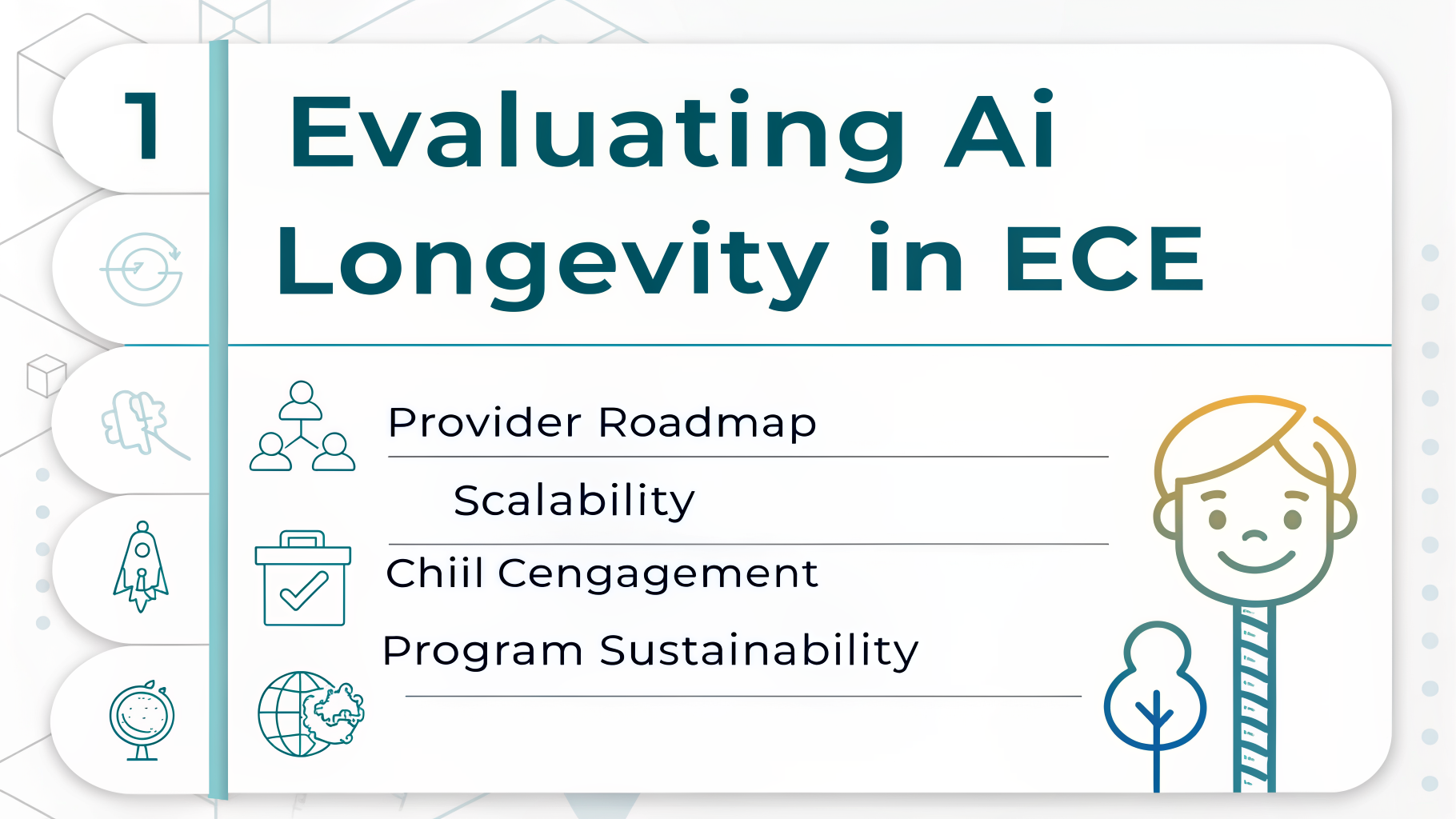
The immediate allure of efficiency gains from artificial intelligence (AI) tools often overshadows critical long-term considerations for Canadian early childhood education (ECE) programs. Responsible AI adoption demands looking past initial benefits to scrutinize how a solution will evolve, scale, and influence child development over years, not just months. For example, a promising AI-powered observation tool today might become obsolete if its provider lacks a clear roadmap for integrating new developmental frameworks or adapting to shifts in provincial curricula, such as Ontario's How Does Learning Happen? document.
Educators must ask providers about their future development plans, including how they ensure the tool remains secure and relevant. Scalability is another key factor: will the AI solution effectively grow with your ECE program, from a small Regina daycare to a multi-site Toronto centre? Furthermore, consider the potential long-term effects on children's engagement, ensuring that screen-based AI interactions complement, rather than diminish, essential human interaction and play-based learning—a cornerstone of Canadian ECE.
The Canadian Context: Provincial Guidelines, Funding, and Community Values
The Canadian Context: Provincial Guidelines, Funding, and Community Values
The most sophisticated AI tool offers little value if it clashes with provincial licensing or fails to resonate with local community values. A critical gap in many AI discussions for early childhood education (ECE) is the lack of focus on Canada's unique regulatory landscape and cultural considerations. Ignoring these can lead to costly, non-compliant implementations or tools that simply don't fit the needs of a specific daycare in, say, British Columbia. When evaluating AI, Canadian educators must ask: How does this tool align with specific provincial ECE licensing requirements and curriculum frameworks, like Ontario's "How Does Learning Happen?" or Quebec's "Accueillir la petite enfance"? For example, a tool designed for play-based observation needs to demonstrate it supports, rather than replaces, the educator's role in documenting emergent curriculum in a licensed group setting in Alberta. Beyond compliance, consider funding. While federal initiatives like the Pan-Canadian AI Strategy encourage responsible AI development, direct grants for ECE AI adoption are less common but emerging. Some provinces or municipalities might offer innovation grants. For instance, a program in Manitoba might find support for tools that enhance educator capacity, aligning with the province's ECE workforce development goals. Moreover, the tool's respect for Canada's multiculturalism and Indigenous perspectives is paramount. Does it offer content in multiple languages? Does it integrate learning approaches that honor diverse cultural backgrounds, rather than imposing a single worldview? Finally, what mechanisms exist for involving parents and the wider ECE community in the AI decision-making process, ensuring their input shapes adoption beyond just addressing concerns? This collaborative approach is vital for successful integration within the Canadian context.Comparing Your AI Evaluation Pillars: A Quick Reference for Canadian Educators
Evaluating AI tools for early childhood education demands a structured approach, moving past generic promises to specific, actionable criteria. This comparative table synthesizes the core questions from our "Beyond the Buzzwords: Essential Questions Canadian Educators Must Ask When Considering AI for ECE" framework, offering a quick reference for assessing potential AI solutions against critical Canadian ECE principles.
| Evaluation Pillar | Core Focus | Key Considerations for Canadian ECE |
|---|---|---|
| Child-First Lens | Developmental appropriateness & well-being. | Does it support play-based learning and holistic development, as per provincial curricula (e.g., Ontario's How Does Learning Happen?)? Does it minimize screen time for a 4-year-old? |
| Ethical Maze | Data privacy, bias, and transparency. | Is it PIPEDA-compliant? How is data for children in a Vancouver daycare protected? Can the AI's recommendations for a child in Quebec be explained clearly? |
| Educator Support | Support, not replacement, for human interaction. | Does it reduce administrative load for a kindergarten teacher in Halifax, allowing more direct child engagement? What training is provided to use tools like YochienAI effectively? |
| Canadian Context | Provincial guidelines, funding, community values. | Does it align with specific Alberta ECE standards? Are there provincial grants for technology adoption? How does it reflect local community values in rural Manitoba? |
By comparing AI tools across these pillars, educators can confidently move beyond marketing hype.
Making the Confident Choice: Your Next Steps in Canadian ECE AI Adoption
Making the Confident Choice: Your Next Steps in Canadian ECE AI Adoption
Moving past the marketing hype and generic claims about AI for ECE demands a critical assessment. Canadian educators, now equipped with a practical toolkit for evaluation, can confidently navigate the landscape. This means testing tools like YochienAI not just for their stated features, but for their real-world impact in an Ontario JK/SK classroom, ensuring they align with play-based learning principles. Pilot programs, such as a three-month trial in a mid-sized Calgary daycare, offer invaluable insights into how these tools integrate with existing workflows and truly support educators. The goal is always a "human-centred AI" approach, a concept increasingly emphasized in global EdTech discussions and crucial for early learning. This means technology augments, rather than replaces, the essential human interactions that define quality ECE. Engage in ongoing dialogue with providers, your peers in Nova Scotia's ECE community, and provincial regulatory bodies to share experiences and refine best practices. By embracing these next steps, Canadian educators can make informed decisions, ensuring AI tools genuinely enhance early learning experiences and support child well-being. For specific inquiries about responsible AI integration in ECE, consider reaching out via the YochienAI contact page.Frequently Asked Questions
What are the main ethical considerations for AI use in Canadian early childhood education?
Main ethical concerns in Canadian ECE AI include data privacy, ensuring compliance with provincial acts like Ontario's FIPPA or Quebec's *Act respecting the protection of personal information*. Algorithmic bias is another key issue, as AI models trained on unrepresentative data could perpetuate stereotypes, impacting diverse learners. Transparency regarding how AI tools make recommendations and obtaining informed consent from parents for data collection and usage are also critical. These considerations are paramount to protect children's rights and foster equitable learning environments.
How can Canadian ECE professionals assess if an AI tool is developmentally appropriate for young children?
ECE professionals in Canada should assess AI tools against provincial frameworks like British Columbia's *Early Learning Framework*. Developmentally appropriate tools prioritize play-based, hands-on interactions over passive screen time. They should support social-emotional skills, not just cognitive drills, and offer adaptable challenges for varying abilities. For instance, an AI-powered story generator should encourage collaborative storytelling, allowing children to contribute, rather than simply presenting pre-made narratives, ensuring active engagement suitable for preschoolers.
Why is it important for Canadian educators to understand AI beyond the buzzwords in ECE?
Understanding AI beyond marketing jargon allows Canadian educators to critically evaluate tools, ensuring they serve genuine pedagogical needs. It helps distinguish between true artificial intelligence (AI), which learns and adapts, and sophisticated automation. For instance, a daycare director in Manitoba needs to know if an "AI-driven assessment" truly offers adaptive insights or just digitizes traditional checklists. This informed perspective prevents wasted resources, protects children from inappropriate tech, and helps educators advocate for ethical, effective integration.
Is AI intended to replace human interaction in Canadian early learning environments?
No, AI is not intended to replace human interaction in Canadian early learning. Its role is to augment educators' capabilities, automating administrative tasks like attendance tracking or providing data insights on learning patterns. For example, an AI tool might suggest activities based on observed engagement, but a kindergarten teacher in Montreal remains essential for delivering responsive care, fostering social-emotional skills, and building meaningful relationships. Human empathy, nuanced communication, and spontaneous play facilitation are irreplaceable in ECE.
Can Canadian ECEs find provincial guidelines or funding for AI implementation?
Provincial guidelines and dedicated funding for AI implementation in Canadian ECE are currently limited and vary significantly. While some provinces, like British Columbia, offer broader educational technology grants, specific AI-in-ECE policies are still emerging. ECE professionals in Alberta might find support through general innovation funds or professional development allocations rather than explicit AI budgets. It's crucial for educators to consult their provincial Ministry of Education or local school board for the most current information on available resources and policy frameworks.
Frequently Asked Questions
What are the main ethical considerations for AI use in Canadian early childhood education?
How can Canadian ECE professionals assess if an AI tool is developmentally appropriate for young children?
Why is it important for Canadian educators to understand AI beyond the buzzwords in ECE?
Is AI intended to replace human interaction in Canadian early learning environments?
Can Canadian ECEs find provincial guidelines or funding for AI implementation?
Keep reading
All articles →
Human-Centred AI in Daycare: One Day, Rules, Sample Policy
Human-centred AI in an early learning centre is a working rule: software can assist, but a named educator decides every choice about a child. This guide shows how that plays out day to day, from reviewing automated reports to writing a short family-friendly policy.
A Practical Checklist for Canadian ECEs Evaluating AI Tools
Most AI guidance treats every tool the same way, which is why evaluations stall. This checklist sorts each tool into a lane first, so Canadian ECEs can decide what to ask vendors and when AI belongs in the classroom.

Putting Children First: A Parent's Guide to Human-Centred AI in Canadian ECE
The true irony of "putting children first" in ECE isn't protecting children from AI, but ensuring they aren't passive data points. This involves designing AI tools that prioritize a child's holistic development, well-being, and safety in the unique Canadian context.