

Human-First AI: What 'Human-Centred AI' Truly Means for Canadian ECE
AI in Canadian early learning should amplify human connection, not replace tasks. "Human-Centred AI" in ECE prioritizes children's well-being and educators' roles, ensuring technology serves human goals.

Demystifying Human-Centred AI: Beyond the Buzzwords for ECE Professionals
Demystifying Human-Centred AI: Beyond the Buzzwords for ECE Professionals
The conversation around AI in Canadian early learning often misses a crucial point: it's not about how AI can replace human tasks, but how it can amplify human connection. Beyond the hype, "Human-Centred AI" in Canadian ECE means designing tools where the well-being, development, and agency of children—and the supportive role of educators—are the explicit priority, ensuring technology serves human goals, not the other way around. This directly counters the common fear, expressed by over 60% of Canadian parents in a 2022 survey, that technology will diminish children's developmental outcomes.
This approach moves past simply ‘using AI’ to consciously shaping it to fit the nuanced, relationship-rich environment of early childhood classrooms. Consider a senior kindergarten teacher in Halifax. Human-centred AI might mean an observation tool like YochienAI that helps her quickly document developmental milestones, freeing her to spend more time engaging directly with a child building a complex block tower, rather than buried in paperwork. The AI augments her capacity to observe and reflect, allowing for richer human interaction, a core tenet of provincial early learning frameworks across Canada.
"We're not looking for AI to teach our children. We're looking for AI to give our educators more time to teach, to connect, and to truly see each child." — kindergarten administrator, Toronto
For Canadian ECE, human-centred AI adheres to core principles: ethical design, transparency in how data is used, and significant user control. It also emphasizes equitable access, ensuring that the benefits of AI support every child’s unique developmental journey, regardless of their background or location. Understanding ‘what is human-centred AI in early childhood education Canada’ is the essential first step to evaluating its potential responsibly, ensuring any integration genuinely enhances the learning environment without compromising the irreplaceable human element.
Why Human-Centred AI is Essential for Canadian Early Learning Classrooms
Why Human-Centred AI is Essential for Canadian Early Learning Classrooms
The conversation around AI in education often misses a crucial point: its greatest value isn't in replacing human effort, but in making human connection stronger. For Canadian early learning settings, a human-centred approach to artificial intelligence isn't merely a nice-to-have; it's a fundamental necessity for enriching child development and bolstering our ECE ecosystem. This perspective directly counters the common fear that technology inherently detracts from the essential human element in a Reggio Emilia-inspired classroom, for instance.
Human-centred AI tools, such as an AI-assisted observation platform like YochienAI, can significantly enhance personalized learning. These platforms help educators observe and understand individual developmental needs more deeply, aligning with provincial frameworks like Ontario's How Does Learning Happen? which prioritizes holistic child development. By automating routine tasks like documentation and reporting on individual progress, AI frees up educators to focus on direct engagement, facilitating play-based learning, and building the strong human relationships that research from the Center on the Developing Child at Harvard University consistently shows are foundational for early childhood development. A senior kindergarten teacher in Vancouver might use an AI tool to quickly log observations, then spend that saved time engaging a child struggling with social-emotional regulation.
"AI should be the quiet assistant in the background, not the star of the show. It gives me more time to actually be with the children, which is why I became an educator." — Early childhood educator, Montréal
Thoughtful integration also offers new avenues for early identification of learning challenges. AI can flag patterns in observations that might indicate a child needs additional support, providing timely insights without replacing the educator's expert judgment. This can be particularly impactful in bridging resource gaps in smaller, rural daycares in Alberta, offering educators access to insights and tools that might otherwise be unavailable, thereby promoting more equitable learning opportunities. This approach directly addresses skepticism regarding AI's actual benefits by demonstrating how it supports, rather than detracts from, established pedagogical practices.
The projected growth of the global AI in education market, set to exceed $25 billion by 2030 according to Grand View Research (2022), underscores the urgency for human-centred design principles to guide its adoption. This financial momentum requires a critical lens to ensure benefits for child development in Canadian ECE are realized, not just technological adoption for its own sake. Moreover, a 2022 survey indicated that over 60% of Canadian parents expressed concerns about the impact of technology on their children's development, highlighting the necessity for intentional, human-first integration strategies.
Ultimately, Beyond the Hype: What 'Human-Cent
Core Principles: What Human-Centred AI Looks Like in Practice (Design & Implementation)

Core Principles: What Human-Centred AI Looks Like in Practice
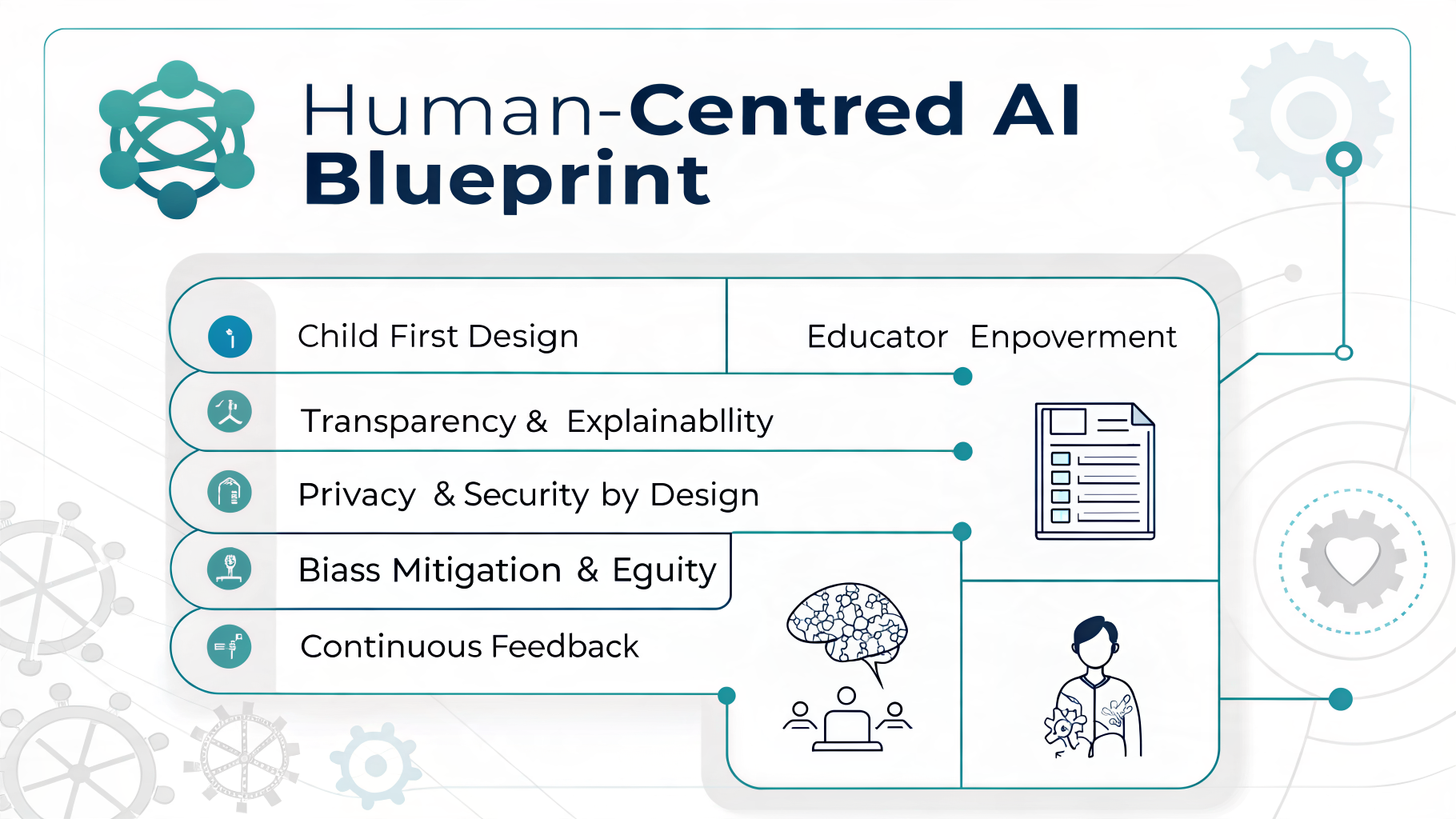
The true measure of human-centred AI in Canadian early childhood education isn't found in abstract definitions, but in its tangible design choices and daily implementation. Ironically, for AI to be truly "human-centred," its development must often prioritize non-AI elements: play, connection, and the nuanced judgment of a skilled educator. This means moving Beyond the Hype: What 'Human-Centred AI' Truly Means for Canadian ECE Classrooms, focusing on actionable principles that ensure technology enhances, rather than detracts from, the early learning experience. Child-first design is paramount. This dictates that AI tools, like an observation assistant identifying developmental milestones in a play-based setting, must be non-intrusive and engaging. They should align with Canadian provincial early learning frameworks, which consistently prioritize holistic child development. For example, a tool designed for a junior kindergarten program in Alberta would focus on supporting emergent literacy through play, not rote drills. Simultaneously, educator empowerment remains central. AI should function as a thoughtful partner, offloading administrative burdens such as detailed observation notes, freeing an educator in a Montreal daycare to engage more deeply with children."I need AI to help me spend less time typing and more time actually *seeing* the children. That's the real value." — kindergarten administrator, TorontoTransparency and explainability build trust. Educators and parents must understand how an AI tool, such as one suggesting personalized activity ideas, arrives at its recommendations. This open approach demystifies the technology. Privacy and security by design are non-negotiable, especially given that a 2022 survey indicated over 60% of Canadian parents expressed concerns about technology's impact on children. Adherence to Canadian data regulations and ethical guidelines is essential, with robust measures built into the system from the outset, as detailed by platforms like YochienAI's privacy and security pages. Finally, continuous feedback and iteration ensure that AI systems adapt. A pilot program in a Winnipeg daycare, for instance, might provide direct input that refines an AI's ability to interpret diverse communication styles, minimizing algorithmic bias and promoting equity.
Real-World Applications: Human-Centred AI Examples in Canadian ECE Settings
Real-World Applications: Human-Centred AI Examples in Canadian ECE Settings
While the concept of human-centred AI might seem abstract, its practical applications are already taking shape in Canadian early learning environments. These aren't futuristic scenarios; they are tools designed to augment the educator's capabilities, allowing them to focus more intensely on direct child interaction and less on administrative burdens. The core idea is that AI handles the data, while the human handles the heart.
Consider AI-assisted observation and documentation. Instead of an educator in a mid-sized Calgary daycare spending valuable time manually jotting notes on every child's interaction, a tool like YochienAI can help capture and analyze observations. This artificial intelligence software processes educator inputs to highlight patterns in a child's play, pinpointing emerging developmental milestones or preferred learning styles. This means a senior kindergarten teacher in Vancouver can receive insights on a child's fine motor skill progression, freeing them to design a more engaging block-building activity rather than sifting through pages of handwritten notes.
Personalized learning support is another tangible benefit. AI can suggest tailored activities based on a child's observed interests and progress, aligning with provincial play-based curricula such as Ontario's "How Does Learning Happen?" framework. If an AI identifies a child showing a strong interest in natural elements and early numeracy, it might suggest outdoor counting games or leaf-sorting activities. This doesn't replace the educator's judgment; it offers a curated starting point, saving hours of resource searching. Similarly, AI-powered platforms can enhance communication. Secure systems allow educators to share developmental updates and activity ideas with parents in real-time, strengthening the home-school connection, as seen with YochienAI's parent communication features. This addresses a common parent concern about staying informed, which a 2022 survey indicated over 60% of Canadian parents prioritize regarding their child's development.
"AI isn't about replacing my eyes or my heart in the classroom. It's about giving me a better lens and more time to connect with each child, especially those who need a little extra support." — Early Childhood Educator, Montreal
Furthermore, AI can power inclusive learning aids for children with diverse needs. Adaptive technologies might offer personalized prompts or sensory feedback to enhance participation, ensuring equitable access to learning. For instance, an AI-driven tablet application could provide visual or auditory cues to a child with a specific learning difference during a group activity, allowing them to engage more fully. Finally, for curriculum planning and resource curation, AI can assist educators in finding and organizing relevant educational resources or activity ideas that align with provincial ECE frameworks. This moves Beyond the Hype: What 'Human-Centred AI' Truly Means for Canadian ECE Classrooms, by showing how AI serves as a thoughtful partner, enhancing the educator's capacity for individualized, responsive teaching, rather than diminishing their role.
Addressing Concerns: AI as a Support, Not a Replacement for Educators and Human Connection
The deepest fear surrounding AI in early childhood education (ECE) isn't about lost efficiency; it's about lost connection. Many educators and parents worry that AI will erode the essential human elements of care and teaching, but a human-centred approach directly counters this by positioning AI as a tool to amplify, not diminish, human interaction and the educator's irreplaceable role in Canadian ECE classrooms.
AI as an Educator's Ally
- Automates Routine Tasks: AI systems, such as observation and reporting tools, can manage administrative burdens, freeing a kindergarten teacher in Montreal to spend more time engaging directly with children in play-based learning.
- Enhances Personalization: By quickly processing observation data, AI can help an educator identify individual learning patterns, allowing for more tailored interactions and support for children, especially those needing extra attention.
- Supports Professional Development: AI tools can offer insights into classroom dynamics or individual child progress, providing valuable data for an ECE team in Vancouver to reflect on their practice and refine pedagogical strategies.
- Strengthens Parent Communication: Automated, secure summary reports, like those from YochienAI, streamline communication with families, ensuring parents receive timely updates on their child's developmental journey and classroom activities.
- Bolsters Ethical Practices: Human-centred design prioritizes robust data privacy and security, aligning with the critical need for ethical AI development highlighted by a 2023 CIFAR report, especially in sensitive educational contexts.
Addressing Common Concerns
- Myth: AI Replaces Educators: This is unequivocally false. AI excels at data processing; it cannot replicate the nuanced emotional support, spontaneous problem-solving, or empathetic guidance a human educator provides.
- Screen Time & Development: A 2022 survey indicated over 60% of Canadian parents worry about technology's impact on child development. Human-centred AI minimizes direct child-facing screen time, focusing instead on educator support.
- Diminished Human Connection: The goal is to enhance connection. By reducing paperwork, an ECE professional gains more opportunities for one-on-one interactions, deep conversations, and responsive caregiving with children.
- Data Privacy Risks: Without careful implementation, data breaches are a concern. Human-centred AI demands transparent privacy policies and secure data handling, ensuring compliance with Canadian regulations and parental trust.
- Bias in Algorithms: AI models can reflect biases present in their training data. Continuous auditing and diverse data sets are crucial to prevent perpetuating stereotypes or misinterpreting diverse developmental pathways in children.
"AI isn't here to take over; it's here to take on the tasks that pull us away from what truly matters: connecting with our children and guiding their growth." — kindergarten administrator, Toronto
Ultimately, Beyond the Hype: What 'Human-Centred AI' Truly Means for Canadian ECE Classrooms is about discerning the practical value of AI. It serves as a sophisticated assistant, enabling educators to dedicate more energy to the foundational elements of early learning: strong relationships
Evaluating AI Through a Human-Centred Lens: Key Questions for Canadian ECEs

Evaluating AI tools for Canadian early childhood education requires more than just reviewing feature lists; it demands a human-centred lens that prioritizes child development, educator well-being, and ethical standards. Practitioners often worry about technology adding complexity rather than simplifying tasks, a valid concern given the existing demands on ECE professionals in provinces like British Columbia and Ontario. To move Beyond the Hype: What 'Human-Centred AI' Truly Means for Canadian ECE Classrooms, here are key questions for critical evaluation:
When considering AI tools, ECE administrators and educators should consult a practical checklist. This table outlines essential questions to guide the selection process, ensuring alignment with human-centred principles and pedagogical goals.
| Evaluation Criterion | Key Question for ECEs | Why it Matters |
|---|---|---|
| Educator Empowerment | Does it genuinely streamline tasks or create new burdens? | Tools should save time on administrative work (e.g., observations, reporting) allowing more direct interaction with children, as opposed to requiring extensive training or data entry. |
| Child Privacy & Data Security | How does it protect child privacy and data security? | Compliance with Canadian privacy laws (e.g., PIPEDA) is non-negotiable. Tools must clearly outline data collection, storage, and usage policies. For example, YochienAI's privacy policy outlines specific data handling practices. |
| Transparency & Explainability | Is the AI's logic transparent and understandable? | Avoid "black box" solutions. Educators need to understand how an opaque AI makes recommendations, ensuring it aligns with pedagogical judgment. |
| Equity & Bias Mitigation | Does it promote equity and actively mitigate algorithmic bias? | The tool should be accessible to all children, including those with diverse needs, and its design must prevent biases that could lead to inequitable assessments or recommendations, which a 2023 CIFAR report emphasized. |
| Human Connection & Play-Based Learning | Does it support, not replace, human interaction and play? | AI should enhance engagement, observation, and educator-child interactions, rather than isolating children or automating core pedagogical functions that rely on human connection, aligning with Canadian provincial early learning frameworks. |
| Feedback Loop & Continuous Improvement | Is there a clear mechanism for user feedback and iteration? | Human-centred design implies ongoing improvement. Educators should be able to provide input that shapes the tool's evolution based on real-world classroom experience. |
By asking these targeted questions, ECE professionals can move beyond superficial claims and make informed decisions that genuinely benefit children and educators.
The real promise of artificial intelligence in early childhood education isn't about automating teaching, but about elevating the human element. While the global AI in education market is projected to exceed $25 billion by 2030, the critical, often overlooked aspect is how this growth can genuinely serve Canadian ECE's core values: holistic child development and strong human relationships. Thoughtful AI integration evolves ECE practices by allowing educators to leverage data-driven insights for more personalized and responsive learning environments. Consider a senior kindergarten teacher in British Columbia using an AI-assisted observation tool, which processes anonymized activity data to highlight emerging patterns in a child's social-emotional development. This doesn't replace the teacher's observation; it augments it, surfacing subtle trends that might otherwise be missed amidst the busy classroom. This allows the educator to spend more quality time on direct interaction and creative instruction, reinforcing their central role, as prioritized by the BC Early Learning Framework. A 2022 survey revealed that over 60% of Canadian parents worry about technology's impact on development, underscoring the need for AI to function as a supportive partner, not a primary instructor. Nurturing development with thoughtful AI integration in Canada means embracing innovation while firmly grounding technology in ethical considerations, child well-being, and respect for human connections. This approach ensures that as technology advances, the heart of early childhood education—the child and the human relationships supporting them—remains paramount. This vision aligns with the Canadian Institute for Advanced Research (CIFAR)'s 2023 report, which emphasized the critical need for ethical AI development, particularly in sensitive sectors like education. By proactively shaping how AI is developed and used, Canadian ECE can lead the way in demonstrating Beyond the Hype: What 'Human-Centred AI' Truly Means for Canadian ECE Classrooms, serving humanity's best interests by enhancing, rather than detracting from, the essential human connections that define early learning. Canadian early childhood educators often have practical questions about AI in their classrooms, moving beyond abstract discussions to real-world impact. This quick reference card addresses common queries about Beyond the Hype: What 'Human-Centred AI' Truly Means for Canadian ECE Classrooms. To amplify educators' strengths and enrich children's learning, always prioritizing human connection, well-being, and interaction. It's about augmenting, not replacing, the invaluable role of a teacher. No. Human-centred AI acts as a support, automating tasks like observation documentation or administrative checks. This frees up a kindergarten teacher in Alberta to spend more time directly engaging with children, fostering relationships, and guiding play. It integrates 'privacy by design.' This means robust data protection, transparency, and adherence to Canadian privacy regulations (like PIPEDA) are built into the system from its inception. For example, platforms like YochienAI detail their privacy protocols at yochienai.ca/privacy. Absolutely. By providing educators with tools for unobtrusive observation and analysis, AI can offer insights into children's interests and developmental stages during play. This helps an ECE in Nova Scotia tailor environments and introduce materials that foster richer, more responsive play experiences. Look for platforms offering AI-assisted observation, personalized learning suggestions, or enhanced parent communication. Always evaluate them against human-centred principles, ensuring they prioritize child development and educator agency. YochienAI for schools is one such example, built with Canadian ECEs in mind. Key considerations include data privacy, algorithmic bias (ensuring fairness across diverse groups), equitable access to technology, transparency in AI's function, and ensuring the technology consistently respects child autonomy and developmental stages. A 2023 CIFAR report emphasized these needs in sensitive sectors like education. These answers underscore a fundamental shift: AI in ECE, when designed with humans first, serves to empower educators and deepen the learning experience, rather than diminish the essential human touch. The goal is to create more meaningful interactions within the classroom, aligning with Canadian provincial early learning frameworks that prioritize holistic child development and well-being.The Future of Learning: Nurturing Development with Thoughtful AI Integration in Canada
The Future of Learning: Nurturing Development with Thoughtful AI Integration in Canada
Frequently Asked Questions About Human-Centred AI in Canadian ECE
Quick Reference: Human-Centred AI in ECE
Frequently Asked Questions
What does human-centred AI mean for early childhood education in Canada?
How can Canadian ECE classrooms implement human-centred AI effectively?
Why is human-centred AI considered essential for Canadian early learning?
Is human-centred AI a replacement for educators in Canadian preschools?
Can human-centred AI genuinely support child development in Canadian ECE settings?
Keep reading
All articles →
Smart Choices for Canadian ECE: Evaluate AI Tools Critically
Making Smart Choices for Canadian ECE: How to Evaluate AI Tools with Critical Thinking often means looking past the marketing hype to understand what AI actually does. The true value in early learning isn't just adopting new tools, but discerning their alignment with play-based learning and holistic development.

Designing for Little Hands and Big Hearts: Human-Centred AI in Canadian ECE
Human-Centred AI (HCAI) in Canadian early childhood education (ECE) isn't about complexity; it's about intentional simplicity. It aims to augment educator observation skills and deepen parent engagement, ensuring technology serves children's developmental needs.

Before You Click: 8 Essential Questions Canadian ECEs Should Ask About New AI Tools
Canadian ECEs face an overwhelming influx of new AI tools, many ill-suited for young children's unique developmental needs. This demands a structured approach to prevent pedagogical missteps and privacy breaches as the AI in education market skyrockets.