

Human-Centred AI for Canadian ECEs: A Connection Toolkit
For Canadian ECEs, the question isn't just AI adoption, but intention. Human-Centred AI means actively amplifying human connection, freeing educators to engage more deeply with children.

What Does 'Human-Centred AI' Truly Mean in Early Childhood Education?
What Does 'Human-Centred AI' Truly Mean in Early Childhood Education?
While the global market for AI in education is projected to exceed $20 billion by 2027, the real question for Canadian early childhood educators isn't just about adoption, but about intention. Keeping Connection Central: What 'Human-Centred AI' Means for Canadian Early Childhood Educators and How to Choose Tools That Support It boils down to a fundamental shift: AI should actively amplify human connection, not merely avoid diminishing it. This means designing and implementing tools like YochienAI to free up educators, allowing them to engage more deeply with children, rather than replacing crucial interactions.
A truly human-centred approach prioritizes augmenting the capabilities of ECE professionals. Instead of an “AI-first” mindset, where technology dictates practice, HCAI places child development, well-being, and the educator's irreplaceable role at the forefront. For example, an AI tool might automate the tedious process of compiling daily observation notes or generating parent updates, tasks that can consume significant time. By streamlining these administrative burdens, educators gain precious minutes to focus on responsive care, facilitating play-based learning, and nurturing social-emotional development – areas consistently emphasized by the Canadian Council of Ministers of Education (CMEC).
"Our biggest fear wasn't that AI would take over, but that it would pull our educators away from the children. Human-centred AI flips that script – it gives us back time to connect." — kindergarten administrator, Toronto
This framework directly addresses the legitimate fear that AI will diminish the essential human connection vital for early childhood development. Instead, it offers a practical lens through which Canadian ECEs can evaluate tools. Does an AI program, for instance, help a senior kindergarten teacher in Halifax spend less time on paperwork and more time facilitating conflict resolution during block play? If the answer is yes, and it respects privacy guidelines, then it aligns with human-centred principles. The goal is to integrate technology thoughtfully, ensuring it serves to enhance the vital relationships between children, educators, and families, thereby reinforcing the core of early learning.
Why Keeping Connection Central Matters for Canadian ECEs and Children
Why Keeping Connection Central Matters for Canadian ECEs and Children
The rise of artificial intelligence (AI) in early learning presents a surprising paradox: its greatest value might lie not in automating tasks, but in freeing up educators to deepen the very human connections that AI cannot replicate. For Canadian Early Childhood Educators (ECEs), understanding this core principle is essential for choosing tools that genuinely support, rather than undermine, the crucial bonds formed in early learning environments. These strong, positive relationships between children and educators are not merely beneficial; research consistently demonstrates they are critical predictors of long-term success and well-being, influencing everything from language acquisition to social-emotional regulation.
Across Canada, provincial early childhood frameworks, often guided by the Canadian Council of Ministers of Education (CMEC), consistently emphasize play-based learning and holistic child development. This includes a significant focus on social-emotional skills, which blossom through consistent, responsive human interaction. An ECE in a Calgary daycare, for instance, spends countless hours observing, interpreting cues, and engaging in reciprocal play – activities that build the secure attachments vital for a child's cognitive growth. AI tools that aim to augment this process, like YochienAI, do so by reducing administrative load, allowing more direct, meaningful engagement with children, rather than replacing it.
"I worry about screens taking over, but if AI helps me spend less time on paperwork and more time actually talking to a child, that's a win for everyone." — kindergarten administrator, Toronto
The concern among parents about technology's impact on social development is valid; a 2022 survey indicated that roughly 60% of Canadian parents express such worries. This statistic underscores why any discussion about AI in early learning must prioritize human connection. ECEs play a unique role in providing responsive care and building trust with children and families. An AI tool that automatically generates observation notes, for example, gives a senior ECE in Vancouver more time to engage in a conversation with a child struggling with sharing, rather than rushing to document an earlier interaction. This is the essence of Keeping Connection Central: What 'Human-Centred AI' Means for Canadian Early Childhood Educators and How to Choose Tools That Support It.
The goal is not to introduce AI for its own sake, but to strategically implement tools that amplify the ECE's capacity for connection. This means evaluating whether an AI application truly frees up time for direct interaction, helps an educator better understand a child's needs, or streamlines communication with parents in a way that strengthens the home-school bond. The next step involves defining what 'human-centred AI' truly looks like in practice within an early childhood context.
Identifying the Right Fit: Principles for Human-Centred AI Tools
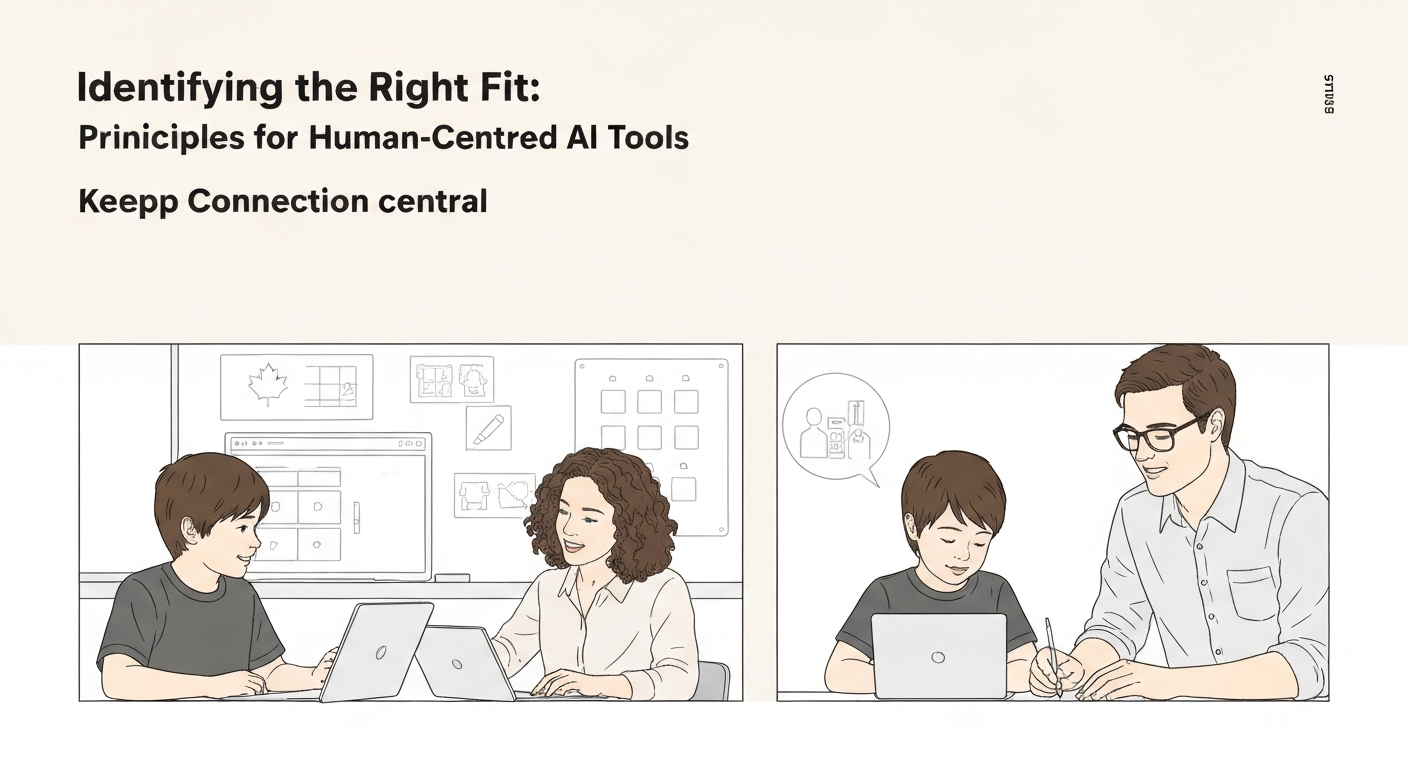
Identifying the Right Fit: Principles for Human-Centred AI Tools
The real challenge with AI in early childhood education isn't just about adopting new technology; it's about discerning which tools genuinely amplify human connection, rather than merely automating tasks. Many AI solutions promise efficiency, but few are built from the ground up to align with the core pedagogical values of Canadian early learning frameworks, which prioritize holistic child development and strong relationships.
Qualities of Human-Centred AI Tools
- Augmentation, Not Replacement: Effective AI tools enhance an educator's capacity for observation and interaction, never substituting their professional judgment. For instance, an AI that summarizes daily observations, like YochienAI, frees up a kindergarten teacher in Manitoba to spend more one-on-one time with children, rather than typing notes.
- Ethical Design & Transparency: Prioritize tools with clear data privacy policies and robust data security. The Government of Canada's Pan-Canadian Artificial Intelligence Strategy emphasizes responsible AI. Look for transparency in how algorithms work and how data is used, similar to the explicit policies found at YochienAI's privacy policy and security measures.
- Developmental Appropriateness: Tools must align with the specific developmental stages of young children and support play-based learning. This means avoiding screen-time heavy or didactic applications, opting instead for tools that indirectly support the ECE's role, such as generating personalized activity suggestions based on observed interests.
- User-Friendliness for ECEs: AI should reduce administrative burden, not add to it. A senior ECE in Quebec will quickly abandon a complex system. Tools like YochienAI for Schools aim to be intuitive, allowing educators more time for meaningful interactions with children and families.
- Promoting Interaction: The best AI actively creates opportunities for more human connection. By streamlining mundane tasks like record-keeping or parent communication, it liberates educators to engage directly with children, fostering the strong relationships critical for early learning. Research consistently shows these relationships are key predictors of long-term well-being.
Potential Pitfalls to Avoid
- Over-reliance on Automation: Some tools might promise to "personalize learning" but inadvertently reduce the need for an educator's nuanced, in-the-moment responses. A 2022 survey showed 60% of Canadian parents worry about technology's impact on social development, highlighting this risk.
- Opaque Data Practices: Tools that lack clear consent mechanisms or don't detail how child data is stored and used can erode trust. Any system that isn't transparent about its large language models (LLMs) or data handling poses a significant ethical concern.
- Screen-Time Heavy Approaches: AI applications designed for direct child interaction on screens often conflict with guidelines for young
A Practical Checklist: Evaluating AI Tools for Connection and Development
A Practical Checklist: Evaluating AI Tools for Connection and Development
The sheer volume of new AI tools can feel overwhelming for Canadian ECEs, yet a structured evaluation process can simplify choosing solutions that genuinely support human-centred AI. This practical checklist helps early learning programs rigorously assess tools, ensuring they enhance connection and align with developmental goals, rather than merely digitizing existing tasks.
Evaluation Category Key Questions for ECEs Example or Consideration Connection Enhancement Does this AI tool free up educator time for direct child interaction? Does it improve parent communication? A tool like YochienAI for Parents can streamline daily updates, letting educators focus on children during program hours. Developmental Alignment How does the tool support play-based learning and holistic child development, consistent with CMEC guidelines? Does it offer activity suggestions that promote social-emotional learning, such as those found on YochienAI Activities? Ethical & Privacy Standards Is child data encrypted and stored securely within Canada? Are consent processes clear and compliant with provincial privacy laws? Verify the tool's security protocols (e.g., YochienAI's security page) and its transparency on data usage. ECE Empowerment & Usability Does the tool significantly reduce administrative workload for educators? Is it intuitive to learn and integrate into daily routines? Consider tools like YochienAI for Schools that aim to simplify observation and reporting without extensive training. Bias Mitigation Are there mechanisms to ensure the AI tool does not perpetuate or amplify biases related to gender, culture, or developmental differences? Look for tools developed with diverse data sets and transparent algorithms to avoid unintended disparities in observation or suggestion. Using this framework helps ECEs move past generic marketing to pinpoint tools that deliver tangible benefits, aligning with the core principles of Keeping Connection Central: What 'Human-Centred AI' Means for Canadian Early Childhood Educators and How to Choose Tools That Support It.
This systematic approach helps Canadian ECEs confidently navigate the options, ensuring selected AI tools genuinely support human connection and developmental goals, rather than introducing new complexities or ethical dilemmas. A 2022 survey indicated that 60% of Canadian parents express concerns about the impact of technology on their children's social development, underscoring the need for careful, transparent tool selection.
Integrating AI: Strategies to Enhance, Not Replace, Human Interaction
While the global market for artificial intelligence (AI) in education is projected to exceed $20 billion by 2027, the real challenge for Canadian Early Childhood Educators (ECEs) isn't just adopting AI, but ensuring it actively strengthens the human connections vital for child development. The irony is that AI, often perceived as isolating, can actually create more opportunities for genuine interaction if integrated thoughtfully. This means shifting focus from merely automating tasks to strategically reallocating educator time towards meaningful engagement.
1Reallocate Time from Admin to Interaction
AI tools, defined as computer systems capable of performing tasks that typically require human intelligence, can manage routine administrative burdens. For example, generative AI can draft observation notes, compile daily reports, or produce parent newsletters. This frees a senior kindergarten teacher in Edmonton from 30 minutes of daily paperwork, allowing them to spend that time facilitating a complex block-building project or engaging in one-on-one dialogue with a child exploring emotions through dramatic play. This direct time reallocation ensures that technology serves to amplify, not diminish, human presence during critical learning moments.
2Personalize Learning Through AI-Informed Insights
AI can analyze anonymized data on child engagement patterns or developmental progress, offering educators insights they might otherwise miss. A daycare in Halifax, for instance, might use an AI-assisted observation platform like YochienAI to quickly document a child's emerging interest in specific animals. This allows an ECE to proactively introduce animal-themed books, art supplies, or outdoor exploration activities, tailoring the play-based curriculum to individual fascinations and fostering deeper, more personalized interactions. The AI doesn't teach; it provides the data points for the ECE to teach better.
3Enhance Parent-Educator Partnerships
Strong home-school connections are fundamental. AI tools can streamline communication, enabling more frequent and substantive updates to parents. Platforms like YochienAI for Parents allow educators to share photos, videos, and brief developmental summaries efficiently. This fosters a shared understanding of a child's day and progress, moving beyond generic updates to specific examples of learning and growth, thereby strengthening the parent-educator bond. A 2022 survey indicated that 60% of Canadian parents express concerns about technology's impact on social development; transparent, enriched communication can address this directly.
4Amplify Observational Capacity
Consider an Ontario daycare utilizing AI-assisted observation to document developmental milestones. Instead of an educator manually typing notes about a child's fine motor skills, the AI system can quickly log key observations from brief inputs. This allows the ECE to remain present and engaged with the children, facilitating group play or one-on-one interactions, rather than stepping away to record. This approach
Canadian Context: Navigating Guidelines and Best Practices for ECEs
The Canadian approach to AI integration in early childhood education (ECE) often feels like navigating a dense forest without a clear trail map. While the Government of Canada's Pan-Canadian Artificial Intelligence Strategy (renewed 2021) outlines broad ethical considerations for responsible AI development, specific, actionable guidance for ECE settings remains scarce. This leaves many early childhood educators in provinces like Nova Scotia and British Columbia struggling to reconcile innovative tools with existing provincial regulations and pedagogical frameworks, often defaulting to caution rather than informed adoption.
Provincial acts, such as Ontario's Child Care and Early Years Act, 2014, dictate stringent requirements for child care operations, including how technology is used and how children's data is handled. Any AI tool must respect these directives. For instance, an AI-powered observation tool that records children's activities must comply with Canadian privacy laws like the Personal Information Protection and Electronic Documents Act (PIPEDA) or its provincial equivalents. This means data must be securely stored, ideally with data residency within Canada, and clear consent mechanisms are paramount. A 2022 survey indicated that 60% of Canadian parents express concerns about the impact of technology on their children's social development, underscoring the need for transparent data practices.
Adopting a human-centred AI approach in Canada means prioritizing tools that align with our national pedagogical emphasis on play-based learning and holistic development, rather than those focused solely on academic benchmarks. The Canadian Council of Ministers of Education (CMEC) consistently highlights social-emotional skills as critical. This perspective informs our Canadian Regulatory & Pedagogical Alignment Framework, which helps ECEs evaluate AI tools for adherence to these principles.
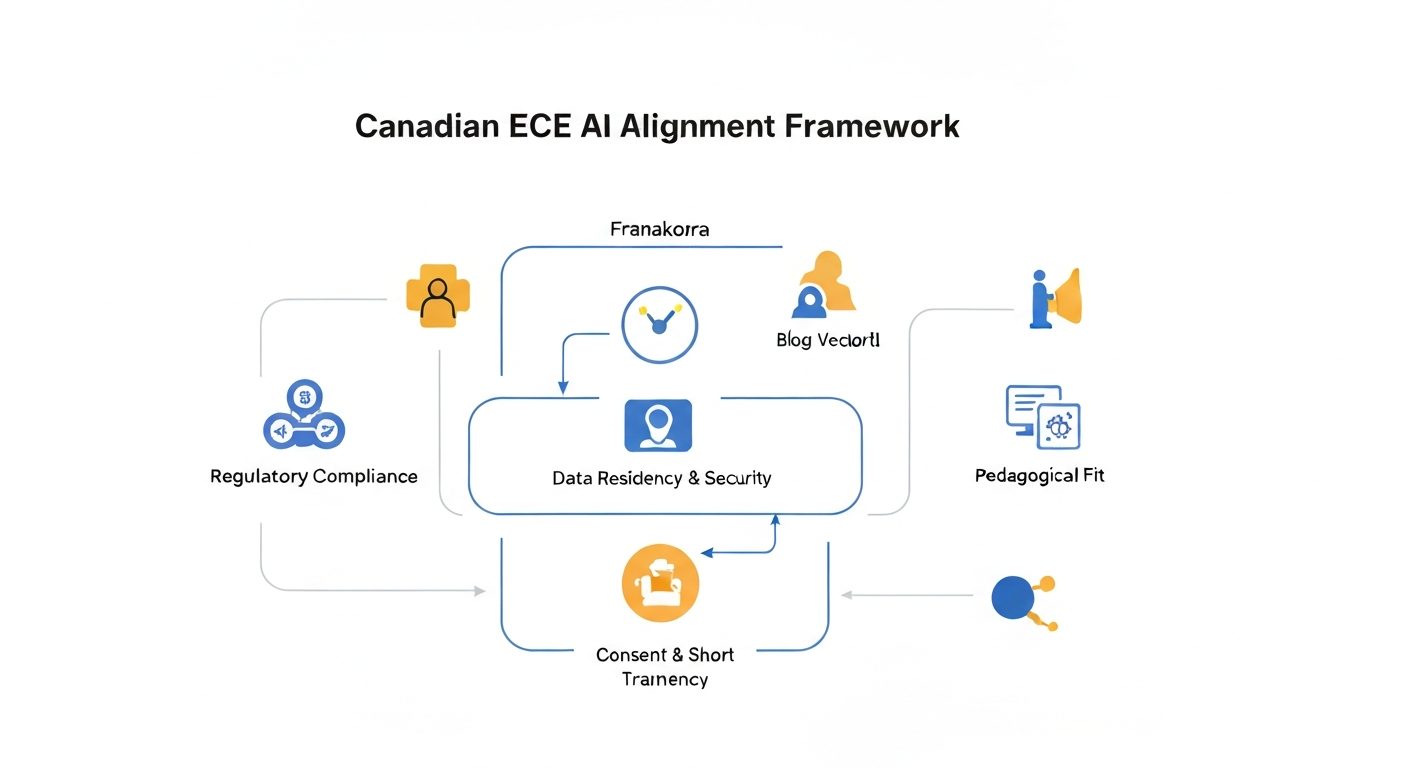
Canadian ECE AI Alignment Framework By using this framework, ECEs can move beyond generic AI discussions to make informed decisions about Keeping Connection Central: What 'Human-Centred AI' Means for Canadian Early Childhood Educators and How to Choose Tools That Support It. This structured evaluation helps ensure that any AI implemented in a Canadian ECE setting enhances, rather than detracts from, the crucial human interactions that define early learning.
Addressing Concerns: Communicating Human-Centred AI to Parents and Staff
Addressing Concerns: Communicating Human-Centred AI to Parents and Staff
Introducing artificial intelligence into early childhood education often surfaces immediate skepticism, particularly among parents. A 2022 survey indicated that roughly 60% of Canadian parents express concerns about technology's impact on their children's social development. This apprehension highlights a critical need for transparent, proactive communication when implementing human-centred AI tools in settings like a Winnipeg daycare or a preschool in rural Nova Scotia.
Effective communication transforms apprehension into understanding. Educators must clearly articulate why and how human-centred AI tools are being used, emphasizing their role in enhancing, not replacing, human connection and educator capacity. For instance, explaining that an AI observation tool, such as YochienAI, helps a senior kindergarten teacher in Surrey, BC, quickly analyze developmental patterns from notes, thereby freeing them to spend more direct, quality time interacting with children, makes the benefit tangible.
"We don't just tell parents we're using AI; we show them how it helps us spend more time on what truly matters: connecting with their child. That clarity makes all the difference." — Kindergarten administrator, Toronto
Highlight the direct benefits for families: how AI provides personalized insights into a child's progress and improves communication. Tools like YochienAI, for example, offer features specifically for parents, allowing educators to share meaningful observations and progress updates more efficiently. This shifts the perception from AI as a barrier to AI as a bridge for better understanding a child's learning journey.
Addressing privacy and data security concerns head-on is non-negotiable. Clearly explain the robust measures in place, such as YochienAI's security protocols, and how the program complies with Canadian regulations like provincial privacy acts. A daycare director in Calgary might hold an information session, distributing a handout that outlines the specific data encryption methods used and the policy for data retention, fostering trust.
Finally, create open forums for questions and feedback. A monthly "Tech Talk" session for parents and staff at a Quebec CPE (Centre de la petite enfance) can foster a collaborative environment where concerns about screen time or data handling are openly discussed. This strategy directly tackles skepticism about AI's actual benefits versus its potential risks and the 'de-humanizing' perception, ensuring that the core principle of Keeping Connection Central: What 'Human-Centred AI' Means for Canadian Early Childhood Educators and How to Choose Tools That Support It remains at the forefront.
Frequently Asked Questions About Human-Centred AI in Canadian ECE
Canadian Early Childhood Educators (ECEs) and parents often have practical questions about integrating AI into early learning environments without sacrificing the vital human element. Understanding how human-centred AI functions in a daycare setting is crucial for keeping connection central.
Quick Reference: Human-Centred AI in ECE
How does AI enhance human connection?By automating administrative tasks like record-keeping or generating progress reports, AI frees up educators. A senior kindergarten teacher in Edmonton, for example, might save 30 minutes daily on documentation, allowing more time for direct interaction, responsive care, and observing children's unique play patterns.
What about privacy in Canadian daycares?Key concerns include data security, explicit consent for collecting child data, and ensuring data storage remains within Canada. Always review a tool's privacy policy (e.g., YochienAI's privacy policy) and security measures to ensure compliance with federal and provincial privacy laws like PIPEDA.
Are there specific Canadian AI regulations for young children?While no single AI-specific ECE regulation exists, provincial child care acts (like Ontario's Child Care and Early Years Act) and federal/provincial privacy legislation govern data handling and technology use. Responsible AI development, as highlighted by the Pan-Canadian Artificial Intelligence Strategy, emphasizes ethical considerations across all sectors.
How do I explain human-centred AI to skeptical parents?Focus on how the AI supports the educator's ability to connect with their child, personalize learning activities, and improve communication, rather than replacing human interaction. For instance, explaining that an AI tool helps an educator track a child's emergent interests more effectively, leading to tailored play invitations, builds trust.
Will AI replace ECEs?Human-centred AI is designed to augment, not replace, the irreplaceable role of ECEs. Research consistently demonstrates that strong, positive relationships between children and educators are critical for long-term success and well-being. AI handles data; ECEs foster relationships, emotional support, and creative learning environments.
Where can I find examples of human-centred AI tools for Canadian ECEs?Look for tools developed with Canadian ECEs in mind, focusing on observation, communication, and administrative support. YochienAI, for example, offers AI-assisted observation to help educators see every child more clearly, providing developmental insights and streamlining parent updates.
These questions highlight the practical considerations for Keeping Connection Central: What 'Human-Centred AI' Means for Canadian Early Childhood Educators and How to Choose
Frequently Asked Questions
What is human-centred AI for early childhood educators in Canada?
Human-centred AI in Canadian early childhood education refers to tools designed to support educators and children, enhancing learning experiences without diminishing human connection. These AI applications, like smart scheduling assistants or personalized activity suggestions, aim to free up ECEs for direct interaction, aligning with frameworks such as Ontario's "How Does Learning Happen?". The focus is on augmenting human capabilities, ensuring technology serves pedagogical goals and strengthens relationships, rather than automating core human functions.How can Canadian ECEs choose AI tools that support child development and connection?
Canadian ECEs should prioritize AI tools that align with provincial early learning frameworks, like British Columbia's Early Learning Framework, and enhance, not replace, hands-on activities. Look for tools that minimize screen time, offer robust data privacy protections compliant with Canadian regulations, and are intuitive for educators. Examples include AI-powered administrative assistants that reduce paperwork, allowing more direct child interaction, or adaptive learning platforms that suggest offline activities. The goal is to select technology that genuinely supports developmental goals and strengthens relationships.Why is maintaining human connection important when using AI in Canadian early learning?
Maintaining human connection is paramount because early learning hinges on responsive relationships for healthy development. ECEs in Nova Scotia, for instance, understand that children learn emotional regulation, empathy, and social skills primarily through direct interaction with caring adults and peers. AI tools, while helpful for tasks like curriculum planning or resource organization, cannot replicate the nuanced emotional feedback, spontaneous play, or deep attachment that human educators provide. Technology should always serve to enhance these vital human bonds, not diminish them.Is AI safe for young children in Canadian daycare settings?
AI can be safe for young children in Canadian daycare settings if implemented thoughtfully. Key considerations include strict adherence to data privacy laws, ensuring age-appropriate content, and minimizing screen time, aligning with Canadian Paediatric Society recommendations. Tools like AI-powered interactive storybooks, when used sparingly and with adult guidance, can be beneficial. However, unchecked use or tools that collect excessive personal data pose risks. ECEs must critically evaluate each tool's design, purpose, and potential impact on child well-being and privacy before integration.Can AI replace human interaction in Canadian early childhood education?
No, AI cannot replace human interaction in Canadian early childhood education. The core of early learning is built on responsive relationships, emotional support, and complex social interactions that AI cannot replicate. A kindergarten teacher in Quebec, for example, provides nuanced guidance, comfort, and spontaneous learning opportunities essential for development. AI tools, such as adaptive learning games or administrative aids, serve as valuable supports, freeing educators for more direct engagement. They augment human capabilities, but the foundational role of human connection remains irreplaceable for holistic child development.Keep reading
All articles →Smart Choices for Canadian ECE: Evaluate AI Tools Critically
Making Smart Choices for Canadian ECE: How to Evaluate AI Tools with Critical Thinking often means looking past the marketing hype to understand what AI actually does. The true value in early learning isn't just adopting new tools, but discerning their alignment with play-based learning and holistic development.
Designing for Little Hands and Big Hearts: Human-Centred AI in Canadian ECE
Human-Centred AI (HCAI) in Canadian early childhood education (ECE) isn't about complexity; it's about intentional simplicity. It aims to augment educator observation skills and deepen parent engagement, ensuring technology serves children's developmental needs.
Before You Click: 8 Essential Questions Canadian ECEs Should Ask About New AI Tools
Canadian ECEs face an overwhelming influx of new AI tools, many ill-suited for young children's unique developmental needs. This demands a structured approach to prevent pedagogical missteps and privacy breaches as the AI in education market skyrockets.


