
Human-Centred AI in Canadian ECE: Principles for Keeping Humanity at the Heart
The true innovation for Canadian Early Childhood Education (ECE) lies not in AI's capacity to replace human tasks, but in its ability to amplify human connection. Human-centred AI is designed to augment rich, play-based interactions, prioritizing child well-being and supporting educator judgment.

Defining Human-Centred AI in the Canadian ECE Context
While much of the public discourse around artificial intelligence in education focuses on its potential to deliver individualized learning paths or automate grading, the true innovation for Canadian Early Childhood Education (ECE) lies not in AI's capacity to replace human tasks, but in its ability to amplify human connection. Human-centred AI (HCAI) in this context means technology explicitly designed to augment, not diminish, the rich, play-based interactions central to Canadian ECE curricula, prioritizing the well-being and holistic development of every child and supporting the educator’s professional judgment.
HCAI distinguishes itself from mere "tech for tech's sake" by aligning directly with the core values of Canadian early learning frameworks, such as Ontario's How Does Learning Happen? or British Columbia's Early Learning Framework. Instead of imposing standardized, impersonal solutions, HCAI tools aim to enhance the child's social-emotional development, foster creativity, and support cognitive growth through play. For instance, an HCAI tool might analyze observational notes to highlight a child’s emerging interests, freeing an educator from hours of manual data entry to instead engage directly with children in a mud kitchen or block area.
This approach resonates with the Canadian government's broader commitment to responsible AI development, as outlined in the Pan-Canadian AI Strategy, which emphasizes ethical considerations and public trust. For ECE, this translates into ensuring AI tools are transparent, accountable, and respect the unique developmental needs of young children. Tools like YochienAI exemplify this philosophy by focusing on supporting educators to "see every child more clearly" through AI-assisted observation, rather than dictating learning outcomes. This allows educators in settings from a rural Manitoba daycare to a large urban Quebec garderie to spend less time on paperwork and more time facilitating meaningful interactions.
Ultimately, keeping humanity at the heart of AI in Canadian ECE means a deliberate shift away from automation as an end goal. It means leveraging intelligent systems to provide insights that help educators, strengthen parent-teacher communication, and enrich the child's learning journey, all while preserving the irreplaceable value of human relationships and expert pedagogical practice.
The Core Principles: Keeping Children and Educators at the Heart of AI Design
The Core Principles: Keeping Children and Educators at the Heart of AI Design
The widespread anxiety that artificial intelligence (AI) will diminish human connection in early childhood education (ECE) often overlooks a critical prerequisite: AI tools, by their very nature, require human-designed ethical guardrails to be effective and beneficial. Without intentional, human-centred design, AI risks becoming just another technological distraction rather than a genuine support for children's development and educators' practice. Keeping Humanity at the Heart: Principles for Human-Centred AI in Canadian Early Childhood Education means prioritizing the well-being and agency of every child, and supporting every educator.
For AI to truly serve Canadian ECE, five foundational principles must guide its integration. First, Child Agency & Well-being First demands that any AI tool respects children's rights, actively fosters their holistic development, and never compromises their safety or autonomy. For instance, an AI-assisted observation platform like YochienAI can help identify developmental milestones or areas needing support, but the child’s data is never used for predictive judgment or to limit their choices in a play-based environment. Second, Human Oversight & Augmentation ensures AI helps educators, freeing them from administrative burdens to maximize direct interaction. Industry reports indicate that ECE professionals spend a significant portion of their day on documentation; AI can streamline this, allowing a senior kindergarten teacher in Halifax to dedicate more time to play-based learning rather than report writing.
Third, Transparency & Explainability is vital. Educators and parents must understand how an AI system functions and makes its recommendations. If an AI suggests a particular learning activity, the underlying reasoning should be clear, enabling trust and verification. Fourth, Data Privacy & Security by Design means robust measures protect sensitive child and family data, adhering strictly to Canadian privacy acts like PIPEDA and provincial regulations in jurisdictions like Ontario or British Columbia. Finally, Equity & Inclusion mandates that AI is accessible and beneficial for all children, actively designed to avoid biases that could exacerbate existing inequalities or marginalize specific groups, such as children with diverse learning needs or from different cultural backgrounds.
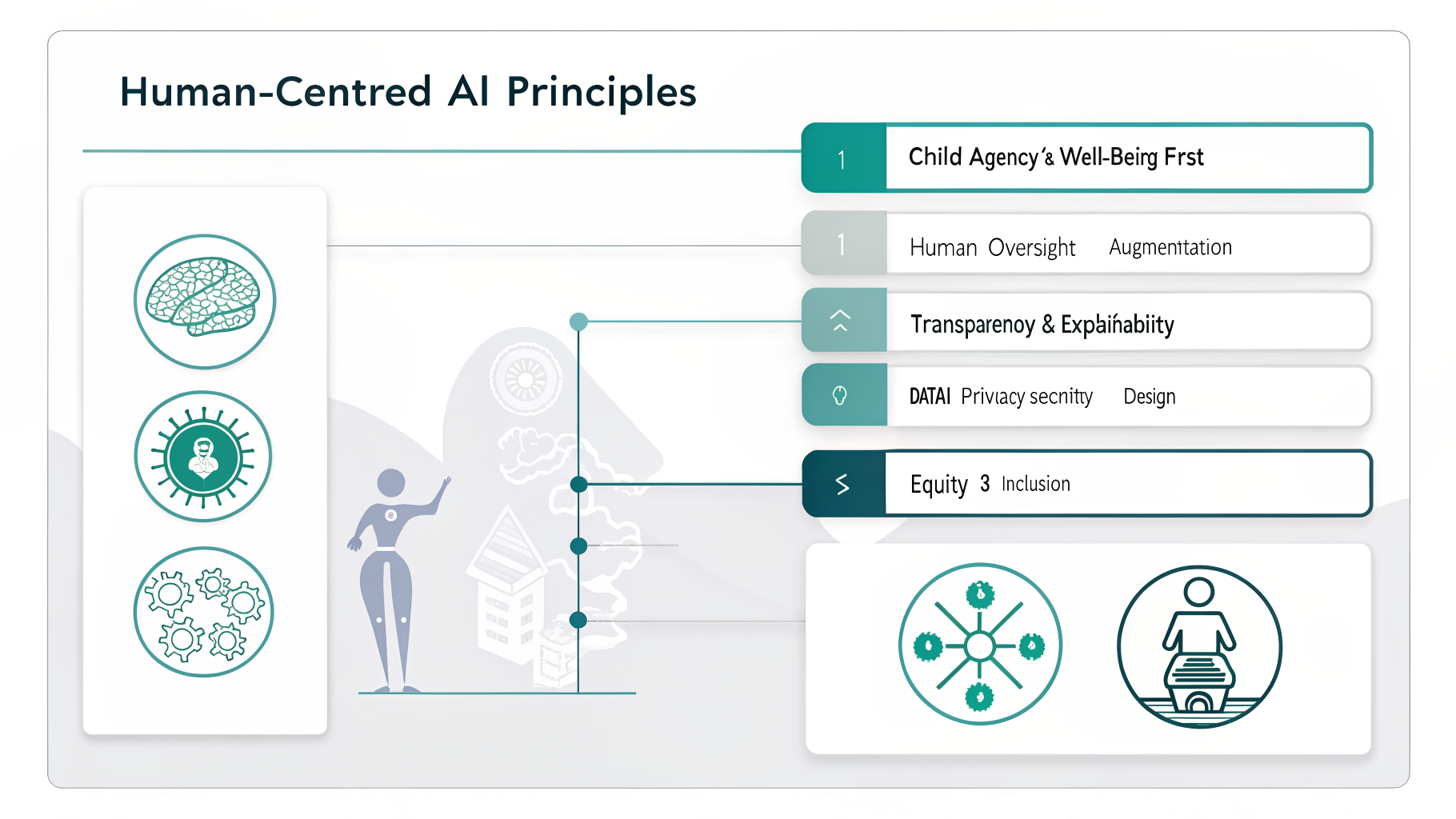
These principles are not theoretical ideals; they form a practical framework for evaluating and integrating AI tools into Canadian ECE. They act as a compass, ensuring every technological decision remains anchored in the unique needs of young children and the invaluable role of their educators.
Putting Principles into Practice: Real-World Examples for Canadian ECE Settings

Moving beyond theoretical discussions, the true test of human-centred AI lies in its practical application within Canadian early childhood education settings. Thoughtful integration means AI tools enhance, rather than diminish, the rich, play-based learning environments that define our programs, always Keeping Humanity at the Heart: Principles for Human-Centred AI in Canadian Early Childhood Education.
AI for Enhanced Observation & Assessment
AI can act as a silent assistant, helping educators observe patterns in children's play and interactions that might otherwise be missed in a busy classroom. For example, platforms like YochienAI use AI-assisted observation to process anonymized data.C. preschool classroom, flagging potential developmental milestones or areas needing support. This doesn't replace an educator's judgment; it provides objective data points, freeing up a senior kindergarten teacher in Edmonton to spend more time directly engaging with children, knowing the AI is helping track broad trends.
AI for Personalized Learning Support
Adaptive learning tools, when mediated by an educator, can suggest activities tailored to a child's unique developmental stage. Imagine an AI tool recommending specific outdoor play activities for a child in a Montreal daycare who shows emerging spatial reasoning skills, based on prior observations. The key here is that the AI suggests, but the educator decides, integrates the idea into the existing play-based curriculum, and facilitates the interaction. The child experiences a personalized activity, but the human connection remains central.
AI for Administrative Efficiency
One of AI's most immediate benefits is its capacity to automate routine administrative tasks. Tools can handle attendance tracking, schedule reminders for parent-teacher interviews in a Toronto early learning centre, or even draft initial versions of daily activity reports. Industry reports indicate that administrative burdens consume a significant portion of an ECE's day. By offloading these tasks, AI allows educators to reclaim valuable time—time that can be redirected towards direct child interaction, curriculum planning, or professional development.
AI for Parent Communication
AI can streamline and personalize communication with families. Secure platforms can summarize a child's day, highlight specific achievements, or suggest at-home activities aligned with classroom learning.
Addressing Ethical Concerns: Data Privacy, Bias, and Child Well-being
Addressing Ethical Concerns: Data Privacy, Bias, and Child Well-being
The most significant barrier to AI adoption in Canadian early childhood education isn't technical complexity, but rather the deep-seated anxieties of parents and educators regarding data privacy, algorithmic bias, and the potential erosion of human connection. Thoughtful integration of AI demands a proactive stance on these ethical considerations, aligning with Canadian regulatory frameworks and prioritizing the unique vulnerabilities of young children.Safeguarding Children with Responsible AI
- Canadian Data Privacy Compliance: Adhering to the federal Personal Information Protection and Electronic Documents Act (PIPEDA) and provincial acts like Ontario's Freedom of Information and Protection of Privacy Act (FIPPA) ensures explicit consent is obtained before collecting any child data, and that robust security measures protect it. Providers like YochienAI, built in Ontario, typically design with these regulations in mind.
- Mitigating Algorithmic Bias: Developers can actively test AI models using diverse datasets representing various socio-economic backgrounds, cultural contexts, and developmental stages found across Canada. This proactive approach helps identify and correct biases that might otherwise lead to inequitable recommendations for a child in Nunavut versus one in downtown Montreal.
- Prioritizing Child Well-being: AI tools, such as an observation assistant, can reduce educator paperwork, freeing up time for more direct, play-based interactions. This ensures AI supports, rather than replaces, the essential human connection and unstructured play critical for social-emotional development, as highlighted by NAEYC guidelines.
- Transparency and Accountability: Clear policies outlining how AI uses data, who has access, and mechanisms for correcting errors build trust. For instance, a childcare centre in Vancouver using an AI tool for progress reports should have a published policy detailing data retention and parent access rights, fostering confidence in the system.
Potential Ethical Pitfalls to Avoid
- Inadequate Consent & Security: Failing to secure explicit, informed consent from parents for data collection, or using platforms with weak encryption, violates privacy laws and erodes trust. A breach of child data in a public school board, for example, could trigger significant legal and reputational damage.
- Unchecked Algorithmic Bias: This could particularly affect Indigenous children if their unique learning contexts are not represented.
- Over-reliance and Screen Time: Excessive use of AI-driven educational apps can inadvertently increase screen time, detracting from crucial hands-on play and peer interaction. A kindergarten teacher in Halifax noted,
- Lack of Transparency: When parents and educators don't understand how an AI tool makes recommendations or uses data, it fosters suspicion and resistance. Opaque systems prevent meaningful oversight and make it difficult to address concerns or challenge outputs.
A Human-Centred AI Checklist: Evaluating Tools for Your Program
Evaluating AI tools for early childhood education often feels like navigating a new language, but the core questions remain human-centred: does it truly serve the child and the educator, or just the technology? Many educators in Canadian early learning programs express concern that AI will diminish human connection. A practical checklist helps cut through the hype, ensuring that any AI integration upholds the foundational principles of Keeping Humanity at the Heart: Principles for Human-Centred AI in Canadian Early Childhood Education.
This checklist provides a framework for ECE professionals to assess AI solutions, moving beyond surface features to scrutinize their alignment with child development, educator support, and ethical standards. It helps programs, like a Montessori school in Vancouver considering a new observation platform, systematically compare options.
| Principle Area | Key Questions for Evaluation | Example: Human-Centred AI Tool (YochienAI) |
|---|---|---|
| Child-Centric Design | Does it enhance play-based learning and social-emotional skills without replacing direct interaction? | Assists educators in documenting observations, allowing more time for direct engagement during free play; never interacts directly with children. |
| Educator Support | Does it reduce administrative burden, freeing educators for child engagement and professional growth? | Automates report generation and parent communication, helping reduce paperwork for early-childhood educators. |
| Data Governance & Security | Are data privacy policies clear, compliant with Canadian regulations (e.g., PIPEDA, provincial acts), and data securely stored? | Data encrypted at rest and in transit, stored on Canadian servers, with clear consent protocols for parents outlined in the privacy policy. |
| Transparency & Explainability | Can the AI's functions and outputs be easily understood and explained to parents and staff? | Provides plain-language summaries of developmental insights, allowing educators to easily articulate observations and AI-generated suggestions to parents. |
| Bias Mitigation | Has the tool been tested for fairness and equity across diverse child populations and learning styles? | Developed with input from diverse Canadian ECE programs (e.g., rural Saskatchewan, urban Montreal) to minimize cultural or linguistic bias in its observation analysis. |
| Parental Involvement | Does it facilitate meaningful communication and collaboration with parents, respecting their role? | Offers customizable parent portals for secure updates and two-way communication, allowing parents to contribute insights and guide AI use. |
By using such a checklist, ECE leaders can ensure that AI tools are not merely adopted for their technological novelty, but are instead carefully integrated to genuinely support the holistic development of children and the vital work of educators.
The Role of Educators and Parents in Guiding AI Integration

The Indispensable Role of Educators and Parents
The most significant irony in the discussion around artificial intelligence (AI) in early childhood education (ECE) is the common fear that technology will sideline human connection, when in reality, human guidance is AI's most critical prerequisite for success. Without engaged educators and informed parents, AI tools—even those designed with the best intentions—risk becoming mere distractions or, worse, detrimental to child development. Tools like large language models (LLMs) that generate text, or machine learning algorithms that identify patterns, are only as effective and ethical as the humans who select, implement, and interpret their outputs. Educators, far from being replaced, become architects of AI integration. A kindergarten teacher in rural Saskatchewan, for example, needs professional development to critically evaluate an AI-powered observation tool like YochienAI. They must understand how it processes data to suggest insights, not just how to click buttons. This equips them to adapt the tool to their specific classroom context, ensuring it supports play-based learning and social-emotional development rather than disrupting it. Many Canadian ECE professionals may not yet feel fully prepared to assess educational technology, which points to a clear need for targeted professional development. Supporting parental partnership is equally vital. Parents in Halifax, concerned about screen time and data privacy, need clear, open communication from their child's daycare about why and how AI tools are used. This includes explaining what data is collected, how it's protected, and how it directly benefits their child's learning journey. Informed consent, as outlined by Canada's privacy acts, isn't just a legal formality; it's a cornerstone of trust. Resources like YochienAI's parent information page help bridge this communication gap. This collaborative spirit extends to co-creating policies and guidelines. An ECE centre in Vancouver could establish a working group of educators, administrators, and parents to draft local policies for AI use, ensuring they reflect community values and prioritize child well-being. This proactive approach ensures that AI serves to enhance the irreplaceable human relationships between children, educators, and families, thereby truly Keeping Humanity at the Heart: Principles for Human-Centred AI in Canadian Early Childhood Education. The next step involves exploring how these principles translate into tangible practices within diverse Canadian ECE settings.Challenges and Opportunities in Adopting Human-Centred AI
Challenges and Opportunities in Adopting Human-Centred AI
A surprising irony in the rapid growth of AI in early childhood education (ECE) is that the most advanced tools often require the most foundational human skills to implement successfully. While the global education technology market sees significant AI expansion, Canadian ECE professionals and parents frequently express valid skepticism, fearing AI might erode the essential human connection at the heart of early learning. This concern isn't unfounded; without deliberate human-centred design, AI could indeed become a distraction rather than a support. Addressing this skepticism requires transparent communication and practical demonstrations of AI's supportive role. Many educators in provinces like British Columbia or Nova Scotia worry about AI replacing the nuanced observations only a human can make. They also cite concerns about potential negative impacts on child development, particularly regarding screen time for preschoolers. However, when integrated thoughtfully, AI tools – such as those assisting with observation and documentation – can free up valuable educator time, allowing for more direct, meaningful interaction with children. These views highlight both the apprehension and the potential. The significant parental concern underscores the need for AI solutions that clearly articulate their benefits without compromising child well-being or privacy, aligning with Canada's Digital Charter principles. The potential for administrative task reduction, perhaps through tools that automate observation summaries or parent communication, directly addresses a major pain point for educators. Imagine a kindergarten teacher spending less time on documentation and more time facilitating play-based learning or engaging in one-on-one conversations. This efficiency gain, however, requires substantial upfront investment in both technology and professional development. Funding and infrastructure remain practical hurdles. Smaller, rural daycares in Saskatchewan, for instance, might lack the broadband internet or device access necessary for robust AI integration. Furthermore, providing adequate training for educators to confidently utilize and critically assess AI tools is an ongoing challenge. Successful adoption isn't just about the technology, but about supporting the people who use it. The opportunity for enhanced learning is profound when Human-Centred AI (HCAI) is applied thoughtfully. AI can provide personalized insights into a child's developmental trajectory, supporting diverse learners by flagging specific needs or suggesting tailored activities. For example, an AI-powered observation platform like YochienAI can help an educator in Montreal identify patterns in a child's play that suggest emerging interests or areas needing more support, enriching the educational experience without replacing human judgment. This type of tool helps educators dedicate more time to direct child interaction and fostering creativity, truly Keeping Humanity at the Heart:Beyond the Hype: The Future of Responsible AI in Canadian Early Learning
The deepest irony of integrating artificial intelligence (AI) into early childhood education is that its greatest success lies not in its own capabilities, but in its capacity to amplify human connection. Despite widespread anxieties, the future of responsible AI in Canadian early learning does not involve replacing educators with algorithms; instead, it promises to free up valuable time for the meaningful interactions that truly shape young minds.
Human-Centred AI in ECE: Future Outlook
Human-centred AI (HCAI) is designed to augment, not supplant, the irreplaceable role of human educators. For instance, an AI tool might analyze observation notes to identify patterns in a child's play, allowing a senior kindergarten teacher in Halifax to spend less time on administrative tasks and more time engaging directly with children on their social-emotional development. The goal is to foster deeper connections, not diminish them.
HCAI frameworks are inherently flexible. They incorporate new pedagogical insights, such as evolving understanding of play-based learning, and integrate technological advancements while upholding core ethical principles. This ensures tools remain relevant and beneficial, adapting to the unique needs of Canadian early learning environments.
Expect continued development of national and provincial guidelines. Initiatives like Canada's Pan-Canadian AI Strategy and existing privacy acts (e.g., PIPEDA) will guide responsible innovation, ensuring that AI tools used in a Calgary daycare or a Quebec preschool adhere to high standards of data protection and child well-being.
Addressing disparities in funding and infrastructure is crucial. A federal program might offer subsidies for HCAI tools in rural Manitoba daycares, ensuring all children and educators, regardless of location or socioeconomic status, can benefit from ethical AI support. This requires proactive policy and investment.
Start with education and pilot programs. For a Toronto ECE center, this might mean trialing a specific AI-assisted observation tool like YochienAI, which focuses on educator support, and then engaging in dialogue with providers who prioritize HCAI principles and Canadian ECE values. Focus on understanding how these tools align with your program's existing philosophy.
Ultimately, the long-term vision for Keeping Humanity at the Heart: Principles for Human-Centred AI in Canadian Early Childhood Education hinges on a collective commitment to ethical design and continuous evaluation. By prioritizing the unique developmental needs of young children and supporting educators, we can ensure that AI serves as a helpful ally in enhancing, not undermining, the foundational human relationships that define quality early learning experiences.
Frequently Asked Questions
What is human-centered AI in Canadian early childhood education?
Human-centered AI in Canadian ECE prioritizes children's development and educator well-being. It involves designing artificial intelligence tools, like adaptive learning platforms or administrative assistants, to augment human capabilities, not replace them. For instance, an AI tool might help a kindergarten teacher in Alberta personalize learning activities by analyzing engagement patterns, allowing the teacher more time for direct interaction. The goal is to ensure technology serves pedagogical goals and supports the unique needs of Canadian early learners, respecting cultural and linguistic diversity.
How can AI be used responsibly in Canadian ECE settings?
Responsible AI use in Canadian ECE involves strict ethical guidelines and transparent practices. This means employing AI tools, such as speech-to-text for accessibility or scheduling assistants for daycare administrators in Quebec, only when they enhance learning or operational efficiency without compromising child safety or privacy. Educators must receive training on AI limitations and biases. Prioritizing direct human interaction, minimizing screen time, and ensuring parental consent for data use are crucial for maintaining a balanced, child-first approach.
Why is data privacy important for AI tools in early learning?
Data privacy is paramount for AI tools in early learning because children's data, like learning progress or behavioural observations, is highly sensitive. Unauthorized access or misuse could lead to identity theft, targeted advertising, or even discriminatory profiling, impacting a child's future. For a preschool in British Columbia using an AI-powered assessment tool, robust encryption and anonymization protocols are essential. Protecting this data builds trust with parents and ensures that AI supports, rather than exploits, the vulnerable early years population.
Can educators and parents influence AI integration in ECE?
Absolutely, educators and parents are crucial in shaping AI integration in Canadian ECE. Their active participation ensures AI tools meet real pedagogical needs and align with community values. For instance, a parent advisory committee in an Ontario childcare centre could review proposed AI applications, offering feedback on screen time or data collection. Teachers can pilot tools, sharing insights on classroom impact. Advocating for clear policies with provincial education ministries or participating in focus groups helps ensure AI development remains responsive and accountable to its primary stakeholders.
Is human-centered AI beneficial for children's well-being in ECE?
Yes, when implemented thoughtfully, human-centered AI can benefit children's well-being in ECE. It can support individualized learning paths, allowing a child struggling with phonics in a Nova Scotia pre-primary program to receive tailored practice without isolating them. AI can also free up educator time from administrative tasks, enabling more direct, meaningful interactions with children. The key is ensuring AI augments human connection and creativity, respects developmental stages, and never replaces the essential warmth and responsiveness of a human caregiver.
Frequently Asked Questions
What is human-centered AI in Canadian early childhood education?
How can AI be used responsibly in Canadian ECE settings?
Why is data privacy important for AI tools in early learning?
Can educators and parents influence AI integration in ECE?
Is human-centered AI beneficial for children's well-being in ECE?
Keep reading
All articles →
Human-Centred AI in Daycare: One Day, Rules, Sample Policy
Human-centred AI in an early learning centre is a working rule: software can assist, but a named educator decides every choice about a child. This guide shows how that plays out day to day, from reviewing automated reports to writing a short family-friendly policy.
A Practical Checklist for Canadian ECEs Evaluating AI Tools
Most AI guidance treats every tool the same way, which is why evaluations stall. This checklist sorts each tool into a lane first, so Canadian ECEs can decide what to ask vendors and when AI belongs in the classroom.

Putting Children First: A Parent's Guide to Human-Centred AI in Canadian ECE
The true irony of "putting children first" in ECE isn't protecting children from AI, but ensuring they aren't passive data points. This involves designing AI tools that prioritize a child's holistic development, well-being, and safety in the unique Canadian context.