
Navigating AI in Your ECE Classroom: 5 Questions for Canadian Educators
Navigating AI in Your ECE Classroom means facing new curriculum decisions without clear Canadian guidelines. Many educators feel overwhelmed, lacking a structured method to evaluate tools effectively.

Navigating AI in Your ECE Classroom: Essential Questions for Canadian Educators
The true challenge of Navigating AI in Your ECE Classroom: Essential Questions Every Canadian Educator Should Ask Before Adopting New Tools isn't choosing the 'best' AI, but recognizing that every AI tool introduces a new curriculum decision, often without clear, Canada-specific ECE guidelines. While the global AI in education market is projected to grow significantly, this rapid expansion leaves many Canadian educators feeling overwhelmed, lacking a structured method to evaluate tools beyond basic features.
This guide introduces a 'Decision-Pathway' framework, designed to cut through the confusion and help early childhood educators in provinces like Ontario and British Columbia make informed 'Go/No-Go' choices. It moves past simple checklists, offering a robust process to assess AI tools through a child-first, Canadian-context lens. For instance, a senior kindergarten teacher in Edmonton might consider a new AI-powered story generator. The pathway forces a deeper look: Does it genuinely enhance literacy, or simply replace the creative, interactive storytelling crucial for 4-5 year olds?
Our goal is to equip you with essential questions that prioritize early childhood development and align with Canadian values. This means ensuring any adopted AI tool supports, rather than detracts from, the critical human interactions and play-based learning central to programs like Quebec's CPE network. The questions prompt a nuanced evaluation, considering everything from developmental appropriateness to data privacy, fostering thoughtful adoption in your ECE environment.
Why AI in ECE? Balancing Innovation with Early Childhood Principles
Why AI in ECE? Balancing Innovation with Early Childhood Principles
The rapid integration of artificial intelligence (AI) into education presents a surprising paradox for early childhood educators: while the technology promises efficiency, its true value in ECE hinges on its ability to *preserve* and *enhance* human connection and play, not diminish it. Educators in provinces like British Columbia and Ontario increasingly encounter AI tools, yet the core principles of early learning remain non-negotiable. Understanding this tension is the first step in Navigating AI in Your ECE Classroom: Essential Questions Every Canadian Educator Should Ask Before Adopting New Tools.
AI, defined as computer systems capable of performing tasks that typically require human intelligence (like problem-solving or learning), is already transforming administrative loads. Tools like YochienAI, developed in Ontario, use AI-assisted observation to help educators efficiently document milestones, personalize learning insights, and streamline parent communications. This allows a senior kindergarten teacher in Halifax to spend less time on paperwork and more time engaging with children during free play. The global AI in education market is projected to grow significantly, underscoring its inevitable presence in our sector.
Despite this growth, the Canadian Paediatric Society consistently emphasizes the foundational importance of play-based learning, direct human interaction, and hands-on experiences for optimal early childhood development. AI in ECE must serve to augment these principles, not replace them. For instance, an AI tool that identifies a child's emerging interest in dinosaurs through observed play can help an educator curate relevant books and activities, enriching the human-led learning experience.
The Canadian Lens: Navigating Unique Standards, Values, and Regulations
The Canadian Lens: Navigating Unique Standards, Values, and Regulations
Canadian educators face a unique challenge: while global AI trends dominate headlines, the specific provincial and territorial frameworks governing early childhood education (ECE) demand a localized approach. Unlike some jurisdictions, Canada’s Pan-Canadian AI Strategy emphasizes responsible, human-centric AI development, a principle that must extend into every daycare and kindergarten classroom. This means a blanket adoption of AI tools, even highly-rated ones, is often insufficient without careful consideration of local guidelines and community values. For instance, an early learning centre in rural Saskatchewan will have different technology access and community expectations than a large, urban facility in downtown Vancouver. Provincial regulations on screen time, data residency, and curriculum alignment vary significantly. Ontario's "How Does Learning Happen?" framework, for example, prioritizes relationships and engagement, requiring any AI tool to demonstrably support these pedagogical goals, not detract from them. This makes Navigating AI in Your ECE Classroom: Essential Questions Every Canadian Educator Should Ask Before Adopting New Tools. a nuanced process.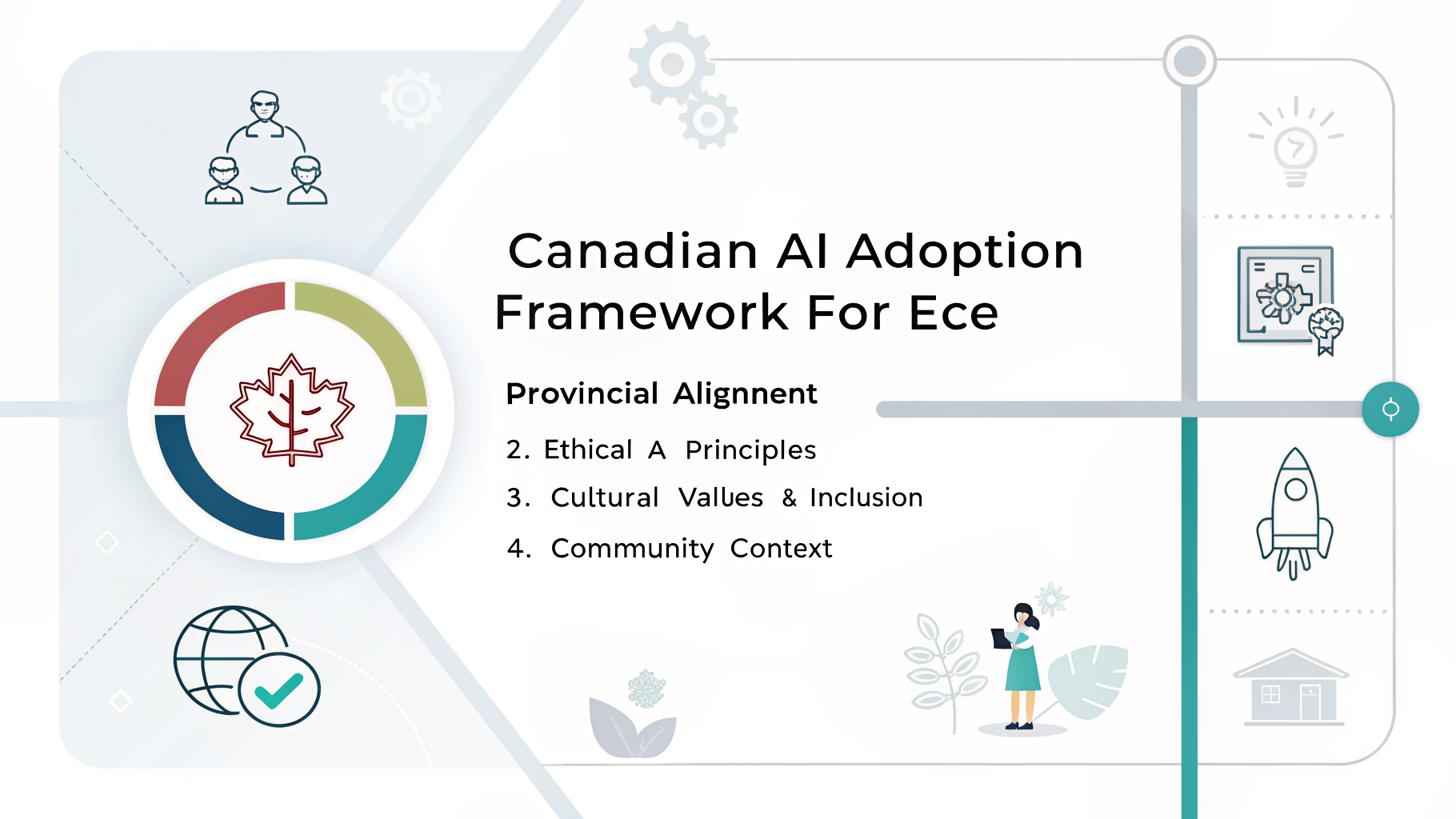
Question 1: Does it Prioritize Child Development and Well-being?

The immediate allure of AI tools can sometimes overshadow their fundamental purpose in early childhood education: serving the child. Before considering any new technology, ask: Does this tool genuinely support healthy development and well-being, or does it introduce risks that outweigh potential benefits? This question is central to Navigating AI in Your ECE Classroom: Essential Questions Every Canadian Educator Should Ask Before Adopting New Tools.
Potential Developmental Benefits
- Personalized Learning Pathways: Tools like customized story apps can adapt to a child's pace, offering tailored vocabulary or concept reinforcement.
- Enhanced Observation: AI-assisted platforms, such as YochienAI, can help educators track developmental milestones, freeing up time for direct interaction.
- Accessibility Support: AI can provide alternative communication methods or adaptive interfaces for children with diverse learning needs, for example, text-to-speech for pre-readers.
- Stimulating Creativity (with caveats): Certain generative AI art tools, when used interactively with an educator, might spark imaginative play by suggesting prompts.
Developmental Risks & Considerations
- Reduced Hands-On Play: Over-reliance on screens can displace critical time for block building, sand play, or outdoor exploration.
- Limited Social Interaction: Excessive individual screen time can diminish opportunities for peer collaboration and verbal communication, crucial for social-emotional growth.
- Impact on Attention Spans: Fast-paced, algorithm-driven content can potentially hinder the development of sustained attention.
- Stifled Independent Problem-Solving: If AI provides all the answers, children may not develop persistence in tackling challenges independently.
A senior kindergarten teacher in Halifax, for instance, might find an AI tool that analyzes vocal patterns for early speech delays incredibly useful. However, that same teacher would likely reject an AI program that replaces collaborative group story time with individual tablet-based reading, recognizing the loss of shared experience and social cues.
Question 2: Is Data Privacy and Security Guaranteed and Transparent?
Question 2: Is Data Privacy and Security Guaranteed and Transparent?
The most sophisticated AI tool becomes a liability if it compromises children's privacy. Educators navigating AI in their ECE classroom must scrutinize how these tools handle sensitive personal information, especially in Canadian contexts where regulations like PIPEDA (Personal Information Protection and Electronic Documents Act) and provincial equivalents (e.g., Ontario's FIPPA, British Columbia's PIPA) set strict standards. A daycare administrator in Alberta, for instance, faces direct legal responsibility for safeguarding every child's developmental records and family contact information.
Transparency is non-negotiable. Before adopting any AI platform, demand clear answers on data collection, storage, and access. This includes understanding if anonymized data contributes to broader AI model training, a common practice that requires explicit consent and careful oversight. For example, a platform like YochienAI explicitly details its security protocols, including encryption standards and access controls, to prevent unauthorized access or breaches.
Understanding an AI tool's data practices requires asking specific questions about how information is managed, from collection to deletion. The following table outlines key areas for inquiry:
| Data Privacy Aspect | Educator's Question | Why It Matters |
|---|---|---|
| Data Collection | What specific types of child data (e.g., observations, photos, names) are collected, and is it truly necessary? | Minimizes data footprint, reducing risk exposure. |
| Data Storage & Access | Where is the data stored (e.g., Canadian servers?), and who within the company can access it? | Ensures compliance with Canadian data residency laws and limits internal exposure. |
| Usage & Sharing | Is data used for AI model training or shared with any third parties? If so, under what conditions? | Protects against commercial exploitation or unintended data dissemination. |
| Parental Consent | How does the tool facilitate explicit, informed parental consent for data collection and usage? | Fosters trust and legal compliance; a key concern for many Canadian parents regarding child data. |
Question 3: How Does it Support (Not Replace) Human Interaction and Social-Emotional Learning?
How Does it Support (Not Replace) Human Interaction and Social-Emotional Learning?
The most sophisticated AI tool becomes detrimental if it isolates children or diminishes the rich, spontaneous interactions fundamental to early childhood development. While AI in education is projected to grow significantly, its application in ECE must actively foster, not hinder, the human connections that teach empathy, cooperation, and self-regulation. A senior kindergarten teacher in Halifax, for example, might consider an AI-powered storytelling app. Does it offer prompts for children to collaborate on a narrative, or does it simply deliver a passive experience?
Effective AI integration encourages dialogue and shared experiences. Tools like YochienAI, which assist educators with observations and developmental insights, are designed to free up teacher time for direct engagement, rather than replacing it. This contrasts sharply with tools that demand extensive solitary screen time. The Canadian Paediatric Society consistently emphasizes play-based learning and human interaction as critical for healthy development. An AI tool should act as a catalyst for these interactions, perhaps by suggesting collaborative activities based on observed interests, rather than serving as a digital babysitter.
Parental concerns about screen time are valid and widespread. When considering AI, educators in mid-sized urban daycares must be ready to articulate how a tool facilitates human connection despite its digital nature. For instance, if an AI program helps children identify emotions, the follow-up must be a guided group discussion led by an educator about expressing those feelings in real-world scenarios. Navigating AI in Your ECE Classroom: Essential Questions Every Canadian Educator Should Ask Before Adopting New Tools. requires ensuring that any technology serves as a bridge to richer human interaction, not a barrier.
Question 4: Is it Developmentally Appropriate, Inclusive, and Accessible for All Children?

Question 4: Is it Developmentally Appropriate, Inclusive, and Accessible for All Children?
The most sophisticated AI tool offers little value if it misses the mark on a child's developmental stage, or worse, excludes them entirely. Many "educational" AI applications are designed for older students, with features like complex text analysis or abstract problem-solving that are simply not appropriate for a three-year-old in a Vancouver daycare. A critical step in Navigating AI in Your ECE Classroom: Essential Questions Every Canadian Educator Should Ask Before Adopting New Tools involves scrutinizing how a tool truly aligns with the concrete, play-based learning needs of early childhood. Consider a tool designed to teach letter recognition. Is it interactive and multi-sensory, or does it rely solely on screen-tapping? Does it adapt to a child who needs more time, or does it push them forward rigidly? A senior kindergarten teacher in Halifax, Nova Scotia, needs to assess if the AI's interaction model supports the "learning through play" philosophy central to programs like Ontario's How Does Learning Happen? framework. This means looking beyond surface-level engagement to deep, meaningful interactions that foster intrinsic motivation. Algorithmic bias presents another often-overlooked challenge. If an AI's training data predominantly features children from one cultural background, it might struggle to accurately recognize or respond to the diverse facial expressions, speech patterns, or even drawing styles of children from other backgrounds. This can lead to inequitable outcomes, where some children receive less effective or less personalized support. Ultimately, an AI tool should act as an extension of an educator's thoughtful pedagogy, not a replacement for it. The next logical step, therefore, is to consider how such a tool integrates into the existing human-centric environment, supporting social-emotional growth rather than detracting from it.Question 5: What are the Ethical Implications, Potential Biases, and Long-Term Impacts?
The deepest questions about AI in early learning aren't about immediate efficiency, but about the subtle, long-term shifts in how children learn, think, and interact. While tools promise quick wins, the ethical implications and potential for algorithmic bias demand a critical, forward-thinking perspective from every Canadian educator navigating AI in their ECE classroom.
Scrutinize Algorithmic Bias
AI models learn from data, and if that data reflects societal biases, the AI can perpetuate them. For instance, an AI tool designed to suggest learning activities might inadvertently favor certain cultural narratives or learning styles if its training data was not diverse. Ask: Was the AI trained on a dataset representative of Canada's diverse population, including Indigenous perspectives and various socio-economic backgrounds?
Assess Impact on Creativity & Critical Thinking
Will an AI-suggested activity truly foster open-ended play, or will it funnel children towards pre-determined outcomes? The Canadian Paediatric Society emphasizes play-based learning for developing imagination. Consider if the tool limits a child's opportunity to explore, problem-solve independently, or engage in the kind of 'messy' learning that sparks true creativity. An example: a drawing app that auto-corrects lines might hinder a child's unique artistic expression.
Identify 'Red Flags' for Long-Term Harm
Beware of tools that promise to "personalize" learning by isolating children with individual screens for extended periods, or those that gamify every activity to the point of extrinsic motivation replacing intrinsic joy. Another red flag: tools that lack transparency about their algorithms, making it impossible to understand why they suggest certain actions. This opacity can undermine trust and prevent educators from making informed choices.
Commit to Ongoing Professional Development
The ethical landscape of AI is constantly evolving. Organizations like the AI Ethics Institute regularly publish new guidelines.
Making the Decision: Your Next Steps Towards Thoughtful AI Adoption in Your ECE Classroom
Making the Decision: Your Next Steps Towards Thoughtful AI Adoption in Your ECE Classroom
Even after carefully considering the essential questions for Navigating AI in Your ECE Classroom: Essential Questions Every Canadian Educator Should Ask Before Adopting New Tools, the path forward isn't always a simple "yes" or "no." Often, it involves a nuanced plan for further investigation or a cautious pilot. For instance, if a tool like YochienAI meets your initial criteria for child development, data security, and pedagogical support in an Ontario daycare, your next step might be a limited trial with one classroom, not immediate center-wide deployment.
When piloting new AI tools, define clear, measurable objectives upfront. A senior kindergarten teacher in Vancouver might aim to reduce observation documentation time, allowing more direct interaction with children during play-based learning. Continuously monitor the tool's impact on child engagement, educator workflow, and overall classroom dynamics. Crucially, collect feedback from all stakeholders: educators, specialists, and even parents. This iterative process helps refine usage and identify unforeseen challenges or benefits.
Communicating your rationale is paramount. Parents, in particular, often harbor concerns about screen time and data privacy, with many Canadian parents expressing reservations about technology use for young children. Prepare to explain how an AI tool supports, rather than supplants, human interaction and play-based learning, citing its specific role in enhancing observation or personalizing activities. Highlight the safeguards in place, such as adherence to PIPEDA or provincial privacy guidelines, and the tool's developmental appropriateness for preschoolers in Nova Scotia.
Finally, recognize that AI is not static. Continuous evaluation and adaptation are vital as both technology and ECE best practices evolve. Explore resources from organizations like the Canadian Centre for Child Protection or your provincial Ministry of Education for updated guidelines. Engage with professional learning communities to share experiences and refine your approach, ensuring any AI tools continue to align with child-first principles and Canadian values.
Frequently Asked Questions About AI in Canadian ECE
Many Canadian early childhood educators find themselves asking similar questions when considering AI tools, often feeling overwhelmed by the rapid pace of technological change. The real challenge isn't just understanding AI, but translating its capabilities into practical, child-first applications within a Canadian ECE context.
Quick Reference: Common AI Questions in Canadian ECE
Prioritizing novelty over developmental appropriateness is a major pitfall. Avoid tools that promise "AI-driven instruction" for preschoolers; these often bypass the crucial human interaction foundational to early learning. Another trap is neglecting data privacy; always ask about servers, encryption, and compliance with Canadian privacy laws like PIPEDA.
Transparency is key. Focus on how AI tools *support* educators, not replace them. For example, explain how an AI-assisted observation tool like YochienAI helps a senior kindergarten teacher in Edmonton track developmental milestones more efficiently, freeing up time for direct engagement. Address screen-time concerns directly, emphasizing that AI is a background support, not a child-facing screen activity.
While a comprehensive national framework for AI in ECE is still developing, provinces like Ontario have initiated discussions around digital literacy in early years. Educators should consult their provincial Ministry of Education or local school board for specific technology use policies. The Pan-Canadian AI Strategy offers ethical principles that serve as a valuable guide.
Engage with professional ECE associations (e.g., AECEO in Ontario, BCECE in British Columbia) as they begin to publish guidance. Follow organizations like the Canadian Centre for Child Protection for insights on digital safety. Look for webinars and workshops specifically tailored to AI ethics in early learning, often hosted by university research centers or tech-in-education groups.
AI-assisted observation uses AI to help educators analyze existing data (e.g., notes, photos) to spot patterns in a child's development, like a tool categorizing observations against an ELECT framework. This supports the educator's judgment. AI-driven instruction, in contrast, directly delivers content or activities to a child based on AI analysis.
Frequently Asked Questions
Why use AI in Canadian ECE classrooms?
What questions to ask before adopting AI in Canadian ECE?
Is AI in ECE safe for child data privacy in Canada?
How can AI support human interaction in Canadian ECE?
What are the ethical implications of AI tools in Canadian ECE?
Keep reading
All articles →
Human-Centred AI in Daycare: One Day, Rules, Sample Policy
Human-centred AI in an early learning centre is a working rule: software can assist, but a named educator decides every choice about a child. This guide shows how that plays out day to day, from reviewing automated reports to writing a short family-friendly policy.
A Practical Checklist for Canadian ECEs Evaluating AI Tools
Most AI guidance treats every tool the same way, which is why evaluations stall. This checklist sorts each tool into a lane first, so Canadian ECEs can decide what to ask vendors and when AI belongs in the classroom.

Putting Children First: A Parent's Guide to Human-Centred AI in Canadian ECE
The true irony of "putting children first" in ECE isn't protecting children from AI, but ensuring they aren't passive data points. This involves designing AI tools that prioritize a child's holistic development, well-being, and safety in the unique Canadian context.