

Putting Children First: Human-Centred AI for Canadian ECEs
Human-Centred AI for Canadian ECEs prioritizes augmenting, not replacing, the vital human element in early learning. It designs AI tools to deepen educators' insights into a child's holistic development, moving beyond mere administrative automation.

What 'Human-Centred AI' Truly Means for Canadian ECEs: Beyond the Buzzwords
What 'Human-Centred AI' Truly Means for Canadian ECEs: Beyond the Buzzwords
While many discussions around AI in education focus on efficiency gains or cost savings, Putting Children First: What 'Human-Centred AI' Truly Means for Canadian Early Childhood Educators is a commitment to augmenting, not replacing, the critical human element in early learning. It means AI tools, like an observation assistant for a senior kindergarten teacher in Halifax, are designed primarily to deepen an educator's insight into a child's holistic development, rather than merely automating administrative tasks, which is often the initial, less impactful application.
Human-centred AI (HCAI) in Canadian early childhood education (ECE) places the child's well-being, developmental stage, and privacy at its absolute core. This contrasts sharply with purely efficiency-driven AI, which might prioritize system throughput or data collection without sufficient regard for pedagogical impact or ethical safeguards. For instance, an HCAI tool might analyze anonymized play patterns to suggest tailored activities for a child struggling with fine motor skills, whereas an efficiency-focused tool might simply generate attendance reports faster. Canada's Pan-Canadian Artificial Intelligence Strategy (PCAIS) increasingly emphasizes ethical AI development, mirroring this child-centric need in education.
For a Canadian ECE, HCAI translates into practical benefits that free up valuable interaction time. Imagine a daycare in Saskatoon using AI to quickly transcribe and categorize anecdotal observations, allowing educators to spend less time typing notes and more time engaging in responsive interactions with toddlers. Tools like these should enhance an educator's ability to observe, personalize learning support, and streamline administrative duties — not replace the nuanced judgment of a trained professional. The Brookfield Institute for Innovation + Entrepreneurship noted growing AI adoption in Canada by 2022, underscoring the urgency for ECEs to understand and demand ethical, child-first applications.
"The real test of any AI in my classroom isn't how fast it works, but how much more time it gives me to truly see and connect with each child." — Kindergarten administrator, Toronto
Crucially, HCAI prioritizes transparency in its operations and protects the sensitive data of young children. This means educators should understand how an AI tool arrives at its suggestions and have clear assurances about data privacy — a paramount concern given the Canadian Paediatric Society's guidelines on screen time and the vulnerability of young learners. Ultimately, human-centred AI in ECE is about empowering educators to deliver even higher quality, individualized care, ensuring technology serves the child, not the other way around.
Why 'Putting Children First' is the Guiding Star for AI in Early Learning
Integrating artificial intelligence (AI) into early childhood education presents a peculiar challenge: the very tools designed to enhance learning can, if misapplied, inadvertently detract from the core human interactions young children need most. While AI promises efficiency for educators, the non-negotiable guiding principle for Canadian early childhood educators (ECEs) must remain "putting children first" – ensuring every technological choice directly supports, rather than compromises, foundational developmental needs like play, social connection, and responsive relationships. This isn't merely a philosophical stance; it's a practical necessity to prevent AI from becoming a sophisticated distraction in programs rooted in play-based and inquiry-based pedagogies, as seen in Ontario's "How Does Learning Happen?" framework.
The skepticism some ECEs feel about AI is valid, stemming from a fear that screens might replace vital human connection. However, a child-first approach reframes AI not as a substitute for a senior kindergarten teacher in Edmonton, but as a supportive tool. For instance, AI-assisted observation platforms like YochienAI can help ECEs quickly document and analyze developmental milestones, freeing up time for direct engagement with children. This allows educators to spend more moments facilitating complex block-building projects or mediating conflicts, rather than being buried in paperwork. The Canadian Paediatric Society's 2017 guidelines consistently highlight that quality content and interactive co-viewing with an adult are paramount when screen time is introduced, a principle that extends directly to AI-enhanced learning materials.
"I need tools that give me more time with the kids, not less. If AI can do that, great. If it pulls me away, it's not for us." — daycare supervisor, Vancouver Island
Ultimately, prioritizing children in AI use in ECE means carefully selecting tools that respect developmental stages, cognitive abilities, and emotional needs. It means rejecting tools that are overly complex or distracting for a three-year-old in a Montreal daycare, in favour of those that genuinely augment the educator's capacity to foster responsive relationships and rich learning environments. This human-centred AI approach ensures that technology serves the unique needs of young learners, rather than dictating them, laying the groundwork for a thoughtful integration strategy explored in the next section.
Core Principles: Building a Child-Centred AI Framework for Canadian Classrooms

Core Principles: Building a Child-Centred AI Framework for Canadian Classrooms
The true challenge of integrating AI into early childhood education isn't technological; it's pedagogical. Many Canadian provincial ECE curriculum frameworks, like Ontario's How Does Learning Happen?, are rooted in child-centred, play-based, and inquiry-based pedagogies. This philosophy demands that any AI tool introduced must support, not disrupt, these foundational approaches. A robust framework for Canadian Early Childhood Educators must therefore move beyond abstract notions of "human-centred" to concrete principles that prioritize the child's developmental trajectory above all else.
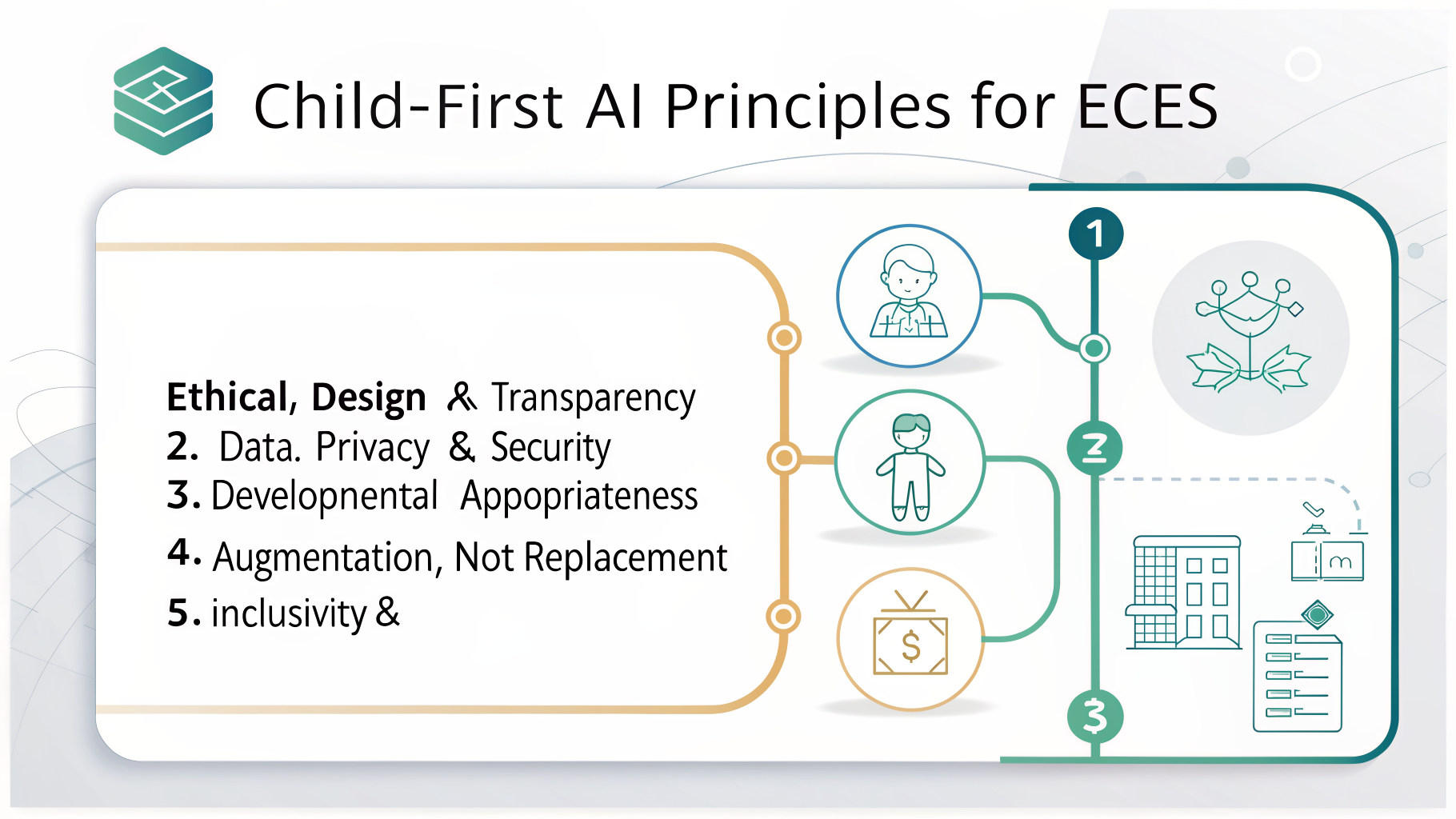
This framework emphasizes ethical design, data privacy, and developmental appropriateness as non-negotiable pillars. AI tools, such as those that assist with observation, must be transparent in their function, allowing educators to understand exactly how insights are generated. For instance, if an AI suggests a child might benefit from more fine motor activities, the educator should know what specific behaviours or interactions triggered that suggestion. Data privacy is paramount; adherence to Canadian privacy laws, like PIPEDA, must be strict, with robust security measures to protect sensitive child data. Providers like YochienAI, built in Ontario, offer specific assurances around privacy and security for early learning settings. Furthermore, any AI interaction must align with the cognitive, social, and emotional stages of young children. A pre-kindergarten child in Calgary, for example, benefits from AI that supports a teacher's real-time observation of play rather than requiring direct, prolonged interaction with a screen-based application. The goal is always augmentation, not replacement; AI should empower educators, enhancing their capacity to provide individualized care and deepen human connection, not diminish it. Finally, inclusivity and equity are critical, ensuring AI tools are accessible and beneficial for all children, regardless of background or ability, actively avoiding biases that could exacerbate existing inequalities.
"We need AI that helps us see the quiet child in the corner, not AI that demands every child's attention away from the real world. It's about deepening our understanding, not automating our interactions." — kindergarten administrator, Toronto
Implementing these core principles ensures that AI remains a supportive tool in Canadian early learning programs, genuinely "Putting Children First: What 'Human-Centred AI' Truly Means for Canadian Early Childhood Educators." By anchoring every decision in these ethical and developmental considerations, educators can confidently integrate technology that truly serves the unique needs of young learners and strengthens the vital human connections in their classrooms.
Practical Steps: Implementing Human-Centred AI in Your ECE Program
Implementing human-centred AI in early childhood education doesn't require a complete program overhaul; it begins with deliberate, manageable steps. The goal is to integrate tools that genuinely enhance the learning environment and support educators, all while upholding the core principle of Putting Children First: What 'Human-Centred AI' Truly Means for Canadian Early Childhood Educators.
Needs Assessment & Goal Setting
Before exploring any AI tool, identify specific, existing challenges. For instance, is your team struggling with the volume of child observations needed for developmental reports in a busy Toronto daycare? Or perhaps administrative tasks like parent communication consume too much time. Clearly defining these pain points ensures AI adoption serves a real purpose, aligning with your program's child-centred philosophy rather than introducing technology for its own sake.
Research & Selection
Investigate AI tools specifically designed for ECE settings. Prioritize solutions that offer clear child-development benefits and robust privacy policies. For example, look for tools that assist with observation documentation or personalized learning activity suggestions, always scrutinizing their data handling practices. A Canadian-developed option like YochienAI focuses on AI-assisted observation and developmental insights while adhering to local privacy expectations.
Pilot Program & Feedback
Introduce chosen AI tools on a small, controlled scale. A senior kindergarten teacher in a Halifax school might pilot a new AI-powered story generator with one group of children for a month. Actively collect feedback from educators on ease of use, time saved, and perceived impact on children. Observe children's engagement and interactions. This iterative process allows for adjustments before wider implementation.
Educator Training & Support
Provide comprehensive training for all educators using new AI tools. A program director in Calgary might organize a half-day workshop, not just on how to click buttons, but on the "why" behind the tool, its limitations, and how it integrates into the existing pedagogical framework. Ongoing support, like a dedicated "AI champion" or regular check-ins, builds confidence and competence.
Ongoing Monitoring & Evaluation
Continuously assess the AI's impact. Does it genuinely reduce educator workload, allowing more direct interaction with children, as intended for a preschool in rural Quebec? Is it enhancing developmental insights without increasing screen time for children, in line with Canadian Paediatric Society guidelines? Regular evaluation ensures the technology continues to serve the children and educators effectively, adapting as needed.
By approaching AI integration with these practical steps, Canadian ECE programs can move beyond theoretical discussions. This structured method ensures every technological decision directly supports child development and well-
Evaluating AI Tools Through a Child-First Lens: A Canadian Educator's Checklist
Evaluating AI Tools Through a Child-First Lens: A Canadian Educator's Checklist
Many AI tools promise efficiency, but for Canadian Early Childhood Educators (ECEs), the true measure of value isn't just speed—it's whether a tool genuinely supports child development and strengthens human connection. The irony is that the most effective AI in early learning often feels invisible, working in the background to amplify the educator's impact rather than replace it. Evaluating AI for Putting Children First: What 'Human-Centred AI' Truly Means for Canadian Early Childhood Educators demands a structured approach that goes beyond marketing claims.
| Evaluation Aspect | Child-First AI Tool | Efficiency-First AI Tool |
|---|---|---|
| Developmental Appropriateness | Supports play-based learning for a 4-year-old, like YochienAI's observation summaries that highlight emerging skills in alignment with Ontario's 'How Does Learning Happen?' framework. | Pushes rote memorization tasks or early literacy drills beyond typical 3-5 year old cognitive stages, potentially causing frustration. |
| Privacy & Data Security | Complies with Canadian privacy laws, clearly outlines data anonymization, and limits data access to authorized ECEs, with transparent policies like those found at YochienAI Privacy. | Collects extensive personal data without clear consent, stores it on servers outside Canada, or shares it with third parties for commercial purposes. |
| Enhances Human Interaction | Automates routine tasks (e.g., progress report drafts) to free up a senior kindergarten teacher in Vancouver for more one-on-one reading time or conflict resolution. | Replaces direct educator-child interactions with screen-based activities or generates generic feedback that diminishes personalized engagement. |
| Bias & Equity | Tested across diverse Canadian demographics, ensuring accessibility for children with varying needs and cultural backgrounds, avoiding stereotypes in content. | Reflects biases in its training data, leading to recommendations that may not be relevant for children from specific socio-economic backgrounds or cultural groups. |
| Transparency & Explainability | Shows educators why it suggests a particular observation focus, for example, by highlighting specific keywords from notes, making its logic understandable. | Offers "black box" recommendations without explaining the underlying reasoning, leaving educators unable to critically assess or adapt its insights. |
This checklist helps ECEs in provinces like Quebec and Nova Scotia move beyond generic promises to concrete evaluation. Prioritizing tools that align with established Canadian ECE frameworks and privacy standards ensures that any AI integration genuinely serves the child's best interests, supporting the educator's role rather than complicating it.
Addressing Concerns: AI, Screen Time, and Preserving Human Connection in ECE

Addressing Concerns: AI, Screen Time, and Preserving Human Connection in ECE
The rise of artificial intelligence (AI) in early childhood education naturally raises questions about screen time and the irreplaceable value of human interaction. Many Canadian educators worry that AI tools might inadvertently pull children away from essential play-based learning or diminish the responsive relationships crucial for development. However, by adhering to a “Putting Children First” approach, AI can act as a supportive “third hand,” not a replacement for human connection.
How AI Can Enhance Connection
- Enabling Deeper Educator Focus: AI tools for administrative tasks, like AI-assisted observation analysis, free up educators from paperwork. A senior kindergarten teacher in Edmonton, for instance, can spend less time documenting observations manually and more time engaging directly with children during block play or story time.
- Informing Individualized Interactions: By quickly synthesizing observational data, AI can highlight specific developmental patterns or emerging interests for a child. This allows an ECE in rural Manitoba to tailor their interactions and activity planning more precisely, fostering a stronger, more responsive relationship.
- Supporting Play-Based Learning: AI can suggest open-ended activity ideas that align with provincial curriculum frameworks, like Ontario's “How Does Learning Happen?”. An ECE might use AI to generate prompts for outdoor exploration based on children’s recent inquiries, encouraging active, hands-on discovery rather than passive screen use.
- Facilitating Parent-Educator Partnerships: AI-powered communication tools can streamline sharing insights with parents, ensuring they are better informed about their child’s day. This transparency builds trust and strengthens the home-school connection, fostering a united front for the child’s well-being.
Mitigating Risks: Screen Time and Detachment
- Adhering to Screen Time Guidelines: The Canadian Paediatric Society (CPS) recommends limiting screen time for young children, emphasizing quality content and interactive engagement when screens are used. AI must primarily support educators in the background, not directly deliver extended child-facing digital content.
- Prioritizing Backend AI Use: The primary role of AI should be to assist educators with tasks like record-keeping, curriculum planning, or identifying developmental trends, thereby reducing their administrative load. This “behind the scenes” integration ensures children’s direct experience remains human-centric.
- Ensuring Active, Not Passive, Engagement: Any child-facing AI, if used, must promote active learning, problem-solving, and creativity, aligning with play-based pedagogies. Tools that encourage passive consumption or replace hands-on exploration should be avoided in Canadian early learning settings.
- Maintaining Human Oversight and Interaction: An ECE in Vancouver noted,
"AI is a tool for us, not a teacher for the children. Our primary job is to connect, observe, and respond personally."
This perspective underscores that AI should always augment, not diminish, the direct human relationship.
Ultimately, &ldquo
The Educator's Role: Advocating for Ethical, Child-Centred AI in Canada
The Educator's Role: Advocating for Ethical, Child-Centred AI in Canada
While AI often feels like a top-down mandate, Canadian early childhood educators are uniquely positioned to shape its ethical integration. They are not just end-users; their daily insights into child development, gathered in settings from a Toronto daycare to a rural B.C. preschool, are invaluable. ECEs understand the nuances of play-based learning and the critical importance of responsive relationships, principles central to frameworks like Ontario's 'How Does Learning Happen?'. This frontline perspective makes their voices essential in determining what "Putting Children First: What 'Human-Centred AI' Truly Means for Canadian Early Childhood Educators" looks like in practice.
To confidently advocate, ECEs must first build their own AI literacy. This involves participating in professional development workshops that demystify concepts like AI-assisted observation or large language models (LLMs). For example, understanding how a tool like YochienAI processes observation notes allows an educator to ask targeted questions about data privacy and algorithmic bias, rather than simply accepting a developer's claims. This knowledge empowers them to engage meaningfully in discussions about ethical AI use within their institutions.
"We can't just wait for tech companies to tell us what's good for kids. We need to be at the table, representing the children, and demanding tools that genuinely support their learning without compromising their privacy or human connection." — Early Childhood Educator, Vancouver Island
Advocacy also extends to institutional policy. When a daycare centre in Edmonton considers adopting a new AI-powered learning platform, educators should press for clear policies on data security, developmental appropriateness, and screen time limits, aligning with guidelines from the Canadian Paediatric Society. Beyond their own institutions, ECEs can collaborate with technology developers and researchers. Providing direct feedback on prototypes ensures that AI tools are genuinely useful, ethical, and align with Canadian ECE best practices, rather than being designed in a vacuum. Sharing successful human-centred AI implementations, such as how a specific program used AI to streamline administrative tasks, thereby freeing up more time for direct child interaction, helps build a collective knowledge base across the ECE community.
Ultimately, ECEs are critical champions for ensuring AI serves the child, not the other way around. Their active participation, from policy discussions in provincial ECE associations to providing direct feedback on new platforms, can steer AI development towards solutions that truly enhance early learning experiences in Canada.
Frequently Asked Questions About Human-Centred AI in ECE
Many Canadian Early Childhood Educators (ECEs) and parents hold valid questions about integrating Artificial Intelligence (AI) into early learning environments. The core challenge often lies in distinguishing genuine benefits from marketing hype, all while ensuring that the technology truly serves the child.
Quick Reference: Human-Centred AI in ECE
These tools enhance, rather than replace, human interaction. Examples include AI-assisted observation platforms like YochienAI, which help ECEs in provinces like Ontario gain deeper insights into child development, or administrative AI assistants that manage scheduling, freeing up an educator's time for direct engagement with children.
The design principle must be augmentation, not substitution. ECEs in settings from Vancouver to Halifax carefully select tools that support their work—such as generating personalized learning path ideas—while setting clear screen time limits in line with Canadian Paediatric Society guidelines, which emphasize quality content and adult interaction for young children.
Collecting sensitive child data, potential for misuse, and ensuring compliance with Canadian privacy legislation like PIPEDA are paramount. Human-centred AI tools prioritize robust data encryption, anonymization where possible, and transparent consent processes with parents.
When implemented with a child-first approach, AI offers tangible benefits. It can aid in early intervention by flagging developmental patterns, personalize learning experiences based on individual needs, and significantly reduce educator administrative workload, allowing more focus on play-based learning and responsive relationships.
Seek resources from provincial ECE ministries, professional development associations, and organizations like the Canadian Centre for Child Protection. These bodies often provide guidance aligned with Canada's Pan-Canadian Artificial Intelligence Strategy's ethical considerations.
Parents are essential partners. They must be fully informed about AI use, provide explicit consent for data collection, and participate in feedback loops to ensure their child's well-being remains the central focus. Transparency builds trust and reinforces the "Putting Children First: What 'Human-Centred AI' Truly Means for Canadian Early Childhood Educators" ethos. See resources for parents for more details.
Addressing these questions directly helps bridge the gap between AI's technological promise and its practical, ethical application in Canadian early childhood settings. The goal is to demystify AI, allowing educators to make informed choices that genuinely enhance child development and support their vital work, rather than complicate it.
Frequently Asked Questions
What are the core principles of child-centred AI for Canadian classrooms?
How can Canadian ECEs implement child-centred AI in their programs?
Why is a "children first" approach crucial for AI in early learning?
Is AI in ECE harmful regarding screen time or human connection?
Can Canadian educators advocate for ethical AI tools in early childhood?
Keep reading
All articles →
Smart Choices for Canadian ECE: Evaluate AI Tools Critically
Making Smart Choices for Canadian ECE: How to Evaluate AI Tools with Critical Thinking often means looking past the marketing hype to understand what AI actually does. The true value in early learning isn't just adopting new tools, but discerning their alignment with play-based learning and holistic development.

Designing for Little Hands and Big Hearts: Human-Centred AI in Canadian ECE
Human-Centred AI (HCAI) in Canadian early childhood education (ECE) isn't about complexity; it's about intentional simplicity. It aims to augment educator observation skills and deepen parent engagement, ensuring technology serves children's developmental needs.

Before You Click: 8 Essential Questions Canadian ECEs Should Ask About New AI Tools
Canadian ECEs face an overwhelming influx of new AI tools, many ill-suited for young children's unique developmental needs. This demands a structured approach to prevent pedagogical missteps and privacy breaches as the AI in education market skyrockets.