

A Thoughtful Approach: 7 Essential Questions for Canadian ECE AI Adoption
AI tools promise efficiency, but Canadian ECEs must ensure adoption aligns with play-based learning and strict child privacy laws. A thoughtful approach, guided by essential questions, is crucial given the unique ethical and regulatory nuances in Canada.

The Imperative for Thoughtful AI Adoption in Canadian ECE: Why Ask These Questions?
The Imperative for Thoughtful AI Adoption in Canadian ECE
While artificial intelligence (AI) tools promise efficiency, the real challenge for Canadian Early Childhood Educators (ECEs) isn't just adopting AI, but ensuring it aligns with Canada's deeply ingrained pedagogical commitment to play-based learning and stringent child privacy laws like Quebec's Law 25. A thoughtful approach, guided by essential questions, is crucial because the “one-size-fits-all” global advice on AI adoption often overlooks the specific developmental, ethical, and regulatory nuances of early learning and child care (ELCC) programs across provinces.
The sheer volume of new AI tools, from automated observation platforms to personalized learning apps, creates significant overwhelm and confusion for educators already stretched thin. Without a structured method, it’s easy to adopt solutions that might inadvertently compromise a child’s data privacy or detract from essential human-to-human interactions. For instance, a 2022 report by the Brookfield Institute highlighted a significant need for ethical AI guidelines across Canadian sectors, a gap even more pronounced in the sensitive ECE environment.
“We need more than just a checklist; we need a compass that points us towards ethical, developmentally sound, and distinctly Canadian AI choices for our youngest learners.” — kindergarten administrator, Toronto
This is why a “human-first” approach is non-negotiable. Technology should enhance the vital role of the educator and foster genuine connection, not replace it. To navigate this landscape effectively, this article introduces a “Canadian ECE AI Readiness & Ethical Vetting Framework.” This framework provides a structured, question-based process designed to cut through the noise, helping educators systematically assess the actual benefits versus potential harms of any AI tool, ensuring responsible and beneficial integration into Canadian ELCC settings.
Our Canadian ECE AI Readiness & Ethical Vetting Framework: A Structured Approach
The true challenge with AI in early childhood education isn't simply choosing a tool; it's establishing a rigorous, values-driven process for evaluation. Many Canadian early learning and child care (ELCC) programs feel overwhelmed by the sheer volume of emerging AI solutions, often fearing missteps in ethics or privacy. To address this, we've developed a Canadian ECE AI Readiness & Ethical Vetting Framework: a multi-stage decision-making system designed to systematically evaluate AI tools against five critical dimensions.
This framework moves beyond basic checklists, offering weighted criteria across Pedagogical, Ethical, Operational, Regulatory, and Stakeholder Engagement aspects. Each dimension contributes to a clear 'go/no-go' recommendation, providing Canadian educators with a structured, actionable pathway. For instance, the Ethical dimension directly addresses user pains around privacy, ensuring tools comply with Canada's federal PIPEDA and provincial acts like Quebec's Law 25, which govern children's data. The Pedagogical dimension ensures alignment with the Canadian Council of Ministers of Education (CMEC)'s emphasis on play-based learning and holistic child development.
"We need more than just a list of features. We need a way to confidently say, 'Yes, this AI helps our kids learn, and no, it won't compromise their privacy.'" — kindergarten administrator, Toronto
By focusing on these areas, the framework empowers educators to make informed choices, mitigating fears of making unethical choices or violating privacy regulations. It’s a thoughtful approach to ensure AI tools enhance, rather than diminish, the human-centred core of Canadian ELCC programs.
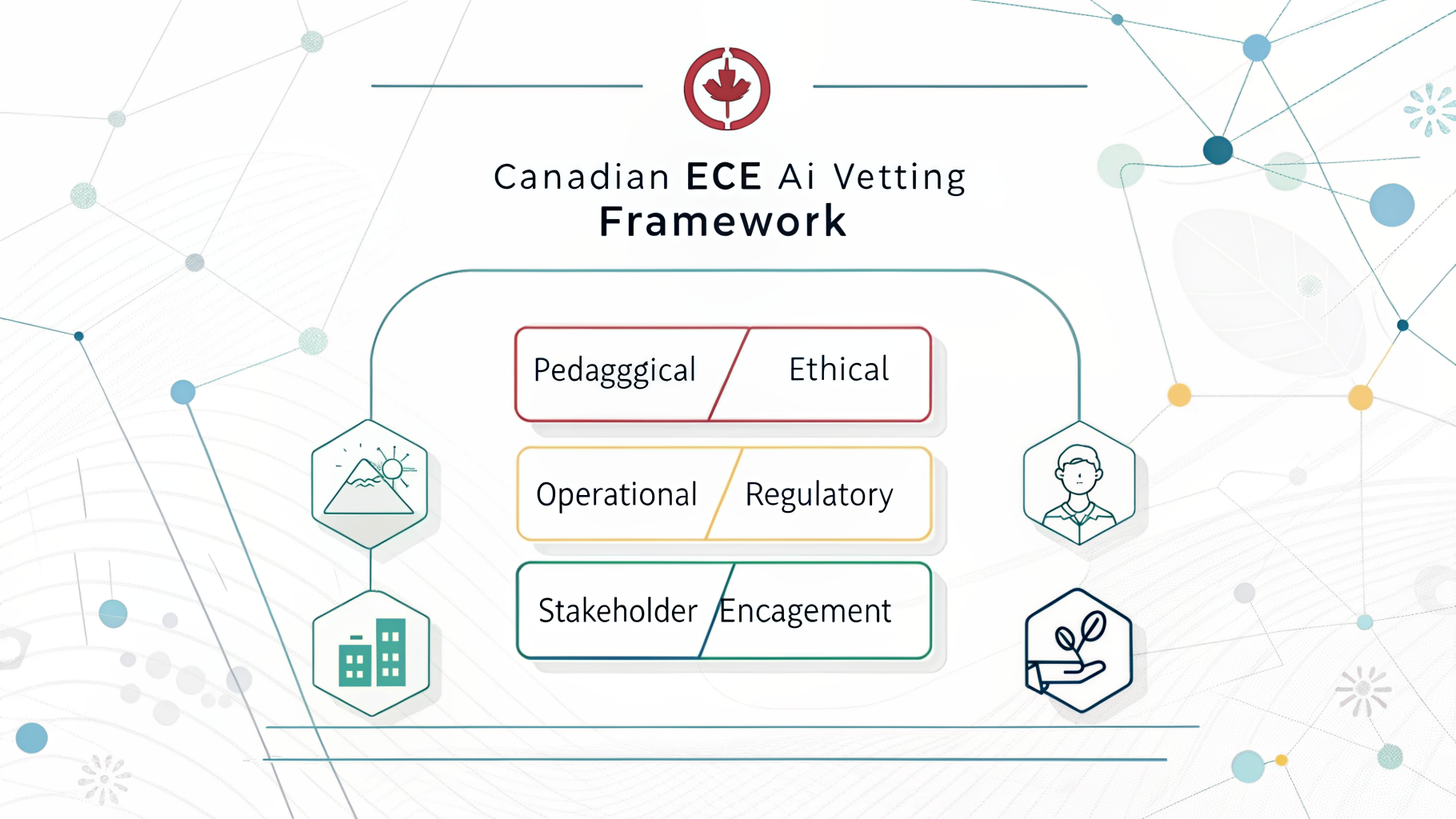
This comprehensive lens ensures that any AI tool considered for adoption, from an AI-assisted observation platform to an administrative aid, is developmentally appropriate and fully vetted for the unique nuances of Canadian early childhood settings, providing
Question Set 1: Pedagogical & Developmental Appropriateness – Is it Right for Our Children?
The true challenge with AI in early childhood education isn't just identifying powerful tools, but rather discerning which ones genuinely align with Canadian pedagogical values and the unique developmental needs of young children. It's an ironic twist: the more advanced the technology, the more critical it becomes to ground our decisions in fundamental human-centred principles.
Pedagogical & Developmental Appropriateness Checklist
Does the AI tool support, not supplant, play-based learning and holistic development? The Canadian Council of Ministers of Education (CMEC) consistently emphasizes these principles. For example, does it offer open-ended prompts for imaginative play or merely direct rote learning?
How does the tool enhance educator-child and child-child interactions? A senior kindergarten teacher in Halifax might question if an AI-assisted observation platform helps her spend more time engaging with children, rather than reducing direct contact.
Is the AI tool truly appropriate for the specific age group (e.g., 3-5 years old), considering their cognitive, social-emotional, and physical milestones? An app designed for 8-year-olds won't serve a junior kindergarten class in Alberta.
What research or pilot studies demonstrate the tool's educational benefits for young children? Look for evidence beyond anecdotal claims, specifically regarding learning outcomes or developmental gains.
Does the AI tool risk creating screen-time dependencies or replacing essential hands-on experiences with physical materials? The goal is integration, not substitution, particularly in programs like Ontario's JK/SK where tactile exploration is paramount.
Engaging with these questions is the first step in a thoughtful approach: essential questions Canadian early childhood educators should ask before adopting AI tools. It ensures that any technology introduced serves the child's best interest, enhancing their learning journey without compromising the irreplaceable value of human connection and authentic play.
"We need to be sure
Question Set 2: Ethical Safeguards & Data Privacy – Protecting Our Youngest Learners

Ethical Safeguards & Data Privacy – Protecting Our Youngest Learners
The true cost of adopting an AI tool isn't just financial; it’s measured in trust and data security. Safeguarding the personal information of children in Canadian early learning settings demands a rigorous ethical review, directly addressing concerns about violating privacy regulations like Quebec's Law 25.Quick Reference: Ethical & Privacy Vetting
Does the AI tool strictly adhere to Canada's federal PIPEDA and relevant provincial acts (e.g., Alberta's PIPA, Quebec's Law 25) for children's data? A vendor's compliance must be explicit. For instance, YochienAI details its privacy practices for early childhood programs on its privacy page, setting a benchmark for transparency.
What specific data points does the tool gather, how is this data stored, and which parties have access? Clear answers are non-negotiable. Educators should inquire about server locations, encryption standards, and internal access controls. YochienAI, for example, outlines its security measures for Canadian educators here.
Are the vendor's data retention, anonymization, and deletion policies clearly articulated and easy to understand, especially concerning children's profiles? Indefinite data storage is a red flag in early childhood contexts.
How does the AI tool ensure its algorithms are fair, accountable, and transparent? Unchecked bias, even unintentional, could inadvertently affect assessments or recommendations for a child in a daycare in Vancouver, for instance. This requires probing the tool's underlying data and design principles.
Are the consent processes for parents and guardians straightforward and unambiguous regarding data collection and AI tool usage? Consent forms must be in plain language, not legal jargon, ensuring families fully understand what they are agreeing to.
Question Set 3: Operational Viability & Educator Support – Can We Implement it Effectively?
Even the most pedagogically sound AI tool will fail if it's too difficult or costly to use in practice. This section of our framework, part of A Thoughtful Approach: Essential Questions Canadian Early Childhood Educators Should Ask Before Adopting AI Tools, focuses on the practicalities of integrating AI into daily operations at a Canadian early learning and childcare centre.
Operational Viability & Educator Support Checklist
What specific training does the vendor provide for educators to effectively use and integrate the AI tool? Do they offer ongoing professional development, like the resources found at YochienAI's school support page, or is it a one-time onboarding? A daycare in Regina, for instance, found that without continuous support, initial enthusiasm for a new observation AI waned within three months.
What are the comprehensive long-term costs, beyond the initial subscription? Consider maintenance, potential hardware upgrades (e.g., new tablets for a Vancouver Island preschool), and hidden fees. Sustainable adoption requires transparent financial planning, especially for publicly funded programs in provinces like Quebec.
How reliable is the vendor, and what ongoing technical support is available? A small ECE centre in rural Nova Scotia needs readily accessible support, not just an email address. Superficial treatment of long-term implications, such as slow response times or lack of dedicated Canadian support staff, can quickly derail implementation.
Does the AI tool integrate seamlessly with existing ECE systems and workflows, like provincial reporting platforms or parent communication apps? Or does it create additional administrative burdens, requiring double data entry or forcing educators to learn entirely new, isolated systems?
How does the AI tool genuinely enhance the educator's role, reducing workload in areas like observation note-taking or report generation, rather than attempting to replace their critical functions? The goal is to free up a senior kindergarten teacher in Halifax to spend more time on direct child interaction, not less.
Question Set 4: Canadian Regulatory Compliance & Accountability – Navigating the Legal Landscape

Navigating the legal and regulatory landscape is often the least glamorous part of adopting new technology, but for Canadian early childhood educators considering AI tools, it's non-negotiable. Provincial licensing bodies and federal privacy laws like PIPEDA demand rigorous adherence, making compliance a foundational question rather than an afterthought.
Canadian Regulatory Compliance & Accountability Checklist
Does the AI tool and its proposed use comply with specific provincial licensing requirements and quality standards for early learning and child care (ELCC)? For example, a tool that tracks individual child progress must clearly align with observation and documentation standards set by provinces like Ontario or British Columbia, ensuring it supplements, not replaces, mandated human observation.
How does the AI tool support accessibility requirements for children with diverse needs, aligning with Canadian inclusion principles? Does it offer customizable interfaces, alternative input methods, or support for various learning styles, as outlined in provincial accessibility acts?
What are the vendor's commitments to accountability for AI system errors or unintended consequences? A vendor like YochienAI, built in Ontario, should clearly articulate their process for addressing inaccuracies in AI-generated observations or data anomalies, including data correction and impact mitigation protocols.
What are the implications for existing staff-to-child ratios and supervision requirements when using AI tools in the classroom? No AI tool can replace a human educator's direct supervision; the technology must enhance, not detract from, the required adult presence.
Are there any provincial or federal funding opportunities or grants available in Canada for AI integration in early learning that this tool aligns with? Programs supporting educational technology adoption, particularly those focusing on equitable access or enhanced learning outcomes, might offer financial support.
Ultimately, a thoughtful approach to AI adoption means understanding that these tools operate within a complex regulatory ecosystem. Asking these essential questions helps Canadian early childhood educators ensure that any AI integration not only enhances learning but also upholds the highest standards of safety, privacy, and accountability required across the country's diverse EL
Question Set 5: Stakeholder Engagement & Communication – Building Trust with Families and Staff
AI adoption in early learning centres often hinges less on technical prowess and more on the trust established with families and staff. The real challenge isn't just selecting a tool, but communicating its purpose and benefits transparently within the diverse Canadian cultural landscape.
Stakeholder Engagement & Communication: Building Trust
How will the centre openly communicate the adoption of AI tools, like YochienAI, to parents and guardians? This plan must address potential concerns directly and explain how the tool supports children's learning without replacing human interaction. Consider a dedicated information session, perhaps with materials translated into common community languages in a city like Vancouver.
What clear, accessible channels exist for parents and staff to provide feedback and raise concerns about the AI tool's use? This could involve anonymous surveys, parent-teacher conferences, or a designated contact person, ensuring all voices are heard in a diverse community like Edmonton.
How does the AI tool facilitate better communication and collaboration between educators, parents, and specialists? For instance, does it offer secure ways to share developmental insights or progress updates, streamlining discussions with a child psychologist in Ottawa?
What strategies will ensure all families can understand and engage with the AI tool, accounting for varying levels of digital literacy? Statistics Canada data from 2021 indicates significant disparities in internet access and digital skills across Canadian households, necessitating support like in-person workshops or simplified guides for families in rural Saskatchewan.
How will the centre explicitly demonstrate that the AI tool reinforces its commitment to a 'human-first' approach? Reassure stakeholders that technology serves to enhance, not diminish, the invaluable human connections and direct interactions central to early childhood education.
Engaging stakeholders proactively is crucial for successful AI integration. Centres must articulate how a thoughtful approach to AI, guided by essential questions Canadian early childhood educators should ask, aligns with their pedagogical philosophy. This builds a foundation of trust that supports innovation while upholding
Canadian ECE AI Vetting Framework: Key Considerations at a Glance
Canadian ECE AI Vetting Framework: Key Considerations at a Glance
Navigating the landscape of AI tools for early learning requires a structured lens. Our Canadian ECE AI Readiness & Ethical Vetting Framework provides a comprehensive approach, ensuring that A Thoughtful Approach: Essential Questions Canadian Early Childhood Educators Should Ask Before Adopting AI Tools is applied systematically across all decision points. This overview highlights the core dimensions.
| Framework Dimension | Primary Focus | Key Canadian-Specific Considerations |
|---|---|---|
| Pedagogical & Developmental Appropriateness | Ensuring alignment with child development principles and learning objectives. | Compatibility with play-based learning models common in provinces like Ontario and Alberta; avoidance of excessive screen time for preschoolers. |
| Ethical Safeguards & Data Privacy | Protecting children's personal information and ensuring fair, unbiased use. | Adherence to PIPEDA and provincial privacy acts (e.g., Quebec's Law 25); transparent consent processes for guardians in Manitoba. |
| Operational Viability & Educator Support | Assessing feasibility of implementation and professional development needs. | Integration with existing ELCC program structures; availability of French language support for educators in New Brunswick. |
| Regulatory Compliance & Accountability | Meeting legal requirements and establishing clear responsibility. | Alignment with provincial licensing standards for child care facilities; clear vendor accountability for data breaches under Canadian law. |
This structured overview helps educators, like a senior kindergarten teacher in Vancouver, quickly grasp the breadth of considerations before evaluating specific tools. It moves beyond generic questions, anchoring the vetting process in the unique realities of Canadian early learning and care programs.
Beyond the Questions: A Framework for Informed Decision-Making in Canadian ELCC
The conversation around AI in Canadian early learning and child care (ELCC) has shifted from speculative "if" to practical "how." Canadian educators often face a landscape of overwhelming options and unclear guidance, leading to hesitation or, worse, unvetted adoption. This 'Canadian ECE AI Readiness & Ethical Vetting Framework' directly addresses that gap, transforming uncertainty into a structured, confident decision-making process. For instance, a senior ECE director in Vancouver, evaluating an AI-powered observation tool like YochienAI, can now systematically assess its alignment with British Columbia's Early Learning Framework and privacy mandates, moving beyond gut feelings to an informed 'go/no-go' recommendation.
This framework empowers educators to align AI integration with foundational principles, such as those emphasized by the Canadian Council of Ministers of Education (CMEC) regarding play-based learning and holistic child development. It echoes the Brookfield Institute's 2022 call for robust ethical guidelines, providing a practical toolkit for assessing data privacy in light of federal PIPEDA and provincial acts like Quebec's Law 25. An ECE in an Ontario pre-kindergarten program, for example, can use the framework to ensure any AI tool respects child privacy and supports, rather than dictates, emergent curriculum.
Ultimately, adopting AI in Canadian ELCC programs demands a 'human-first' approach, where technology serves as a supportive assistant, not a substitute for the educator's expertise, empathy, and direct interaction. Begin your thoughtful AI adoption journey by applying these essential questions to any AI tools your Canadian ECE program considers, ensuring best practices for AI integration that genuinely benefit our youngest learners.
Frequently Asked Questions
Why should Canadian early childhood educators be cautious about using AI tools?
Canadian ECEs must exercise caution with AI tools due to several factors. Young children's developmental needs, particularly for hands-on, social learning, might not align with screen-based AI activities. Concerns also arise regarding data privacy, as AI systems often collect sensitive information about children and their learning patterns. Furthermore, the potential for algorithmic bias in content recommendations or assessment tools requires careful scrutiny to ensure equitable experiences for all children in programs like Ontario's Full-Day Kindergarten.
What ethical considerations are crucial for Canadian ECE when evaluating AI tools?
Ethical evaluation of AI tools for Canadian ECEs hinges on transparency, fairness, and accountability. Educators must understand how an AI tool collects, uses, and protects children's data, ensuring explicit parental consent for any data sharing. It's crucial to assess if the AI's algorithms are free from bias, providing equitable learning opportunities for diverse learners in settings like a Winnipeg daycare. Transparency about the AI's decision-making processes, rather than a "black box" approach, is also paramount to maintain trust and professional oversight.
How can Canadian ECE ensure AI tools are developmentally appropriate for young children?
Ensuring developmental appropriateness means rigorously aligning AI tools with established ECE frameworks like Ontario's "How Does Learning Happen?" or Alberta's "Flight." Educators should prioritize tools that support active, play-based learning and social interaction, rather than passive screen consumption. For instance, an AI tool should augment a hands-on activity, not replace it, by providing adaptive feedback on a building project, not just showing a video. Teacher mediation is essential to guide children's engagement and interpret AI outputs, ensuring the technology serves learning goals.
Is it challenging for Canadian ECE to navigate AI regulations and data privacy laws?
Navigating AI regulations and data privacy laws can be challenging for Canadian ECEs due to a complex interplay of federal and provincial legislation. While federal acts like PIPEDA govern commercial data, provincial privacy laws (e.g., Alberta's PIPA) also apply. There isn't a unified, ECE-specific AI regulatory framework, leaving individual programs, like a community daycare in rural Quebec, to interpret broad guidelines. This often necessitates seeking legal advice or relying on vendor compliance claims, which requires careful vetting to ensure child data protection.
Can Canadian early childhood educators get support when integrating new AI technologies?
Canadian ECEs can find support for integrating AI through various channels. Provincial ECE associations, like the AECEO in Ontario or the BC ECE Society, often offer professional development workshops and resources on technology use. University ECE programs are beginning to incorporate AI discussions into their curricula. Peer networks among educators and dedicated online communities also provide practical advice. Additionally, some government initiatives or grants, though not always AI-specific, can fund technology integration and training for licensed childcare centres.
Frequently Asked Questions
Why should Canadian early childhood educators be cautious about using AI tools?
What ethical considerations are crucial for Canadian ECE when evaluating AI tools?
How can Canadian ECE ensure AI tools are developmentally appropriate for young children?
Is it challenging for Canadian ECE to navigate AI regulations and data privacy laws?
Can Canadian early childhood educators get support when integrating new AI technologies?
Keep reading
All articles →
Smart Choices for Canadian ECE: Evaluate AI Tools Critically
Making Smart Choices for Canadian ECE: How to Evaluate AI Tools with Critical Thinking often means looking past the marketing hype to understand what AI actually does. The true value in early learning isn't just adopting new tools, but discerning their alignment with play-based learning and holistic development.

Designing for Little Hands and Big Hearts: Human-Centred AI in Canadian ECE
Human-Centred AI (HCAI) in Canadian early childhood education (ECE) isn't about complexity; it's about intentional simplicity. It aims to augment educator observation skills and deepen parent engagement, ensuring technology serves children's developmental needs.

Before You Click: 8 Essential Questions Canadian ECEs Should Ask About New AI Tools
Canadian ECEs face an overwhelming influx of new AI tools, many ill-suited for young children's unique developmental needs. This demands a structured approach to prevent pedagogical missteps and privacy breaches as the AI in education market skyrockets.