

Your AI Readiness Checklist: Essential Questions for Canadian ECEs
The real challenge with AI in Canadian early childhood education is the lack of a human-first roadmap for ethical integration. This AI Readiness Checklist offers a practical framework to answer essential questions for Canadian ECEs.

Navigating AI in Canadian ECE: Your Human-First Readiness Checklist
Navigating AI in Canadian ECE: Your Human-First Readiness
The real challenge with AI in Canadian early childhood education isn't the technology itself, but the overwhelming lack of a clear, human-first roadmap for its ethical integration. While global EdTech investment is projected to exceed $400 billion by 2025, many directors of mid-sized urban daycares in provinces like British Columbia or Quebec still struggle with fundamental questions: Which tools are developmentally appropriate for a junior kindergarten class? How do we protect privacy under Canadian regulations like PIPEDA? Your AI Readiness Checklist provides a practical, step-by-step framework to answer these essential questions for Canadian Early Childhood Educators.
Early childhood educators (ECEs) often feel adrift in the rapid evolution of artificial intelligence (AI), unsure where to begin with integration, especially without dedicated IT support. This checklist cuts through the confusion, offering concrete guidance tailored to the unique opportunities and challenges within the Canadian early learning landscape. It emphasizes child well-being and data privacy above all, aligning with Canadian ECE frameworks that prioritize play-based learning and holistic development.
Instead of fearing missteps or investing in ineffective AI tools, this section prepares you to make informed decisions. We focus on practical steps to evaluate AI solutions, understand their potential impact on children from infants to preschoolers, and leverage available Canadian resources and regulations. The goal is to demystify AI, transforming it from an intimidating concept into a thoughtful, integrated support system for your program and staff.
How This Canadian ECE AI Readiness Checklist Was Developed
Many early childhood educators feel overwhelmed by AI discussions, often missing the core insight: successful integration isn't about adopting every new tool, but about a deliberate, human-first strategy. This Canadian ECE AI Readiness Checklist was developed to cut through the noise, providing practical, step-by-step guidance rooted in child well-being and local realities.
Our Human-First, Canadian-Specific Principles
Every recommendation prioritizes the specific developmental stages of children, from infants to preschoolers. We ask: Does this AI tool genuinely enhance learning for a 3-year-old in a play-based environment, or is it a distraction?
Our framework integrates provincial licensing requirements and federal privacy laws like PIPEDA, ensuring that AI adoption respects Canadian legal landscapes. This means evaluating tools for data residency and consent protocols specific to Canada.
The checklist provides practical templates and steps tailored for small to medium-sized Canadian ECE centers, focusing on implementation without requiring extensive IT expertise. For instance, it offers guidance on evaluating tools like YochienAI for observation and parent communication.
We emphasize comprehensive staff training and strategies for managing the transition, recognizing that educator buy-in is paramount. A senior kindergarten teacher in Halifax needs to feel confident and supported, not just handed a new app.
Before any early learning program in Canada considers integrating artificial intelligence (AI) tools, an honest assessment of current technological capabilities and staff comfort is essential. This foundational step prevents overwhelm and ensures any new initiatives build on existing strengths, rather than exposing glaring gaps. Identify all existing hardware (tablets, computers, smartboards), software (parent communication apps, observation tools), and your internet speed/reliability. For instance, a daycare in rural Alberta might have different connectivity challenges than a downtown Toronto centre. Document what works well and what frequently causes frustration. Use an anonymous survey or informal group discussions to gauge how comfortable your team is with technology. A senior kindergarten teacher in Halifax might be adept with Google Workspace, while a colleague might prefer pen and paper. Understanding this spectrum helps tailor future training. This is a critical component of Your AI Readiness Checklist: Essential Questions for Canadian Early Childhood Educators. Based on your assessment, pinpoint specific training needs, whether it's basic computer skills or familiarity with cloud-based applications. Look for educators who express curiosity or aptitude for new tech
Many early childhood educators in Canada approach artificial intelligence with a key misconception: that the technology itself dictates its use. Instead, the most effective AI integration begins not with the tool, but with a clear understanding of your program's specific needs and pedagogical goals. This foundational step in your AI Readiness Checklist prevents investing in solutions that don't genuinely serve children or staff. Which specific administrative tasks consume the most educator time? Examples include daily attendance tracking, parent communication logs, or scheduling staff breaks. Studies suggest AI could automate up to 30% of such tasks, freeing educators for direct child engagement. Where could AI genuinely enrich a child's learning, aligning with Canadian play-based curricula? Consider tools that offer AI-assisted observation for early childhood education, helping educators identify developmental milestones or tailor activities for individual children, from infants to preschoolers. How will a specific AI tool directly support our provincial early learning framework? For instance, does it help track progress on communication skills as outlined in Ontario's How Does Learning Happen? or foster inquiry-based learning in British Columbia? What clear, quantifiable goals can we set for AI integration? Perhaps reducing time spent on report writing by 15% or increasing documented child observations by 20% within the first six months. Goals should be specific to your program's context. How does
Many early childhood education (ECE) centers operate on tight budgets, making the financial implications of AI adoption a primary concern. Understanding the true cost and potential return on investment (ROI) of an AI tool is crucial for sustainable integration, especially when facing a global EdTech market projected to exceed $400 billion by 2025. When
Launching a small-scale pilot program for AI tools allows Canadian ECEs to test new technologies in a controlled environment, mitigating the common fear of making incorrect, large-scale investments. This approach helps refine implementation strategies and ensures that any AI integration genuinely supports child development and educator workflow before a full rollout. Begin by integrating your chosen AI tool, such as an AI-assisted observation platform like YochienAI, with a single classroom or a small group of educators. For instance, a junior kindergarten program in Vancouver might trial an AI tool for automating daily progress notes, reducing administrative burden for two lead teachers. Establish specific, measurable goals for your pilot. These might include a 20% reduction in time spent on daily reporting, an increase in documented child-initiated learning moments, or a 15% improvement in parent engagement with digital updates. A senior kindergarten teacher in Halifax could track how often they use the AI tool to identify unique learning patterns. Regularly collect input from all stakeholders. This includes anonymous surveys for educators, structured interviews with parents, and observations of children's interactions. A kindergarten administrator in Toronto noted, Adopting AI in Canadian early childhood education isn't about simply buying new software; it's a strategic process that prioritizes child development and regulatory compliance. Many ECE leaders feel overwhelmed by the sheer volume of new tools, fearing missteps in choosing developmentally inappropriate options or violating privacy. This overview helps frame Your AI Readiness Checklist: Essential Questions for Canadian Early Childhood Educators, providing a snapshot of the critical areas to address. Integrating AI into Canadian early childhood education isn't about chasing the latest trend; it's about building a foundation for thoughtful, child-centred enhancement. Many educators feel overwhelmed by the sheer volume of new tools, fearing they'll invest in ineffective technology or compromise privacy. However, a phased, human-first approach minimizes these risks, ensuring that any AI adoption genuinely supports learning and administrative efficiency, rather than creating new burdens. A senior kindergarten teacher in Edmonton, for instance, might start by exploring how AI-assisted observation tools could streamline daily record-keeping, freeing more time for direct interaction with children. This doesn't mean replacing their expertise; it means augmenting it. Continuous learning and open communication with staff—from early childhood assistants to program directors—and parents are paramount throughout this process. A 2023 survey indicated that 60% of Canadian parents are concerned about their child's online privacy, underscoring the need for transparent communication about data handling and security protocols from the outset. By beginning with a single section of Your AI Readiness Checklist: Essential Questions for Canadian Early Childhood Educators today, you start a journey toward a more efficient, future-ready learning environment. To explore how tools like YochienAI can specifically support your centre's unique needs in this transition, we encourage you to contact us for a personalized discussion. Canadian ECEs should prepare for AI not primarily to introduce it to toddlers, but to understand its growing presence in society and its potential for administrative support. Tools like generative AI can streamline report writing or curriculum planning for a preschool teacher in Alberta, freeing up valuable time for direct child interaction. Understanding AI also equips educators to guide children in a future increasingly shaped by these technologies, fostering digital literacy from an informed perspective. Ethical concerns in Canadian ECE primarily revolve around data privacy, algorithm bias, and developmental appropriateness. Using AI tools that collect child data, like personalized learning apps, raises questions about secure storage and parental consent under provincial privacy laws, such as Ontario's PHIPA. There's also the risk of AI algorithms perpetuating societal biases, potentially impacting assessments or recommendations for diverse learners in a Vancouver daycare. Over-reliance on screens is another key worry. ECE programs must prioritize robust data privacy protocols when considering AI tools. This involves selecting vendors compliant with Canadian privacy legislation like PIPEDA or provincial equivalents, ensuring data is stored securely in Canada, and understanding exactly what information (e.g., child progress reports, attendance) an AI tool collects and how it's used. Implementing strict consent processes for parents and regular audits of AI system data handling, perhaps for a Quebec pre-kindergarten program, are crucial steps. AI tools can indirectly benefit child development by supporting educators, not by directly teaching children. For instance, an AI-powered transcription service could help a Nova Scotia ECE quickly document observations during play, allowing more focus on child interaction rather than note-taking. Similarly, AI could generate diverse story prompts or activity ideas tailored to specific developmental stages, enriching the learning environment without increasing screen time for children, thus aiding educators in personalized planning. Staff training is absolutely essential for effective and ethical AI adoption in Canadian ECE. Educators need to understand what AI is (e.g., large language models), its capabilities, and its limitations, rather than just how to click buttons. Training should cover data privacy best practices, identifying potential biases, and critically evaluating AI-generated content for developmental appropriateness. For instance, a daycare director in Manitoba might organize workshops on using AI for administrative tasks, ensuring staff feel confident and informed. Making Smart Choices for Canadian ECE: How to Evaluate AI Tools with Critical Thinking often means looking past the marketing hype to understand what AI actually does. The true value in early learning isn't just adopting new tools, but discerning their alignment with play-based learning and holistic development. Human-Centred AI (HCAI) in Canadian early childhood education (ECE) isn't about complexity; it's about intentional simplicity. It aims to augment educator observation skills and deepen parent engagement, ensuring technology serves children's developmental needs. Canadian ECEs face an overwhelming influx of new AI tools, many ill-suited for young children's unique developmental needs. This demands a structured approach to prevent pedagogical missteps and privacy breaches as the AI in education market skyrockets.Assessing Your Current Technological Landscape and Staff Readiness
Inventory Your Current Tech Ecosystem
Assess Staff Digital Literacy and Comfort
"We tried a new app once, and half our team just reverted to paper. It showed us we needed to meet people where they were at, not just push new tech." — program director, Vancouver Island
Identify Training Gaps and Potential AI Champions
Identifying Your Program's Specific Needs and Goals for AI Integration
Defining Your AI Goals: Essential Questions
Prioritizing Child Development and Ethical AI Use in Early Learning

Prioritizing Child Development and Ethical AI Use in Early Learning
The true challenge of integrating artificial intelligence (AI) into early childhood education isn't about finding the flashiest tool, but ensuring any chosen technology genuinely enhances, rather than detracts from, holistic child development and play-based learning. Many AI applications, particularly those focused on administrative tasks, can free up educators. However, direct-to-child AI tools demand rigorous ethical consideration and alignment with established Canadian ECE frameworks.
Benefits of Thoughtful AI Integration
Key Ethical & Developmental Considerations
Navigating Data Privacy, Security, and Canadian Regulations
Navigating Data Privacy, Security, and Canadian Regulations
Integrating AI tools into early childhood education introduces significant data privacy and security responsibilities, a concern for 60% of Canadian parents according to a 2023 survey. Programs must prioritize understanding and adhering to Canada's Personal Information Protection and Electronic Documents Act (PIPEDA) and applicable provincial privacy laws, such as Alberta's PIPA or Quebec's Act respecting the protection of personal information in the private sector. Ignorance of these regulations can lead to serious breaches of trust and legal consequences, making robust data governance a non-negotiable part of Your AI Readiness Checklist: Essential Questions for Canadian Early Childhood Educators.
Thoroughly vetting every AI tool for its data collection, storage, and usage policies is critical. For instance, when evaluating an observation tool like YochienAI, an administrator in a Regina daycare would examine its Privacy and Security pages to confirm compliance with Canadian standards, especially regarding the handling of sensitive child and family data. This due diligence ensures transparency with parents and protects the program from unforeseen vulnerabilities.
"We can't just adopt new tech because it's shiny. If it doesn't clearly show us how it protects our kids' information, it's a non-starter. Trust is everything with parents." — Kindergarten administrator, Toronto
Establishing these foundational data protection practices is not just about compliance; it's about building and maintaining the trust of families and the
Budgeting, Funding, and Resource Allocation for AI Tools
Budgeting, Funding, and Resource Allocation for AI Tools
Cost Category
Typical Annual Range (CAD)
Considerations for ECEs
Software Subscriptions (e.g., YochienAI)
$500 - $3,000 per center
Per-child or per-educator pricing models; ensure scalability for growth.
Hardware Upgrades (tablets, Wi-Fi)
$0 - $1,500 (one-time)
Assess existing infrastructure; focus on durable, child-safe devices.
Staff Training & Professional Development
$200 - $800 per educator
Crucial for adoption; look for vendor-provided training or provincial grants.
Technical Support & Maintenance
$100 - $500
Factor in ongoing support, especially for smaller centers without dedicated IT.
Data Storage & Security Compliance
Typically included in subscription, or $50-$200 for local backups
Verify compliance with PIPEDA and provincial privacy laws.
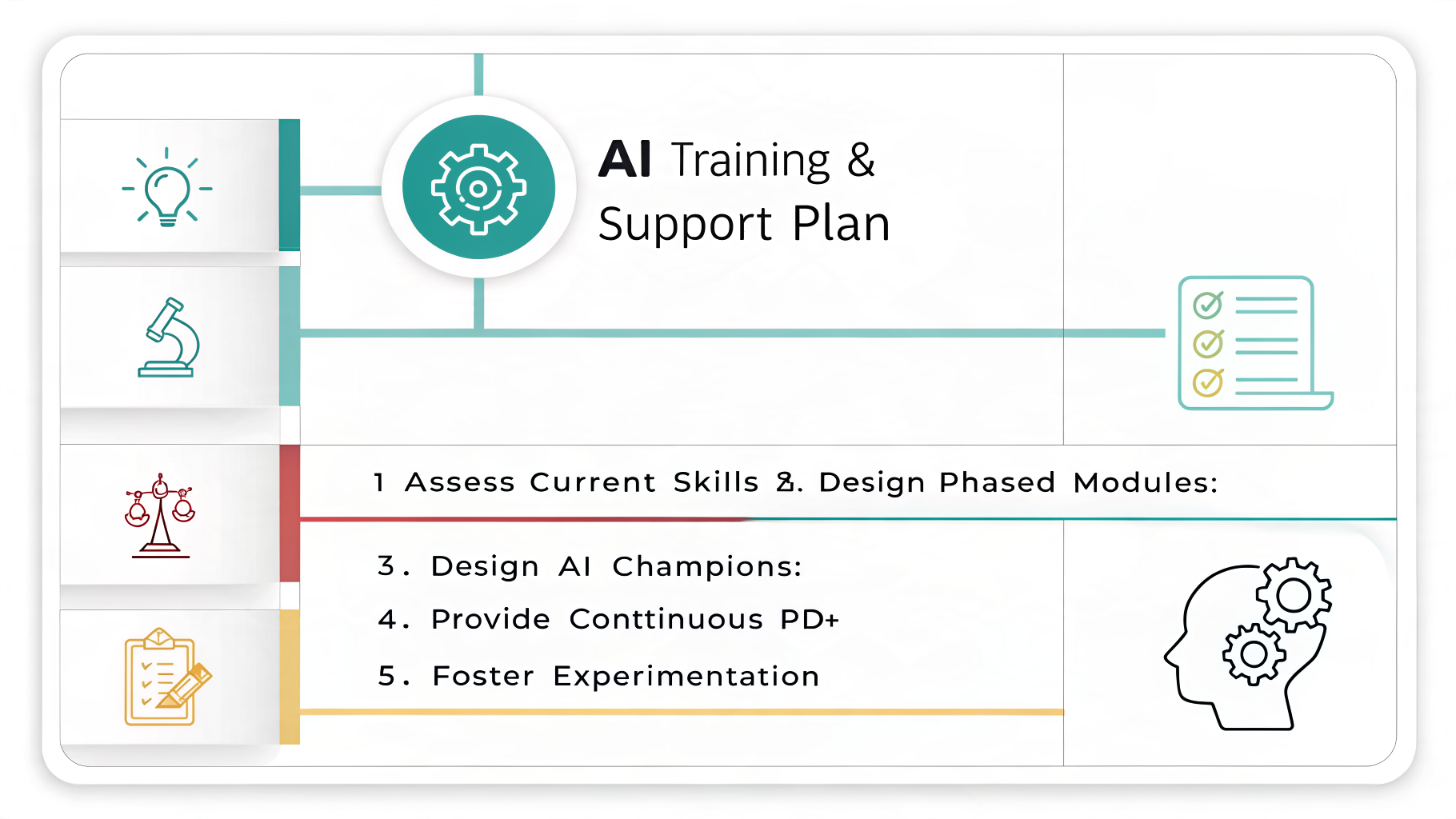
Developing a Comprehensive Staff Training and Support Plan

Developing a Comprehensive Staff Training and Support Plan
Simply acquiring AI tools like YochienAI for observation means little without educators who feel confident using them. The true challenge isn't the technology itself, but rather the human change management required to integrate it into daily practice in Canadian early-childhood programs. A successful strategy designs phased training modules that cater to varying levels of tech expertise, from basic navigation for a seasoned ECE in rural Quebec to advanced application for a tech-savvy kindergarten teacher in Vancouver.
This approach ensures continuous professional development, keeping staff updated on AI best practices and new tools. For instance, designating internal 'AI champions'—perhaps a lead educator at a mid-sized urban daycare—can provide essential peer support and troubleshoot common issues, fostering a culture of experimentation.
"We can't just drop a new AI tool on our educators and expect magic. They need practical, hands-on training and ongoing encouragement to see how it genuinely helps them focus more on the children." — Director of Early Learning, Calgary
Engaging Parents and Building Trust Around AI Adoption
Engaging Parents and Building Trust Around AI Adoption
Many Canadian early childhood education programs overlook a critical step in AI adoption: proactive, transparent communication with parents. Without clear information, parental anxiety about data privacy and screen time can quickly undermine even the most well-intentioned technology integration, especially given that a 2023 survey found 60% of Canadian parents worry about their child's online privacy.
Building Parental Confidence
Potential Pitfalls to Avoid
Implementing and Evaluating Your AI Pilot Program
Start Small and Selectively
Define Clear Success Metrics
Gather Continuous Feedback
"The pilot showed us that while the AI streamlined our observations, the real value came from how
AI Readiness Checklist: Key Considerations at a Glance
Readiness Area
Key Question
Actionable Step
Needs Assessment
Which specific administrative tasks or observation processes consume the most educator time in our program?
Survey staff to pinpoint areas where AI, like an AI-assisted observation tool such as YochienAI, could genuinely reduce workload.
Child Development & Ethics
How does a proposed AI tool align with play-based learning and the developmental stages of children in our care (e.g., infants vs. preschoolers)?
Review the tool's features against provincial ECE curriculum frameworks (e.g., Ontario's 'How Does Learning Happen?') and NAEYC guidelines.
Data Privacy & Security
Does the AI solution comply with Canadian privacy laws like PIPEDA and provincial health information acts?
Obtain a Data Processing Agreement (DPA) from the vendor and consult with your organization's privacy officer or legal counsel.
Staff Training & Buy-in
What training is needed for educators to confidently and competently use AI tools without feeling replaced or overwhelmed?
Develop a phased training plan, starting with pilot groups, and emphasize AI
Your Next Steps Towards AI-Ready Canadian Early Childhood Education
Frequently Asked Questions
Why should Canadian early childhood educators prepare for AI?
What are the ethical concerns of using AI in Canadian early learning?
How can Canadian ECE programs ensure data privacy with AI tools?
Can AI tools benefit child development in Canadian childcare?
Is staff training essential for AI adoption in Canadian ECE?
Frequently Asked Questions
Why should Canadian early childhood educators prepare for AI?
What are the ethical concerns of using AI in Canadian early learning?
How can Canadian ECE programs ensure data privacy with AI tools?
Can AI tools benefit child development in Canadian childcare?
Is staff training essential for AI adoption in Canadian ECE?
Keep reading
All articles →Smart Choices for Canadian ECE: Evaluate AI Tools Critically
Designing for Little Hands and Big Hearts: Human-Centred AI in Canadian ECE
Before You Click: 8 Essential Questions Canadian ECEs Should Ask About New AI Tools


