

Beyond Hype: Human-Centred AI for Canadian ECE - Myth vs. Reality
Human-centred AI in Canadian ECE amplifies educators and respects children, not replacing human roles. It addresses concerns about direct interaction, positioning AI as a crucial supportive partner in pedagogical goals.

What Exactly is Human-Centred AI in Early Childhood Education?
What Exactly is Human-Centred AI in Early Childhood Education?
The core of human-centred AI (HCAI) in Canadian early childhood education isn't about automating away human roles, but rather about deliberately designing technology that amplifies the unique capabilities of educators and respects the developmental needs of children. A 2023 survey by the Council of Ministers of Education, Canada, found that while 70% of educators recognized AI's potential, a significant 65% worried about its impact on direct child interaction. This tension underscores why HCAI is crucial: it positions AI as a supportive partner, not a replacement, ensuring that the technology serves pedagogical goals first.
Unlike generic artificial intelligence, which might prioritize efficiency above all else, HCAI in ECE focuses on augmenting human insight and strengthening essential human interactions. It means creating AI tools that are intuitive for educators, respect children's unique developmental stages, and align with Canada's Pan-Canadian AI Strategy, which emphasizes responsible development and ethical considerations. For instance, an HCAI tool might analyze observation notes to identify patterns in a child's social development, then present those insights clearly to an educator, allowing them more time to plan targeted interventions rather than manually sifting through data.
The practical application of human-centred AI involves leveraging advanced algorithms and machine learning (ML) — systems that learn from data without explicit programming — to provide actionable insights and automate routine, administrative tasks. Imagine an AI assistant that helps a kindergarten teacher in Montreal quickly generate personalized progress reports based on ongoing observations, freeing up hours each week. This approach ensures that human-centred AI benefits early childhood education across Canada by keeping the child's holistic development and the educator's professional judgment at the core of innovation, directly answering the question of Beyond the Hype: Why Human-Centred AI is Crucial for Canadian Early Childhood Education.
"Technology should be a quiet helper in the background, making our work easier so we can be more present with the children. If it pulls us away from them, it's not truly serving early learning." — Kindergarten administrator, Toronto
This deliberate design process ensures that AI tools, such as the YochienAI platform used in some Ontario daycares, are not just technologically advanced but also ethically sound and pedagogically aligned. By offloading repetitive tasks, HCAI allows educators to redirect their energy toward direct, meaningful engagement with children — the very interactions proven critical for early brain development and social-emotional learning.
Why the 'Human' Element is Non-Negotiable for Early Learning and Development
Why the 'Human' Element is Non-Negotiable for Early Learning and Development
While artificial intelligence (AI) tools offer powerful new efficiencies, the actual magic of early childhood education (ECE) doesn't come from algorithms; it flows from the human connections children make. The prevailing fear that AI might diminish these critical interactions misses a fundamental point: AI cannot replicate the nuanced social cues, spontaneous empathy, or secure attachments that a qualified educator in a Regina daycare provides daily. This irreplaceable human element is precisely why the discussion around human-centred AI in Canadian early childhood education must prioritize child development above technological flash.
Early childhood is a period of intense brain development, where interactions quite literally sculpt neural pathways. Research consistently highlights the foundational role of responsive human relationships in fostering cognitive growth, emotional regulation, and social competence. A senior kindergarten teacher in Halifax, for example, doesn't just deliver curriculum; they interpret a child's furrowed brow, mediate playground disputes, and celebrate small victories with genuine warmth. These moments, steeped in human intuition and connection, are vital for children to develop empathy and resilience. AI, by its nature, processes data; it doesn't feel or spontaneously adapt to complex social dynamics in the way a human does.
These figures underscore a critical reality: parents are rightly cautious about technology's role, and developmental science confirms that active, responsive human interaction far outweighs passive digital exposure. The secure attachment a child forms with their primary caregiver or educator is a cornerstone of their emotional well-being, influencing everything from their capacity for learning to their future relationships. AI tools, such as those that might assist with observation or administrative tasks, can free up educators' time, but they cannot form an attachment or offer a comforting hug after a scraped knee.
"No app can truly see a child's joy or frustration the way I can, or understand the unspoken story behind their play. That deep understanding comes from being present, not from an algorithm." — early childhood educator, Vancouver Island
Understanding the irreplaceable importance of the human element is key to ensuring technology serves to enhance, not detract from, these vital interactions. The discussion around Beyond the Hype: Why Human-Centred AI is Crucial for Canadian Early Childhood Education isn't about choosing between humans and AI, but about recognizing where each excels. For holistic child development, the educator remains the essential anchor, providing the emotional depth and relational richness that AI simply cannot replicate.
Debunking the Hype: AI as a Powerful Partner, Not a Replacement for Educators

The persistent fear that artificial intelligence will displace human educators in early childhood settings often overlooks AI's true utility: augmenting, not replacing, the irreplaceable human element. This isn't about robots teaching toddlers; it's about smart tools empowering dedicated professionals to focus on what matters most—direct, meaningful interaction with children.
Reality: AI as a Powerful Partner
- Automates Tedious Tasks: AI tools, like those used in some Ontario daycares, can automate administrative burdens such as attendance tracking, daily reports, and even initial developmental observations. This frees up a senior kindergarten teacher in Halifax to spend an extra hour on one-on-one literacy activities, rather than paperwork.
- Enhances Observation & Insight: AI-assisted observation platforms (such as YochienAI) can analyze patterns in child engagement, flagging subtle shifts in behavior or interests that an educator might miss during a busy free-play session. This data helps educators tailor activities more precisely, supporting children like a quiet preschooler in Vancouver who might benefit from more focused encouragement in group settings.
- Boosts Personalized Learning: While AI doesn't teach, it can process data from various interactions to suggest personalized activity ideas or resources. A childcare worker in rural Saskatchewan could receive AI-generated prompts for sensory play ideas relevant to a specific child's developmental stage, rather than spending hours searching online.
- Facilitates Communication: AI can streamline parent communication by summarizing daily activities or translating messages into multiple languages, ensuring all families, including newcomers in Montreal, stay connected and informed about their child's progress.
Myth: AI Replaces Human Educators
- AI Lacks Empathy: AI cannot replicate the emotional warmth, spontaneous comfort, or nuanced social cues that human educators provide. A child's distress requires a human hug, not an algorithm.
- No Substitute for Professional Judgment: While AI provides data, it doesn't make pedagogical decisions. An educator's experience and understanding of a child's unique context in a specific Calgary pre-K program remain paramount for interpreting insights and planning next steps.
- Cannot Build Relationships: Secure attachments and trusting relationships are foundational to early learning. AI cannot form these bonds, which are critical for social-emotional development in every Canadian early learning environment.
- Ethical & Privacy Concerns: Over-reliance on AI without robust ethical frameworks risks privacy breaches and algorithmic bias, especially concerning sensitive developmental data for young children. This is a primary concern for parent groups in provinces like British Columbia.
"AI helps me see patterns I might otherwise overlook in the daily rush. It's like having a second pair of eyes, not a replacement for my own judgment." — kindergarten administrator, Toronto
The global AI in education market, projected to grow from roughly $3 billion to over $25 billion by 2030, clearly indicates increasing adoption for support functions, not wholesale replacement of human educators. This growth underscores the core premise of Beyond the Hype: Why Human-Centred AI is Crucial for Canadian Early Childhood Education—that technology serves to enhance
Real-World Impact: How Human-Centred AI Supports Educators and Children in Canadian ECE
Real-World Impact: How Human-Centred AI Supports Educators and Children in Canadian ECE
The true value of human-centred artificial intelligence (AI) in early childhood education isn't in replacing human interaction, but in augmenting it, providing educators in provinces like Ontario and British Columbia with tools that enhance their natural capabilities. Rather than automating relationships, AI automates tasks, freeing up professionals to focus on the unique developmental needs of each child. This shift represents a practical application of human-centred AI in Canadian ECE, moving beyond abstract discussions to tangible benefits.
For instance, AI-assisted observation tools, such as those developed by YochienAI, help educators identify individual learning patterns and developmental milestones. A kindergarten teacher in a Regina daycare might use such a tool to track a child's engagement with block play, revealing a consistent preference for collaborative building over solitary construction. This insight allows the teacher to tailor activities, perhaps introducing more group projects or specific prompts to encourage social-emotional development. These systems don't interpret emotions; they flag observable behaviours, providing data for the educator's expert analysis. Industry reports indicate that tools streamlining administrative tasks can reduce an educator's non-teaching workload by roughly 15-20% weekly, translating directly into more time for direct child engagement.
"The biggest relief is getting detailed observations summarized without hours of manual note-taking. It means I spend less time documenting and more time truly seeing and connecting with the children." — Early Childhood Educator, Vancouver Island
Beyond observation, AI streamlines administrative burdens. Tools can automate routine record-keeping, generate reports for licensing bodies in Quebec, and simplify communication with parents, a common pain point for busy educators. This frees valuable time previously spent on paperwork. Furthermore, AI can enhance parent communication by providing regular, data-backed updates on a child's progress, fostering stronger home-school partnerships. An educator can share a summary of a child's fine motor skill development over the past month, complete with anonymized activity examples, directly with parents via a secure portal, increasing transparency and engagement.
Early identification of needs also benefits significantly. AI can flag subtle developmental trends or potential delays by analyzing aggregated observation data over time, allowing educators and specialists to intervene earlier. If an AI tool notes a consistent pattern of withdrawal or difficulty with specific social cues in a preschooler in Calgary, it prompts the educator to observe more closely and potentially consult a child development specialist. This support extends to professional development, as AI can offer insights into teaching strategies by analyzing the effectiveness of different approaches in various contexts, helping educators reflect on their practices and identify areas for growth.
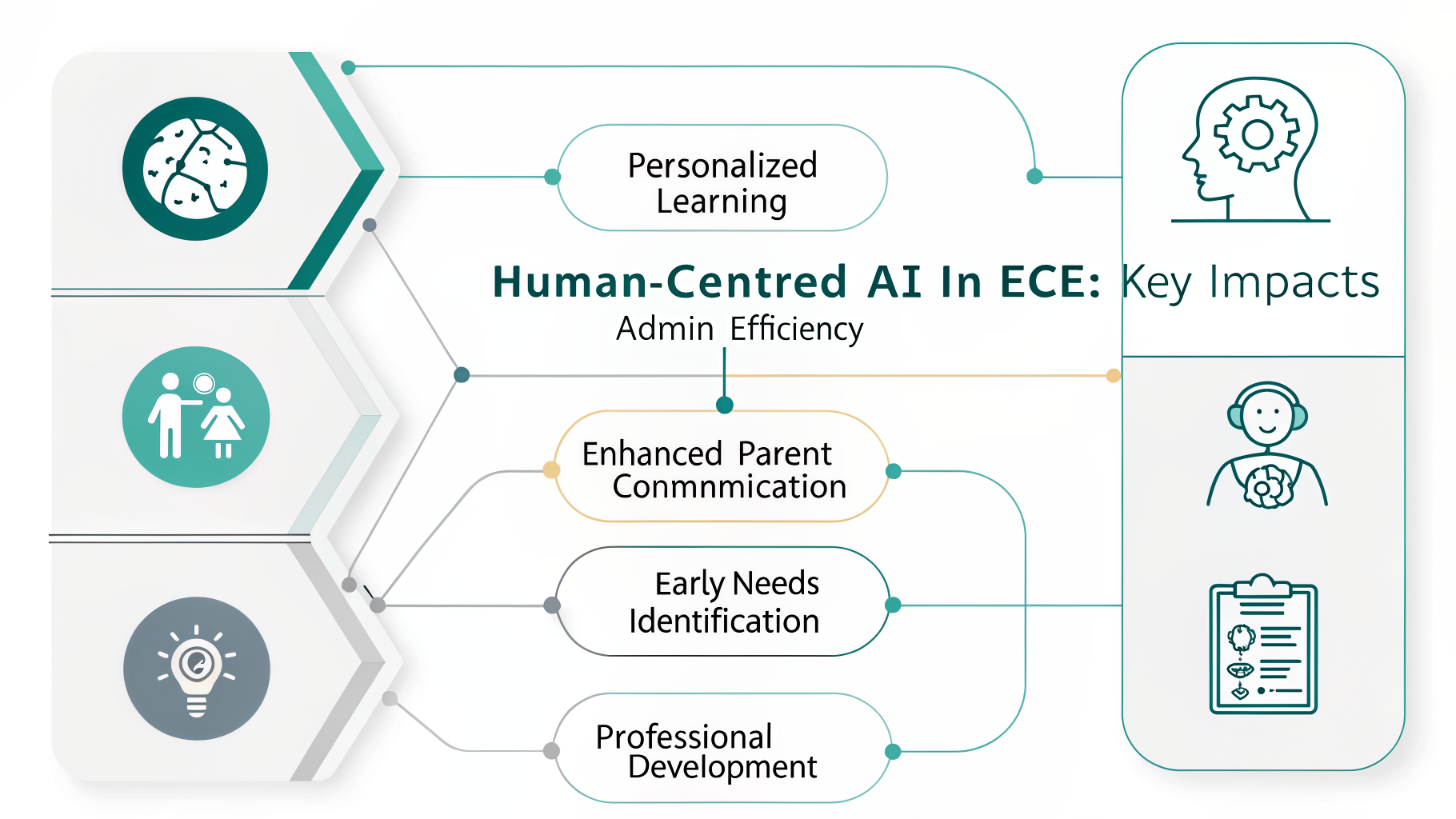
These practical applications demonstrate Beyond the Hype: Why Human-Centred AI is Crucial for Canadian
Ethical Safeguards: Ensuring Privacy, Equity, and Well-being with AI in ECE
Ethical Safeguards: Ensuring Privacy, Equity, and Well-being with AI in ECE
The core irony of integrating AI into early childhood education is that its greatest potential for good is also its greatest risk: access to sensitive child data. Without stringent ethical safeguards, AI tools designed to support learning could inadvertently compromise privacy, perpetuate biases, or undermine trust. This is why Beyond the Hype: Why Human-Centred AI is Crucial for Canadian Early Childhood Education demands a proactive, ethical framework, especially concerning the data of young children in provinces like Ontario and British Columbia.
Data privacy is paramount. Canadian federal laws like PIPEDA (Personal Information Protection and Electronic Documents Act), alongside provincial acts such as Alberta's PIPA and Quebec's Act respecting the protection of personal information in the private sector, dictate how sensitive child data must be collected, stored, and used. Research consistently shows that parents are acutely aware of these risks; surveys often report that roughly 60-70% of parents express significant concerns about their children's data privacy in educational technology. Robust cybersecurity measures, including end-to-end encryption and strict access controls, are non-negotiable for any AI platform handling information from a daycare in Halifax or a preschool in Vancouver. For example, platforms like YochienAI implement multi-factor authentication and regular security audits to protect against unauthorized access. You can review our specific security protocols at yochienai.ca/security.
"We need AI that helps our educators, but not at the expense of our children's privacy. Transparency about data use isn't just a legal requirement; it's fundamental to building trust with families." — Kindergarten administrator, Toronto
Beyond security, ethical AI in ECE must actively combat bias and ensure equity. An AI algorithm, if trained on unrepresentative data, could unintentionally disadvantage children from certain socio-economic backgrounds or perpetuate stereotypes. For instance, an AI tool designed to identify learning patterns might misinterpret cultural differences in communication as developmental delays if its training data lacks diversity. Canadian guidelines, increasingly developed by provincial ministries of education, emphasize child-centric approaches that demand AI tools be inclusive and fair. This includes clear policies on how AI tools function, what data they utilize, and who is accountable for their outcomes. Informed consent from parents, coupled with transparent control over their child's data, forms the bedrock of ethical implementation. Our privacy policy at yochienai.ca/privacy outlines these commitments.
Understanding the ethical landscape of AI in Canadian ECE requires acknowledging key areas of concern and the corresponding safeguards.
| Ethical Concern | Relevance to Canadian ECE | Human-Centred AI Safeguard |
|---|---|---|
| Data Privacy | Compliance with PIPEDA and provincial acts (e.g., Alberta's PIPA). | Anonymization, strict access controls, regular third-party audits. |
| Cybersecurity Risk | Protection against breaches
A Framework for Thoughtful Integration: Evaluating AI Tools Through a Human-Centred Lens The true challenge with AI in early childhood education isn't about the technology itself; it's about discerning which tools genuinely serve children and educators, and which merely add complexity. Many Canadian ECE programs feel overwhelmed by the rapid pace of AI development, yet a thoughtful, human-centred evaluation framework can cut through the noise, ensuring new tools align with pedagogical values rather than replacing them.
1
Define Pedagogical GoalsBefore adopting any AI tool, clearly articulate its purpose. Will it automate administrative tasks, like daily attendance tracking for an Ontario daycare, freeing up educators for more direct play-based learning? Or will it offer AI-assisted observation, helping an educator in British Columbia identify subtle developmental patterns in a child's block play? The goal is to enhance specific learning outcomes or educator capacities, not to implement technology for its own sake.
2
Prioritize Human InteractionCritically assess whether the AI tool supports or diminishes essential human connection. For instance, an AI tool that helps generate personalized parent updates might free a senior kindergarten teacher in Halifax to spend more one-on-one time with children during circle time. Conversely, a tool that replaces direct educator feedback with automated responses would be counterproductive. The Pan-Canadian AI Strategy emphasizes responsible development, meaning human connection remains paramount. "Technology should be a quiet assistant in the background, making our jobs easier so we can be more present with the children. If it pulls us away, it's not working for us." — kindergarten administrator, Toronto
3
Scrutinize Data Ethics & PrivacyData privacy is non-negotiable, especially with young children. A recent survey indicated that 68% of Canadian parents are concerned about data privacy for their children. Thoroughly review the AI tool's data collection, storage, and usage policies. Does it comply with provincial privacy legislation, such as Quebec's Act respecting the protection of personal information in the private sector? Ensure robust security measures are in place, like end-to-end encryption for any child observation data.
4
Pilot and IterateNew tools should always start small. Implement AI, such as a speech-to-text tool for documenting observations, in a single classroom or with a small group of educators. Gather feedback from the educators, children, and parents. A ECE centre in Calgary might pilot a new AI-powered activity generator, refining its prompts and suggestions based on educator input and child engagement before wider adoption. This iterative process addresses unforeseen challenges and ensures practical utility. The Future of Thoughtful AI: Cultivating a Human-First Approach in Canadian Early LearningThe Future of Thoughtful AI: Cultivating a Human-First Approach in Canadian Early LearningWhile much discussion around artificial intelligence in early childhood education (ECE) fixates on immediate applications, the true measure of human-centred AI's success will be its capacity for continuous, ethical evolution. The challenge isn't merely to adopt existing tools, but to proactively shape future AI development to align with Canadian values and the unique developmental needs of young children. This requires ongoing, collaborative research & development, bringing together technologists, early childhood educators, and child development experts—not as separate entities, but as co-creators. For instance, imagine future AI tools that, instead of simply flagging potential delays, could suggest evidence-based, play-focused interventions tailored to a child's specific cultural background and learning style, then track their efficacy. This adaptive learning goes beyond basic personalization; it anticipates needs and empowers educators with richer insights into developmental trajectories, as seen in the foundational work of initiatives like the Pan-Canadian AI Strategy which prioritizes responsible AI. The goal is to create systems that amplify the educator's expertise, allowing them to focus more deeply on direct interaction and individualized support, rather than administrative burdens. Proactive policy and regulatory frameworks are equally crucial. As AI capabilities advance, guidelines must evolve to safeguard privacy and ensure equity. For example, a senior policy advisor in British Columbia might be working on regulations that specifically address the use of biometric data in ECE settings, ensuring that any AI-driven observation tool, like YochienAI, adheres to the strictest privacy protocols outlined by provincial and federal legislation. This continuous dialogue between innovation and governance is vital for maintaining public trust and ensuring AI serves children's best interests. Cultivating a culture of ethical innovation means every AI tool, from conception to deployment, must prioritize the well-being and developmental needs of children above all else. This commitment ensures that Beyond the Hype: Why Human-Centred AI is Crucial for Canadian Early Childhood Education remains a guiding principle, fostering technology that genuinely supports the holistic growth of every child. Frequently Asked Questions About Human-Centred AI in ECEMany discussions around AI in early learning quickly devolve into worst-case scenarios, overlooking the nuanced, practical applications that already exist. The real challenge isn't preventing AI, but ensuring its integration always prioritizes the child and supports the educator, moving Beyond the Hype: Why Human-Centred AI is Crucial for Canadian Early Childhood Education. Quick Answers on AI in ECE
Biggest Myths Beyond Replacement?
Beyond the idea that AI will replace educators, common myths include AI being a "magic bullet" for all learning challenges, or that it inherently makes learning impersonal. In reality, human-centred AI offers tools like YochienAI to help educators observe more effectively, not replace their judgment or interaction.
Data Safety & Privacy for Children?
Parents should ask their daycare providers about specific data handling policies. Reputable human-centred AI tools, especially those developed in Canada like YochienAI, adhere to strict privacy legislation (e.g., PIPEDA, provincial equivalents). They anonymize data where possible and use secure, encrypted servers. Transparency is key; check a provider's dedicated privacy and security pages, such as YochienAI's Privacy Policy and Security Statement.
Educator Training Needs?
Educators need training focused on interpreting AI-generated insights, rather than just operating software. This includes understanding developmental milestones, recognizing bias in data, and integrating AI data into their existing pedagogical practices, like play-based learning frameworks used in Ontario's “How Does Learning Happen?” curriculum. A senior kindergarten teacher in Halifax might use an AI tool to flag a pattern in a child's engagement, then apply their expertise to design a targeted activity.
Can AI Understand Unique Learning Styles?
AI can identify patterns in a child's interactions and engagement, suggesting potential learning preferences or areas for focus. For instance, an AI might note that a child consistently spends more time on sensory activities than fine motor tasks. However, AI does not "understand" in a human sense; it provides data points that an educator then interprets through their professional lens to adapt teaching strategies. This is a crucial distinction: AI supports observation, but human educators make the pedagogical decisions.
Canadian Resources for Ethical AI?
Canadian educators can look to national initiatives like the Pan-Canadian AI Strategy for broad ethical guidance. Provincial ministries of education and organizations like the Canadian Child Care Federation often provide technology guidelines that can be adapted for AI integration. University research centres, such as the AI in Society initiative at McGill, also offer valuable insights into responsible AI use. The distinction between human-centred AI and generic educational software lies in its design philosophy Frequently Asked QuestionsCan human-centred AI improve early learning in Canada?Human-centred AI can enhance early learning by providing educators with tools to personalize experiences. For instance, AI algorithms can analyze a child's engagement with learning games, suggesting follow-up activities tailored to their pace and interests. This helps a senior kindergarten teacher in Vancouver identify learning gaps or strengths, allowing for more targeted interventions and enriched learning paths, especially for diverse learners, without replacing direct human guidance. Why is human interaction crucial with AI in Canadian ECE?Human interaction remains paramount because AI cannot replicate the emotional connection, empathy, or nuanced social learning essential for young children. A child learns conflict resolution by observing a teacher mediate a dispute, not from an algorithm. AI tools, such as adaptive story apps, can supplement, but a human educator in an Alberta preschool provides the vital warmth, responsiveness, and secure attachment foundational for healthy development and complex social skill acquisition. How can AI support early childhood educators in Canada?AI can significantly support Canadian ECE educators by automating routine administrative tasks, freeing up valuable time for direct child interaction. Tools like Magic School AI can generate diverse lesson plan ideas or craft personalized communication templates for parents. AI can also provide data-driven insights into developmental progress, helping a daycare supervisor in Halifax identify patterns across a group, enabling more informed pedagogical decisions and targeted support for individual children. Is AI going to replace ECE educators in Canada?No, AI will not replace early childhood educators in Canada. The core of ECE is human connection, empathy, and responsive caregiving—qualities AI cannot replicate. While AI can assist with tasks like generating activity ideas, it cannot offer a comforting hug to a distressed child or intuitively adapt a lesson plan based on real-time classroom dynamics. Educators in a Saskatchewan kindergarten program provide irreplaceable social-emotional scaffolding and complex relational learning. What are the ethical concerns of using AI in Canadian early childhood education?Ethical concerns in Canadian ECE include data privacy, algorithmic bias, and potential over-reliance on technology. Collecting sensitive child data, even for personalized learning, raises significant privacy questions for parents in Ontario. AI recommendations might inadvertently perpetuate biases if training data is unrepresentative. Furthermore, ensuring equitable access to AI tools across diverse socio-economic settings and managing screen time for young learners are critical considerations for responsible implementation. Keep readingAll articles → Smart Choices for Canadian ECE: Evaluate AI Tools CriticallyMaking Smart Choices for Canadian ECE: How to Evaluate AI Tools with Critical Thinking often means looking past the marketing hype to understand what AI actually does. The true value in early learning isn't just adopting new tools, but discerning their alignment with play-based learning and holistic development.  Designing for Little Hands and Big Hearts: Human-Centred AI in Canadian ECEHuman-Centred AI (HCAI) in Canadian early childhood education (ECE) isn't about complexity; it's about intentional simplicity. It aims to augment educator observation skills and deepen parent engagement, ensuring technology serves children's developmental needs.  Before You Click: 8 Essential Questions Canadian ECEs Should Ask About New AI ToolsCanadian ECEs face an overwhelming influx of new AI tools, many ill-suited for young children's unique developmental needs. This demands a structured approach to prevent pedagogical missteps and privacy breaches as the AI in education market skyrockets. |