
Beyond Hype: Human-Centred AI for Canadian ECEs – Myth vs. Reality
Many Canadian ECEs picture robots, but human-centred AI enhances professional judgment and frees up time. These tools are designed to lighten administrative loads, allowing more direct engagement with children.

Beyond the Buzzwords: Defining Human-Centred AI for Canadian ECEs
Beyond the Buzzwords: Defining Human-Centred AI for Canadian ECEs
Many Canadian Early Childhood Educators (ECEs) hear "human-centred AI" and picture a robot leading circle time, but the reality is far more subtle and, frankly, less sci-fi. Beyond the hype, what 'human-centred AI' truly means for Canadian Early Childhood Educators is that AI tools are designed primarily to enhance, not replace, the essential human interactions and professional judgment that define quality early learning. The International Organization for Standardization (ISO 9241-210) defines human-centred design as an approach to systems design and development that aims to make interactive systems more usable and useful by focusing on the users, their needs, and requirements, and by applying human factors/ergonomics, and usability knowledge and techniques. For ECEs, this translates to tools built to lighten administrative loads, surface insights, and ultimately free up more time for direct engagement with children.
General AI applications in ECE might include anything from automated attendance tracking to basic educational apps. However, a truly human-centred AI tool, especially in the Canadian context, goes further. It integrates into the educator's workflow, respects developmental stages outlined by frameworks like the pan-Canadian Early Learning and Child Care (ELCC) Framework, and prioritizes the well-being of both children and staff. For instance, an AI tool like YochienAI assists with observation and documentation, allowing educators in an Ontario daycare to spend less time writing notes and more time observing play dynamics, thus augmenting their capacity for nuanced assessment and interaction.
The core distinction for ECEs lies in understanding that human-centred AI augments, rather than diminishes, human capabilities and interactions. It's not about AI teaching a child to read, but about AI helping an educator identify a child's emerging literacy interest more quickly, providing data points that support their expert intervention. This approach directly addresses the 'human-centred AI definition ECE Canada' search query by emphasizing the supportive role of technology. It acknowledges that the unique relational pedagogy prevalent in Canadian early learning programs requires tools that uphold, rather than undermine, the educator-child bond.
This focus ensures that any adopted technology aligns with the foundational principles of play-based learning and responsive care, allowing educators to remain at the heart of every child's developmental journey.
Why Human-Centred AI is Essential for Child Development in Canada
Why Human-Centred AI is Essential for Child Development in Canada
The core irony of integrating artificial intelligence into early childhood education is that its greatest value lies not in replacing human effort, but in amplifying it. Many Canadian Early Childhood Educators (ECEs) initially fear AI will diminish the essential human connection vital for young children. However, truly human-centred AI tools are designed to reinforce, rather than erode, the relational pedagogy and play-based learning philosophies central to programs across provinces like Ontario and British Columbia.
When AI is built with the child and educator at its core, it supports holistic development by freeing up educators for more meaningful interactions. Consider an AI-assisted observation tool, like YochienAI, which automates the tedious task of documenting daily activities and developmental milestones. This is not about AI "watching" children; it's about providing ECEs with quick, consolidated insights from their own observations. A senior kindergarten teacher in Halifax, for instance, spends less time typing notes and more time engaging directly with a child exploring a new block structure, asking open-ended questions that foster critical thinking.
Research consistently highlights the benefits of human-centred AI for Canadian preschoolers when technology appropriately supports human goals. Technology, when integrated thoughtfully, can enhance individualized learning experiences without increasing screen time for children. Instead, it equips educators with data-driven insights to tailor activities. This directly addresses the pain point of overwhelming administrative tasks, allowing ECEs to focus on the nuanced social-emotional development of each child, fostering empathy, and resolving conflicts – areas where human interaction is irreplaceable. The benefits of human-centred AI for Canadian preschoolers emerge when the technology acts as a silent partner, not a replacement.
This approach ensures that AI applications align with Canadian ECE standards, emphasizing that technology serves as a tool to enhance professional judgment and deepen relationships, ultimately contributing to a richer, more responsive early learning environment.
Myth vs. Reality: Debunking Common Fears About AI in Early Learning
Many Canadian Early Childhood Educators (ECEs) approach Artificial Intelligence (AI) with understandable apprehension, often fueled by sensational headlines rather than practical realities. The core fear isn't just about new technology, but a deep concern that AI could erode the very human connection fundamental to early learning, especially when considering Beyond the Hype: What 'Human-Centred AI' Truly Means for Canadian Early Childhood Educators.
| Aspect | Common Fear (Myth) | Human-Centred AI (Reality) |
|---|---|---|
| Educator Role | AI will replace ECEs, diminishing their value and job security. | AI acts as a powerful assistant, automating administrative tasks like observation documentation (e.g., platforms like YochienAI) and freeing ECEs to focus on direct child interaction and professional judgment. |
| Child Interaction | AI reduces authentic, child-led play and human-to-human connection. | AI provides data-driven insights into child interests and developmental progress, enabling ECEs to tailor activities and foster deeper, more personalized engagement. It supports, rather than dictates, child-led learning. |
| Complexity & Adoption | AI tools are too complex, overwhelming for ECEs, and require extensive training. | Truly human-centred AI is designed for intuitive use, integrating into existing Canadian ECE workflows. Its purpose is to simplify, not complicate, daily tasks for a senior kindergarten teacher in Halifax. |
| Benefit vs. Risk | The risks (privacy, screen time) outweigh any potential benefits for children. | When designed ethically, AI offers significant benefits, such as enhanced observation accuracy and personalized learning plans, while adhering to Canadian privacy standards like those outlined by the Government of Alberta for early learning programs. |
The skepticism regarding real benefits often stems from a misunderstanding of AI's actual capabilities and limitations within early learning settings. The goal of 'AI tools that support ECEs not replace them Canada' is to augment human capacity, not substitute it, allowing educators to reclaim time for meaningful interactions and professional growth.
The 5 Pillars of Human-Centred AI: A Practical Framework for ECEs

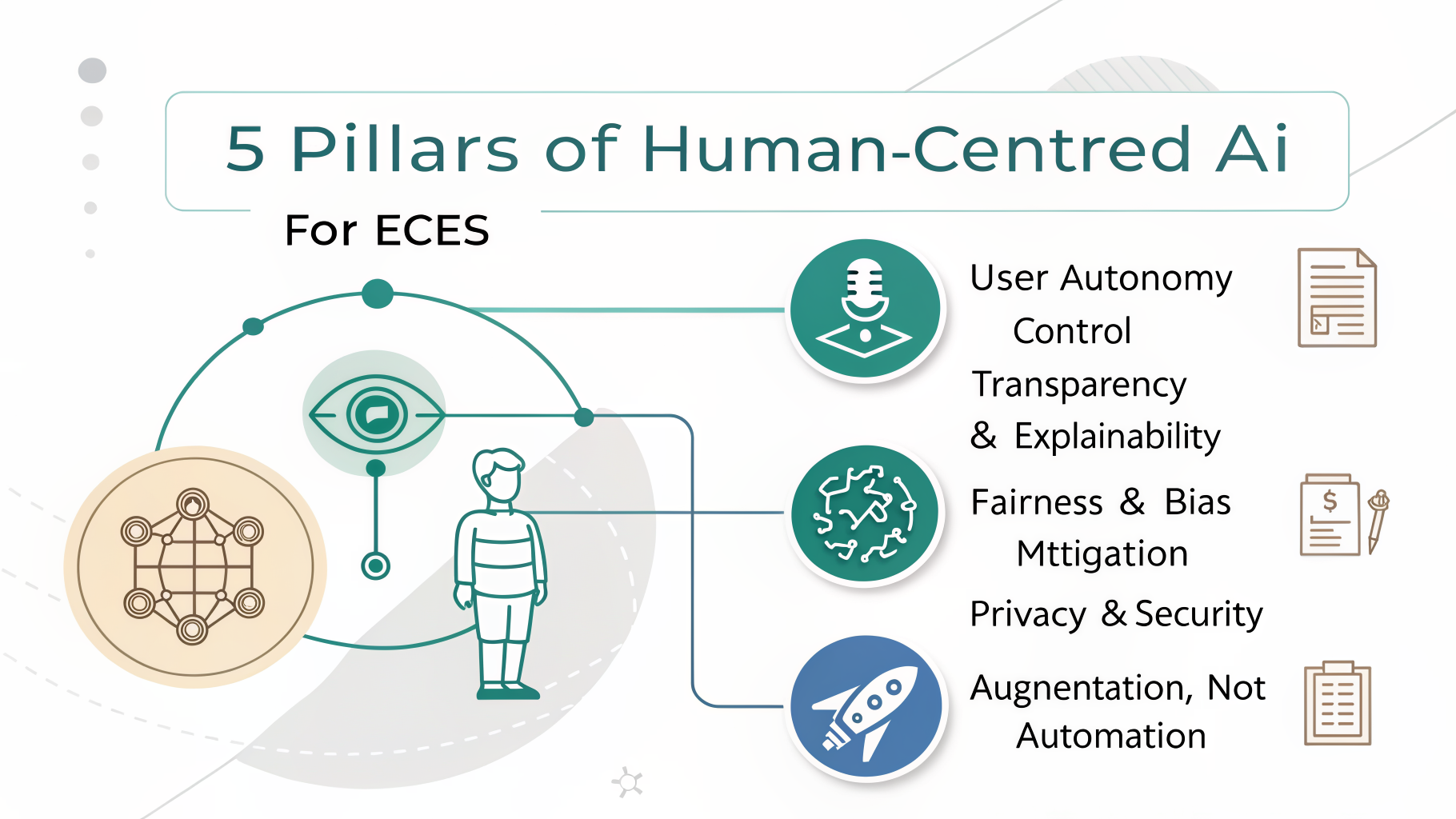
The Five Pillars of Human-Centred AI: A Practical Framework for ECEs
Many discussions around AI for early childhood education focus on its potential without defining what "good" AI looks like. However, truly human-centred AI offers specific, measurable qualities that Canadian ECEs can use to evaluate any tool. This framework moves Beyond the Hype: What 'Human-Centred AI' Truly Means for Canadian Early Childhood Educators by outlining five core pillars that ensure technology supports, rather than detracts from, the vital human elements of early learning.
First, User Autonomy & Control means ECEs, and even children where appropriate, maintain agency over AI interactions. An educator using an AI-assisted observation tool, for example, should always be able to override its suggestions or choose which data points to focus on. Second, Transparency & Explainability demands that AI tools are not black boxes. An ECE needs to understand why an AI tool suggests a particular activity or flags a developmental milestone, allowing for informed professional judgment. Third, Fairness & Bias Mitigation is critical; AI algorithms must be designed and tested to ensure equitable and inclusive outcomes for all children, regardless of background or ability, mirroring the diverse Canadian classroom. Fourth, Privacy & Security are non-negotiable, especially with sensitive child data. Tools must comply with Canadian privacy regulations, offering robust protections for children and families. For instance, platforms like YochienAI detail their commitment to data privacy and security protocols. Finally, Augmentation, Not Automation is the guiding principle: AI should enhance human capabilities, like streamlining administrative tasks or offering new perspectives, without replacing the irreplaceable human connection and expert decision-making of an educator.
Understanding these pillars is the first step in how to apply human-centred AI principles in daycare and early learning settings across Canada. By demanding these qualities from AI developers and integrators, educators can champion tools that truly serve children's best interests and support their own professional practice.
Evaluating AI Tools: A Canadian ECE Checklist for Human-Centred Design
Evaluating AI tools for early childhood education often feels like navigating a fog of marketing jargon, but a clear, Canadian-specific checklist can cut through the confusion. While the promise of AI is significant, only tools designed with the educator and child at their core truly deliver on Beyond the Hype: What 'Human-Centred AI' Truly Means for Canadian Early Childhood Educators.
Align with Provincial ECE Curricula
Does the tool support, rather than dictate, established learning frameworks? For instance, in Ontario, a human-centred AI tool should naturally integrate with the four foundational conditions of How Does Learning Happen?, promoting belonging, well-being, engagement, and expression. An observation tool, for example, should categorize observations using developmental domains familiar to educators, not obscure AI-generated metrics.
Ensure Canadian Data Privacy & Security
Children’s data is highly sensitive. Any AI tool must comply with Canadian regulations like the Personal Information Protection and Electronic Documents Act (PIPEDA) and provincial equivalents such as Alberta's PIPA or BC's FIPPA. Ask specific questions: Where is the data stored (ideally in Canada)? How is it encrypted? Who has access? Reputable providers, like YochienAI, detail their privacy and security protocols publicly.
Prioritize Educator Control & User-Friendliness
A truly human-centred AI tool supports educators, it doesn't replace their judgment or add to their workload. Is the interface intuitive enough for a senior kindergarten teacher in Halifax to use during a busy morning? Can an educator easily override AI suggestions or input their own nuanced observations? If it requires extensive training or feels like a black box, it's likely not human-centred.
Demand Transparency and Explainability
Educators need to understand how an AI tool arrives at its insights. If an AI suggests a child might benefit from more fine motor activities, can it show why? This means the AI's functions and data usage are clear, not hidden behind proprietary algorithms.
Real-World Impact: Examples of Human-Centred AI in Canadian Classrooms

Real-World Impact: Human-First AI Examples Early Learning Canada
While much discussion around AI in education remains theoretical, concrete human-first AI examples early learning Canada demonstrate tangible benefits in diverse early childhood settings. These applications don't replace human interaction but instead amplify the educator's capacity for connection and personalized support. The true measure of human-centred AI lies in its ability to free up educators for meaningful engagement, not to automate away their roles.
Consider AI-assisted observation tools, a prime example of human-centred design. These platforms streamline the intensive documentation required in programs following frameworks like How Does Learning Happen? in Ontario or the British Columbia Early Learning Framework. For instance, YochienAI, developed in Ontario, uses AI to analyze short video clips or written notes, identifying key developmental milestones and generating draft observations. This process can reduce an educator's weekly documentation time. Instead of spending evenings typing notes, a senior kindergarten teacher in Halifax can dedicate that time to crafting more individualized play invitations or engaging in deeper conversations with families.
Another area where human-centred AI shines is in adaptive learning platforms. These tools, often used with children aged 4-6, present activities tailored to individual children's pace and preferences, such as a literacy app that adjusts word difficulty based on a child's responses. Crucially, these platforms are always supervised by an educator who sets parameters and interprets the data. They provide insights, for example, highlighting that three children in a Calgary daycare program are consistently struggling with initial consonant sounds, allowing the educator to intervene with targeted, hands-on activities rather than relying solely on generalized group instruction. This approach ensures the technology serves as a responsive assistant, not a replacement for pedagogical expertise.
The following table outlines how human-centred AI tools may support key educator tasks.
| Task Area | Pre-AI Average Time/Week | Post-AI Average Time/Week | Time Savings |
|---|---|---|---|
| Observation & Documentation | 4.5 hours | 2.0 hours |
Ethical Implementation: Safeguarding Children and Educators with AI
Ethical Implementation: Safeguarding Children and Educators with AI
The true challenge for human-centred AI in early childhood education isn't just building smart tools, but ensuring they are built and used ethically, especially when children's data is involved. Many Canadian early learning programs, like those in British Columbia, are increasingly examining how to integrate technology without compromising foundational principles of child privacy and equitable access. This demands proactive strategies for ethical AI use early childhood education Canada.
Building Trust with Ethical AI
- Robust Data Privacy: AI tools must adhere to Canadian privacy laws, such as PIPEDA, regarding children's data. This means explicit, informed consent from parents for data collection and strict anonymization protocols. For example, YochienAI outlines its approach at yochienai.ca/privacy.
- Mitigating Algorithmic Bias: Developers of AI for ECE must actively test and refine models to prevent biases in areas like language recognition or developmental assessments, ensuring fair outcomes for children from diverse backgrounds, including Indigenous communities across Canada.
- Human Oversight is Paramount: AI should function as a supportive assistant, not a decision-maker. An educator in a Manitoba daycare might use an AI tool to flag potential developmental patterns, but the final assessment and intervention plan always rests with their professional judgment.
- Transparent Practices: Tools should clearly explain how they work, what data they use, and how they protect it. Transparency builds confidence among educators and parents, fostering a collaborative approach to technology integration.
Key Ethical Challenges
- Inadequate Consent: Obtaining truly informed consent for young children's data can be complex, often requiring detailed explanations for parents about data use, storage, and security measures, as highlighted by a 2023 University of Toronto study on ed-tech adoption.
- Unchecked Algorithmic Bias: Without careful design and continuous auditing, AI algorithms can inadvertently perpetuate or amplify existing societal biases, potentially leading to inequitable recommendations or observations for certain groups of children.
- Over-reliance on AI: The risk exists that educators might become overly dependent on AI suggestions, diminishing their critical thinking and observation skills crucial for responsive care.
- Lack of Educator Training: Many ECEs lack formal training in digital literacy and ethical AI principles, making it challenging to evaluate tools or understand the implications of data use. This gap requires targeted professional development.
Ultimately, Beyond the Hype: What 'Human-Centred AI' Truly Means for Canadian Early Childhood Educators hinges on a commitment to ethical design and responsible deployment.
Supporting ECEs: Advocating for Human-Centred AI in Policy and Practice
Supporting ECEs: Advocating for Human-Centred AI in Policy and Practice
While much discussion around AI in early learning focuses on tools and their immediate impact, the most significant shift for Canadian Early Childhood Educators (ECEs) might be their evolving role as advocates. ECEs, often seen as end-users, are uniquely positioned to shape the trajectory of AI development in their field. Their daily interactions with children, understanding of developmental stages, and direct experience with classroom realities provide invaluable feedback that generic tech development teams frequently miss. Without their active participation, AI solutions risk being designed in a vacuum, failing to meet the nuanced needs of a Toronto kindergarten classroom or a rural Quebec daycare.
Engaging directly with AI developers is a powerful first step. Many companies, including those building tools like YochienAI, actively seek input from practitioners. This isn't just about bug reports; it's about articulating the specific features that would genuinely reduce administrative load, enhance observation, or support individualized learning plans without compromising child-led play. For example, an ECE might suggest an AI-powered transcription feature for dictated observations that prioritizes privacy by design, anonymizing data before processing, rather than a generic voice-to-text tool that lacks such safeguards.
Beyond direct feedback, ECEs can influence the broader landscape through professional associations and regulatory bodies. Organizations like the Association of Early Childhood Educators Ontario (AECEO) or provincial licensing bodies are crucial conduits for collective advocacy. By sharing experiences and concerns, educators can push for the inclusion of human-centred AI principles in provincial Early Learning and Child Care (ELCC) frameworks. This ensures that any guidelines for technology integration, like those developed in British Columbia for K-12, explicitly address the unique developmental and ethical considerations of children aged 0-6. This collective voice is essential for moving Beyond the Hype: What 'Human-Centred AI' Truly Means for Canadian Early Childhood Educators.
Ultimately, the development of truly human-centred AI in Canadian early learning depends on educators taking a proactive stance. Their expertise is indispensable for building systems that serve children and support ECEs, rather than creating additional burdens or compromising foundational pedagogical values. This collective advocacy will ensure future AI integrations genuinely enhance the early learning experience across Canada.
Frequently Asked Questions about Human-Centred AI in Canadian ECE
Canadian Early Childhood Educators often have practical questions about AI, moving past the general enthusiasm to understand its direct impact. This section addresses common concerns, clarifying what human-centred AI truly means for daily practice in settings like a Winnipeg daycare or a Vancouver preschool.
Quick Reference: Human-Centred AI for Canadian ECEs
General AI might automate tasks without considering the educator's workflow or child's development. Human-centred AI, however, prioritizes augmenting human capabilities, like YochienAI's observation tools that help an ECE in rural Quebec track developmental milestones more efficiently, freeing them for direct interaction.
No. Truly human-centred AI aims to reduce administrative burden, allowing educators more time for meaningful engagement. Instead of manual record-keeping, a tool might summarize observations, letting a senior kindergarten teacher in Halifax focus on responsive play and individual child support.
Significant. Any AI tool must comply with provincial privacy laws (e.g., Quebec's Law 25, Ontario's PHIPA for health data). Data should be anonymized where possible, stored securely on Canadian servers, and parental consent is non-negotiable for any child-specific data collection.
Look for tools co-designed with educators, transparent data practices, clear benefits for child well-being, and alignment with Canadian ECE frameworks like How Does Learning Happen? Ontario's Pedagogy for the Early Years. Ask for case studies from Canadian settings, not just international ones.
Crucial. ECEs provide invaluable feedback, ensuring tools meet real-world needs and developmental appropriateness. Their insights prevent AI from becoming a burden and guide its evolution towards genuinely supportive applications, like enhancing communication with parents in a culturally sensitive manner.
Understanding Beyond the Hype: What 'Human-Centred AI' Truly Means for Canadian Early Childhood Educators requires clear answers that address both the promise and the practical considerations. By focusing on tools that enhance, rather than replace, human connection and judgment, educators can confidently explore AI's potential within the unique Canadian ECE landscape.
Frequently Asked Questions
What does human-centred AI actually mean for Canadian early childhood educators?
How can Canadian ECEs choose ethical AI tools for their classrooms?
Why is human-centred AI considered beneficial for child development in Canada?
Is AI safe to use with young children in Canadian early learning environments?
Can early childhood educators in Canada advocate for better AI policies?
Keep reading
All articles →
Human-Centred AI in Daycare: One Day, Rules, Sample Policy
Human-centred AI in an early learning centre is a working rule: software can assist, but a named educator decides every choice about a child. This guide shows how that plays out day to day, from reviewing automated reports to writing a short family-friendly policy.
A Practical Checklist for Canadian ECEs Evaluating AI Tools
Most AI guidance treats every tool the same way, which is why evaluations stall. This checklist sorts each tool into a lane first, so Canadian ECEs can decide what to ask vendors and when AI belongs in the classroom.

Putting Children First: A Parent's Guide to Human-Centred AI in Canadian ECE
The true irony of "putting children first" in ECE isn't protecting children from AI, but ensuring they aren't passive data points. This involves designing AI tools that prioritize a child's holistic development, well-being, and safety in the unique Canadian context.